Senegal, Togo, Canada and across Africa
@gonovahub
Blog & Opinions

ECOWAS Has a Cybersecurity Strategy. West Africa Still Needs a Cybersecurity System.

Closing the gap between a regional cybersecurity strategy adopted in 2021 and the institution that must deliver it.

Komlan Messie, MBA, Polytechnician, CEO of NovaHub Consulting • 2026 • 8 min read

ECOWAS has a cybersecurity strategy, West Africa still needs a cybersecurity system
In January 2021, ECOWAS adopted a Regional Cybersecurity and Cybercrime Strategy. Five years later, Ghana holds a Tier 1 global cybersecurity ranking while Nigeria, Côte d'Ivoire and Senegal sit two tiers lower, inside the same Community. That gap is the story.

ECOWAS's cybersecurity problem is no longer strategic design. The 2021 Strategy, built on the 2011 Cybercrime Directive, is sound in structure. The problem is institutional: fifteen national systems of unequal maturity, no fully operational regional coordination body, and a threat landscape that now evolves faster than the Community's capacity to respond. Closing that gap, not writing a new strategy, is the work ahead.

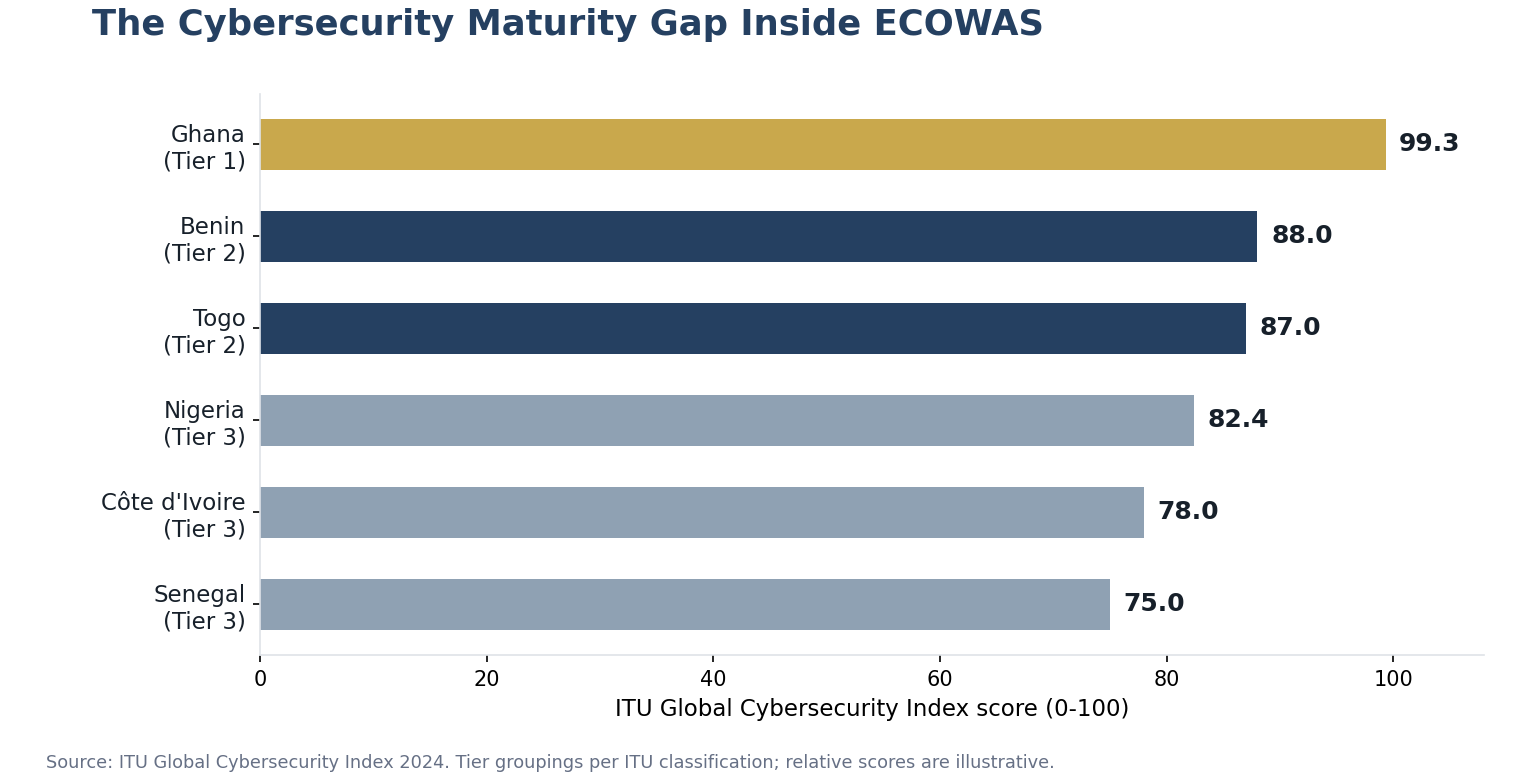
99.27Ghana's ITU Global Cybersecurity Index score, Tier 1. Nigeria, Côte d'Ivoire and Senegal sit in Tier 3. ITU, 2024
55%of reported cybercrimes across Africa are now enabled by artificial intelligence. INTERPOL, 2026
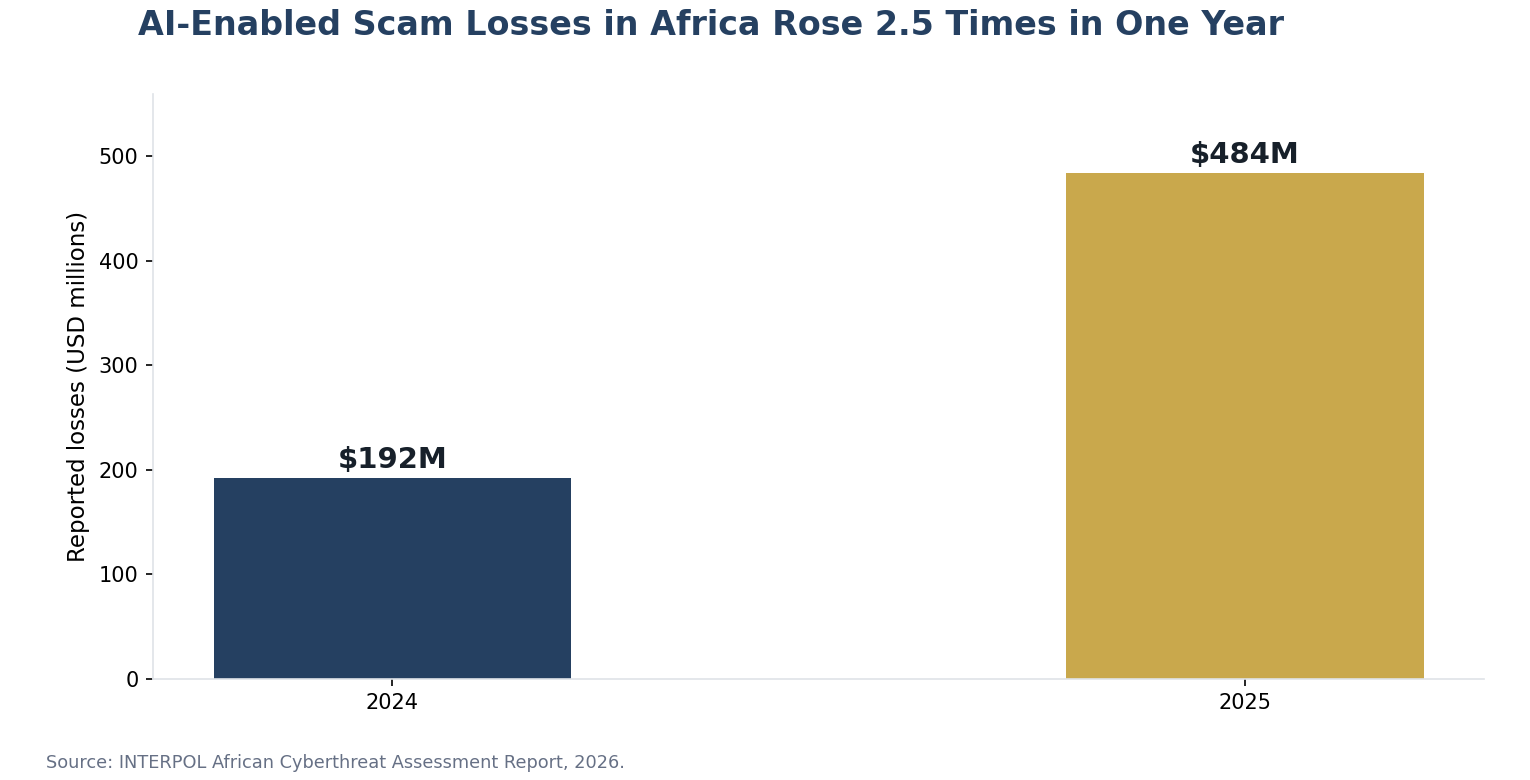
$484Min AI-enabled scam losses across Africa in 2025, up from $192M in 2024. INTERPOL, 2026

1. The strategy is real. The institution behind it is still being built.

ECOWAS adopted its Regional Cybersecurity and Cybercrime Strategy through Directive C/DIR.1/01/2021, instructing member states to adopt national cybersecurity strategies, create dedicated authorities, protect critical infrastructure and strengthen judicial cooperation on cybercrime.1,2 It builds on the ECOWAS Cybercrime Directive of 2011, which set out to align national criminal law and procedure across the region.3 The missing piece has been institutional follow-through. In 2025, ECOWAS experts validated a feasibility study for a Regional Cybersecurity Coordination Centre (RCCC), designed to support coordinated efforts and mutual assistance without duplicating national authorities or CSIRTs.4 That the region is only now validating the feasibility of its coordination backbone, four years after adopting the strategy that calls for one, is the clearest evidence that implementation has lagged design.

Strategic implication: The RCCC is not a new initiative. It is the missing execution layer of a strategy ECOWAS already approved. Its resourcing and staffing should be the single highest-priority regional deliverable of the next 12 months.

2. Fragmentation inside the Community is the real vulnerability

The ITU's 2024 Global Cybersecurity Index shows the disparity starkly. Ghana scored 99.27 and holds Tier 1, a global role-model status.8,9 Within the same Community, Nigeria, Côte d'Ivoire and Senegal sit in Tier 3, reflecting partial advancement and serious gaps in critical cybersecurity areas, while Benin and Togo occupy Tier 2.8

Chart of the cybersecurity maturity gap between ECOWAS member states

This unevenness is structural risk. Digital infrastructure, payment rails and telecommunications networks cross ECOWAS borders freely, so a weak link in one member state's legal or technical framework becomes a regional exposure. ECOWAS's own strategic documentation says as much: the heterogeneity of systems across member states considerably limits regional cooperation, and harmonised requirements and penal provisions are needed to protect transnational infrastructure and enable efficient mutual assistance.2,3

Strategic implication: Regional cybersecurity is only as strong as its weakest jurisdiction. Harmonising legal frameworks, not only building technical capacity, is the binding constraint on regional resilience.

3. The threat is outpacing the response, and AI has changed the timeline

INTERPOL's most recent continental data makes the urgency concrete. Artificial intelligence now enables 55 percent of reported cybercrimes across Africa, making attacks faster, more scalable and harder to detect.5,7 With more than 1.1 billion mobile subscribers recorded in 2025, Africa's digital transformation is expanding rapidly, while cybercrime legislation remains fragmented and AI readiness in law enforcement agencies remains alarmingly low.5

Chart of AI-enabled scam losses in Africa, 2024 to 2025

The financial trajectory confirms the pace. AI-enabled scam losses in Africa rose from $192 million in 2024 to $484 million the following year.5 West Africa is not a peripheral actor: three-quarters of participating countries reported scam centres, with Southern and West Africa the most likely to host them.5 INTERPOL's 2025 assessment also found that cybercrime accounts for more than 30 percent of all reported crime in Western and Eastern Africa, and that 90 percent of African countries need significant improvement in law enforcement or prosecution capacity.6

Strategic implication: Capacity-building plans written before 2024 are already outdated. AI readiness for CSIRTs, prosecutors and financial-crime units is no longer an enhancement to the regional strategy. It is a core requirement of it.

4. The continental legal architecture exists. West Africa should use it fully.

The African Union's Malabo Convention on Cyber Security and Personal Data Protection, adopted in 2014, entered into force in June 2023 after reaching the fifteen ratifications required under Article 36, following Mauritania's ratification.10,11 It offers a continent-wide legal architecture across cybercrime, electronic transactions and data protection, one that ECOWAS's own instruments can plug into rather than duplicate. Yet several regional blocs, ECOWAS among them, had already built their own frameworks, which reduced the perceived urgency of ratifying Malabo in a number of member states.3,10 The result is two credible legal architectures, continental and regional, operating with only partial alignment.

Strategic implication: ECOWAS member states that have not ratified Malabo should treat ratification as a low-cost, high-leverage step. It extends judicial cooperation beyond the region to the full African Union membership, since the regional groundwork is already in place.

The way forward: a three-horizon roadmap

ECOWAS does not need a new strategy. It needs a delivery mechanism, sequenced, financed and measured.

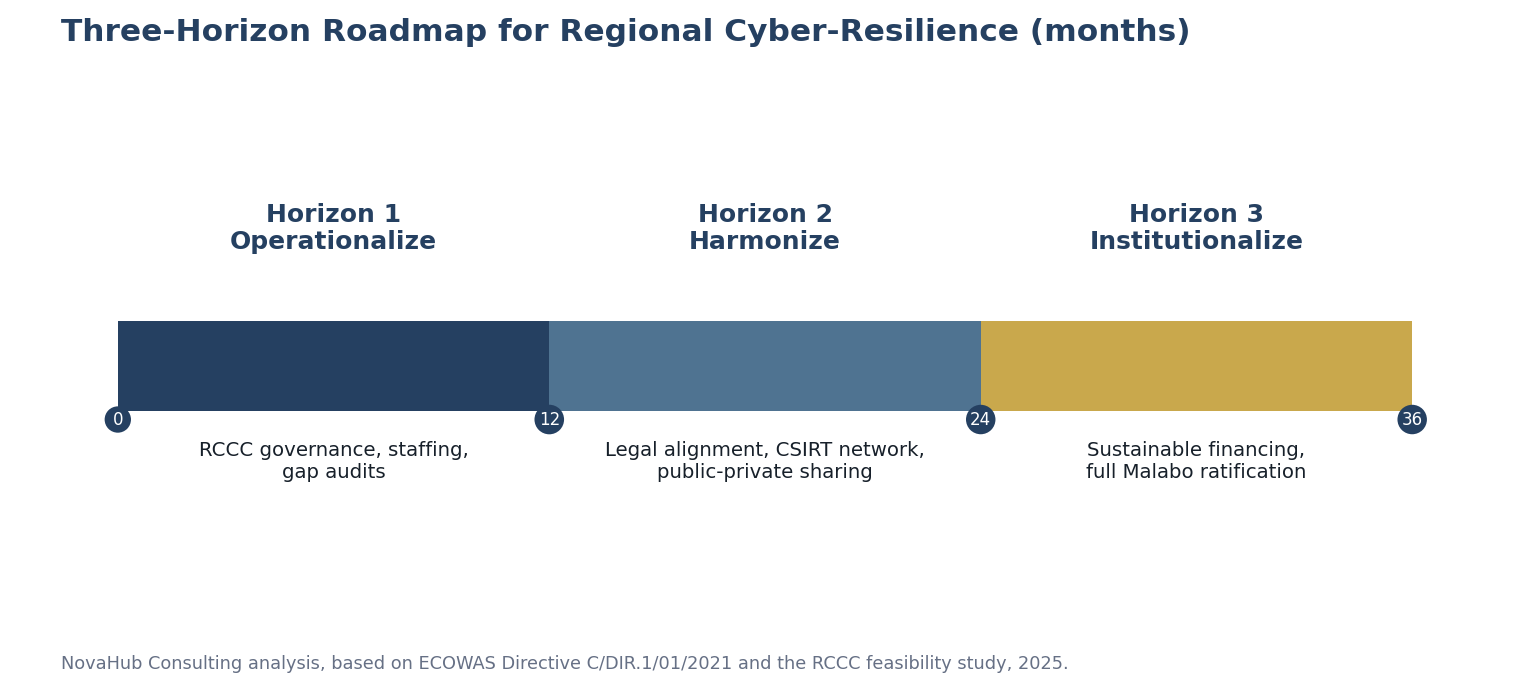
Horizon 1: Operationalize (0 to 12 months)Finalize RCCC governance, staffing and funding. Complete national capability gap assessments. Launch AI-threat readiness audits for CSIRTs and prosecutorial units.
Horizon 2: Harmonize (12 to 24 months)Align national cybercrime legislation with the 2011 Directive and the Malabo Convention. Interconnect national CSIRTs into a regional alert network. Formalize public-private threat intelligence sharing.
Horizon 3: Institutionalize (24 to 36 months)Operationalize sustainable regional financing for cyber-resilience. Complete Malabo ratification across remaining member states. Establish standing ECOWAS-AFRIPOL-INTERPOL operational protocols.
Three-horizon roadmap for regional cyber-resilience

For African decision-makers, sequencing matters more than ambition. Coordination without harmonized law produces information sharing with no enforcement path. Harmonized law without sustainable financing produces frameworks that lapse when donor-funded projects end. The three horizons remove each failure mode in order.

Executive checklist

  • Has your government designated a national CSIRT with a direct line to the future RCCC?
  • Is your national cybercrime legislation aligned with both the 2011 ECOWAS Directive and the Malabo Convention?
  • Has your Malabo Convention ratification been completed and deposited?
  • Does your national law enforcement have an AI-threat detection and response capability, assessed against INTERPOL's most recent findings?
  • Is there a standing budget line for cybersecurity capacity building beyond the current project or donor cycle?

“The real question for leaders is not whether West Africa understands the cybersecurity challenge. The 2021 Strategy and the 2011 Directive prove that it does. The question is whether the region will finish building the institution the strategy already called for, before the threat it describes outgrows the response it authorized.”

NovaHub Consulting

Where NovaHub fits

NovaHub Consulting advises governments, regulators and regional institutions on cybersecurity governance, national CSIRT design, legal harmonization and AI-threat readiness across ECOWAS.

Book a conversation
Komlan Messie
About the author

Komlan Messie, MBA, Polytechnician

A career built at the intersection of business, diplomacy and civic leadership.

Komlan Messie, MBA, is an international executive, entrepreneur and strategic advisor with more than two decades of experience across management, technology, institutional development, strategic transformation and international development. His work focuses on helping organisations, institutions and leaders navigate transformation, innovation, public policy and complex strategic challenges.

Mr. Messie is the founder and Chief Executive Officer of NovaHub Consulting and the Regional Executive Director of WACSOF-FOSCAO, the West African civil society network spanning ECOWAS member states. He is also the cofounder and chairman of the Réseau des Entrepreneurs et Professionnels Africains (REPAF) and the chairman of the Forum Afrique Expansion Canada, and he co-founded Aliments Frunil in Canada. He is a former Vice President of the Project Management Institute Montreal (PMI Montreal) in Canada.

He holds an MBA from HEC Montréal, an M.Sc. in Computer Science and Operations Research from École Polytechnique de Montréal, and a B.Eng. in Electrical Engineering from École Polytechnique de Thiès (Senegal), and is PRINCE2 certified. He works across Canada, Africa and especially the ECOWAS region in French, English, Ewe and Wolof.

Continue the conversation with Komlan Messie
View full profile →

Download this article

Read offline or share with your team, including all charts and the executive checklist.

Sources

1.  ECOWAS Parliament, ECOWAS Adopts a Regional Strategy for Cybersecurity and the Fight Against Cybercrime (2021), parl.ecowas.int.

2.  Diplo Foundation, Digital Watch Observatory, ECOWAS Regional Cybersecurity and Cybercrime Strategy (2023), dig.watch.

3.  Diplo Foundation, Regional Cybersecurity and Cybercrime Policies in Africa (2024), diplomacy.edu.

4.  News Ghana, ECOWAS Experts Validate Feasibility Study on Regional Cybersecurity Coordination Centre (2025), newsghana.com.gh.

5.  INTERPOL, African Cyberthreat Assessment Report 2026 (2026), interpol.int.

6.  INTERPOL, Africa Cyberthreat Assessment Report, 4th Edition (2025), interpol.int.

7.  Infosecurity Magazine, AI Accounts for Over Half of Cybercrime in Africa, Says Interpol (2026), infosecurity-magazine.com.

8.  International Telecommunication Union, Global Cybersecurity Index 2024, summarized in Web Security Lab, Cybersecurity in Africa: Rankings and Insights from the 2024 Global Index, websecuritylab.org.

9.  Ministry of Communication, Digital Technology and Innovations, Ghana, Ghana Ranked Tier 1 Status in Latest ITU Global Cybersecurity Index (2024), moc.gov.gh.

10.  Diplo Foundation, What Is the Malabo Convention? (2025), diplomacy.edu.

11.  African Researchers Magazine, The Malabo Convention: Africa's Cybersecurity and Data Protection Framework Explained (2025), africanresearchers.org.

← Back to Blog & Opinions
Newsletter

Get the analysis before the decision is made.

Subscribe for new insights, policy briefs and event updates. No noise, unsubscribe at any time.

Download the full paper

Enter your details to receive the secure download link. You will also be added to our newsletter list.

ENGAGE NOVAHUB