From Early Warning to Early Action: Can AI Close West Africa's Security Gap?
Four of the world's five most terrorism-affected states are ECOWAS founding members. Three no longer have field monitors. What AI can and cannot fix.
Read the articleA 15-country strategic map of mineral wealth, industrial capacity and the policy window now open for ECOWAS, the African Union and investors.
Komlan Messie, MBA, Polytechnician, CEO of NovaHub Consulting • 2026 • 7 min read
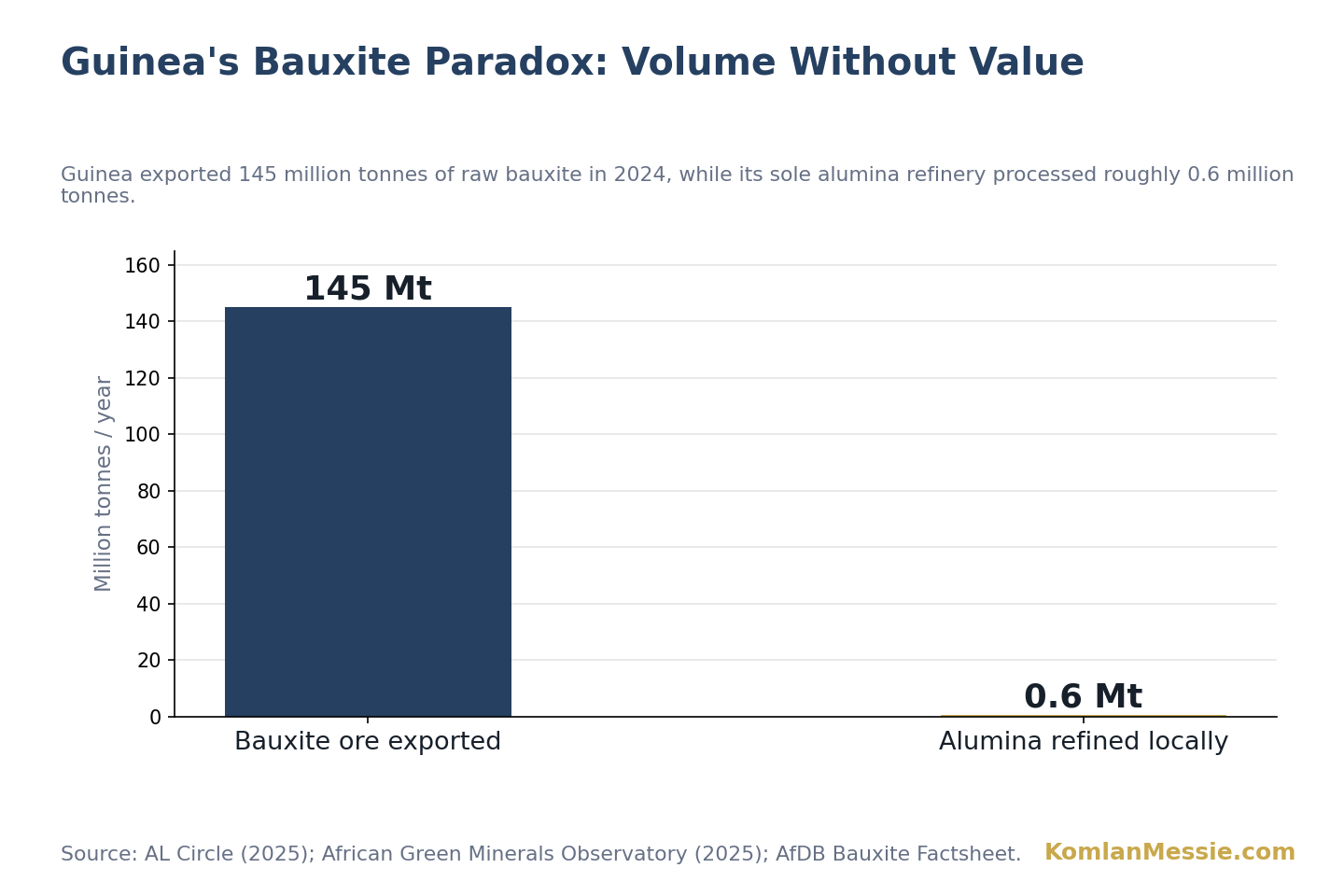
Guinea shipped 145 million tonnes of raw bauxite in 2024. Its only alumina refinery processed roughly 600,000 tonnes, less than half of one percent of what left the ground. The ore travels. The value stays behind.
That single fact captures the strategic question facing every mineral-rich economy in West Africa: the region is not short of resources. It is short of factories. West Africa's mineral wealth is real, diversified and increasingly courted by global buyers. What is missing is not geology but industrial infrastructure: refineries, smelters, power, ports and the regional policy architecture to link them. Until that gap closes, the region will keep exporting jobs, tax revenue and strategic leverage along with its ore.
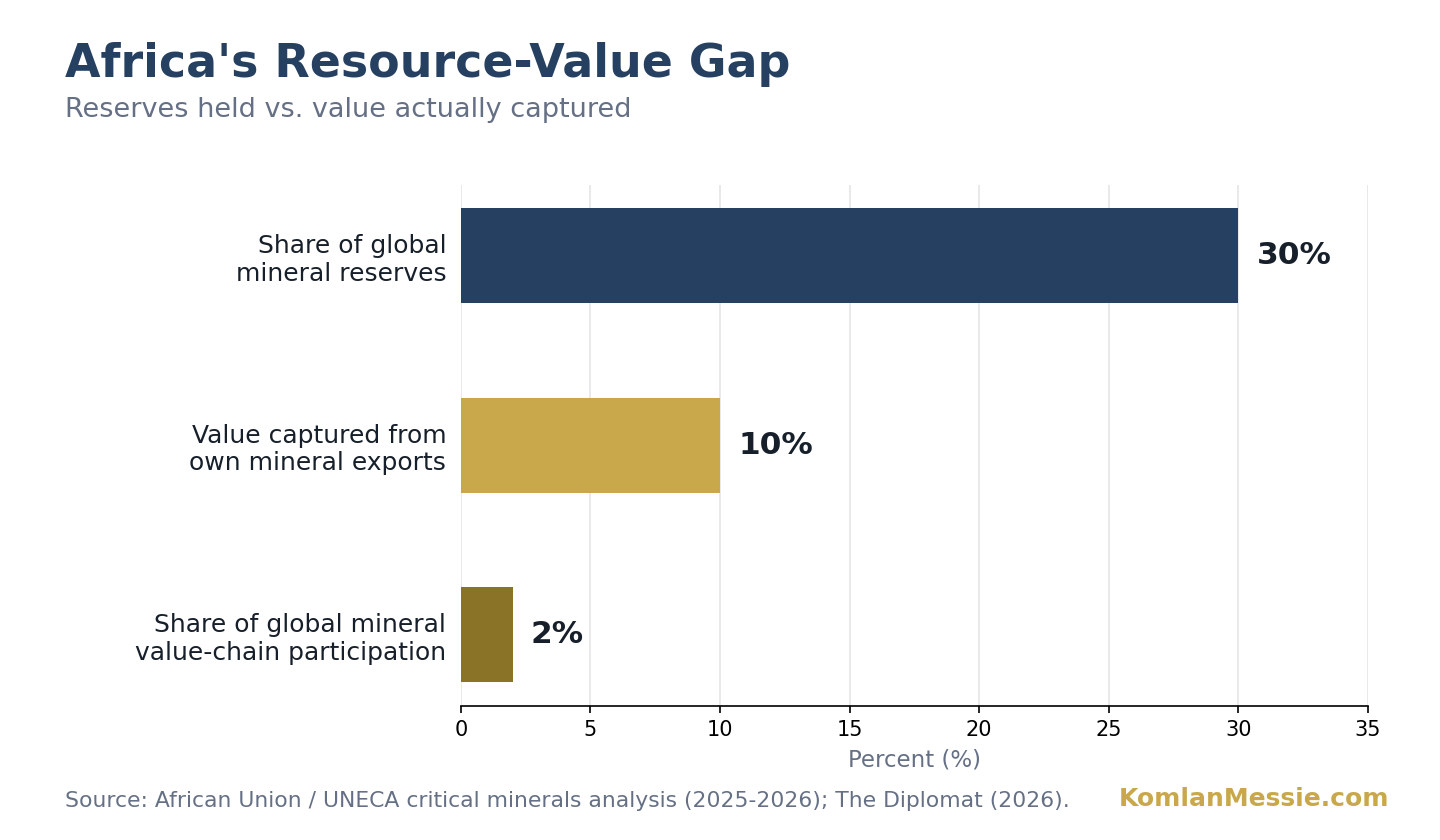
Africa holds an estimated 30 percent of the world's critical mineral reserves, yet captures only about 10 percent of the value generated from its mineral exports.8 The continent's participation in global mineral value chains sits at roughly 2 percent, while intra-African sourcing within those value chains remains below 15 percent.9,10 For West African governments, this is not an abstract statistic. It is the difference between selling ore at spot price and capturing the margin that refining, smelting and manufacturing generate downstream.
Guinea is now the world's largest bauxite exporter, shipping 145 million tonnes in 2024, up from 127 million tonnes in 2023.5 Its reserves, at 7.4 billion tonnes, represent close to a quarter of global bauxite reserves.3 Yet the country's sole significant refinery, Rusal's Friguia plant, processes about 600,000 tonnes of alumina a year, a fraction of one percent of annual output.7
Alumina carries six to seven times the market value of raw bauxite.3 Guinea's 2024 mandate requiring mining operators to submit local refining plans, and its 2025 transfer of a stalled concession to a new state-owned mining company, signal that Conakry understands the stakes. Execution, not intent, will determine the outcome.
The opportunity is not confined to one country or one mineral. Gold, bauxite, iron ore, lithium, manganese, uranium, phosphate and industrial minerals are distributed across all 15 West African states, from Ghana's diversified gold, manganese, bauxite and lithium base to Mauritania's iron ore, gold and copper corridor. This geographic spread is itself a strategic asset. No single country needs to build a complete value chain alone. A regional processing corridor, anchored by power-rich and port-connected hubs, could let neighbouring states specialize and trade intermediate products across borders under the African Continental Free Trade Area.1,10,11
| Country | Minerals |
|---|---|
| Ghana | Gold, manganese, bauxite, lithium |
| Guinea | Bauxite, iron ore |
| Nigeria | Gold, lithium, tantalum, tin, industrial minerals |
| Senegal | Zircon, gold, phosphate |
| Mali | Gold, lithium |
| Burkina Faso* | Gold, manganese |
| Côte d'Ivoire | Gold, manganese, nickel |
| Sierra Leone | Iron ore, rutile, diamonds |
| Liberia | Iron ore, gold |
| Niger* | Uranium, gold |
| Togo | Phosphate, limestone |
| Mauritania | Iron ore, gold, copper |
| Benin | Emerging mineral opportunities |
| The Gambia | Mineral sands |
| Guinea-Bissau | Bauxite, emerging mineral potential |
* ECOWAS suspended Mali, Burkina Faso and Niger's membership in January 2025; the three now form the Alliance of Sahel States. Mineral data spans all 15 West African states regardless of current regional bloc affiliation.
Source: UNECA; African Development Bank; USGS Mineral Commodity Summaries 2024; national geological surveys.
Africa's aluminium refining capacity is roughly 2 percent of the global total, compared with 60 percent for China and 5 percent for Canada.1 The constraint is structural: energy-intensive refining requires reliable, affordable power, deep-water ports and long-term capital, none of which raw extraction requires to the same degree.
This is the honest diagnosis: the binding constraint on West African industrialization is infrastructure and capital formation, not the absence of resources or of demand.
Three developments have converged to create a rare opening. The African Union adopted the African Green Minerals Strategy in February 2025, updating the 2009 African Mining Vision for the energy-transition era.4 Afreximbank's development arm, FEDA, has committed capital including a 300 million dollar investment in the Africa Minerals and Metals Processing Platform.6 And global buyers, facing supply concentration risk, are increasingly open to co-investing in local processing rather than raw offtake alone. From an institutional perspective, ECOWAS and the AU now have both the policy instruments and an investor appetite that did not exist a decade ago. The window will not stay open indefinitely: competing regions and competing minerals will absorb the same pool of processing capital if West Africa does not move first.
“The real question for leaders is no longer whether West Africa has the minerals the world needs. It has already answered that question. The question now is who builds, owns and operates the factories that turn ore into value.”
NovaHub Consulting advises governments, regional institutions and investors on the minerals-processing corridor strategy, concession design and financing structures this brief raises.
Book a conversationRead offline or share with your team, including all charts and the full country map.
1. African Development Bank. (2021). Bauxite Factsheet: Critical Mineral Insights. afdb.org.
2. African Development Bank. (2019). Mineral Beneficiation and Value Addition in Africa.
3. African Green Minerals Observatory. (2025). Guinea: Country Profile and Bauxite Overview. africangreenminerals.com.
4. African Union. (2025). African Green Minerals Strategy.
5. AL Circle. (2025). Guinea Edges Toward 199M Tonnes of Bauxite Exports Amid Refining Gap. alcircle.com.
6. African Business. (2026). The New Scramble for African Minerals and Value Addition. african.business.
7. Kpler. (2025). The Future of Guinea's Position in Global Bauxite Trade and Its Alumina Ambition. kpler.com.
8. The Diplomat. (2026). China and the US Want Africa's Critical Minerals. Will African Countries Actually Benefit? thediplomat.com.
9. UNCTAD. (2024). Economic Development in Africa Report 2024: Unlocking Africa's Trade Potential. unctad.org.
10. UNECA. (2024). Africa's Critical Mineral Resources, a Boon for Intra-African Trade and Regional Integration. uneca.org.
11. USGS. (2024). Mineral Commodity Summaries 2024. U.S. Geological Survey.
← Back to Blog & OpinionsFour of the world's five most terrorism-affected states are ECOWAS founding members. Three no longer have field monitors. What AI can and cannot fix.
Read the articleMobile money processed $357 billion across 485 million accounts in 2024. Broadband adoption remains below 40%. What that gap means for leaders.
Read the articleA 1% rise in AI adoption lifts agricultural productivity by 12% across 53 African countries. The technology works. Data governance, connectivity and regulation do not yet.
Read the article