Trade & Investment
Resetting the Africa-Canada Partnership
Canada's Africa Strategy launched with no new budget, while its economy still sends 72% of exports to a single buyer. Why Africa is a structural necessity, not a preference.
Read the articleThe productivity case for agricultural AI is proven. The institutional case is not.
Komlan Messie, MBA, Polytechnician, CEO of NovaHub Consulting • 2026 • 7 min read
A one percent increase in AI adoption raises agricultural total factor productivity by twelve percent, according to a study spanning fifty-three African countries. That single figure should reorder the priorities of every agriculture minister, agribusiness executive and development financier on the continent.
Yet the infrastructure, data governance and institutional capacity required to capture that gain remain the least developed parts of Africa's AI agenda, not the most advanced. Predictive irrigation platforms, crop disease diagnostics and satellite-based advisory tools already operate at scale in Kenya, Nigeria, Rwanda and beyond. The technology works. The binding constraint is institutional: unresolved data ownership, a two-tier connectivity gap that keeps digital advisory tools out of reach for most smallholders, and regulatory frameworks still in their preparatory phase. For the executives, investors and policymakers deciding where to commit capital over the next three years, the sequencing question is no longer whether to invest in agricultural AI. It is whether the institutional scaffolding exists to convert pilot success into structural transformation.
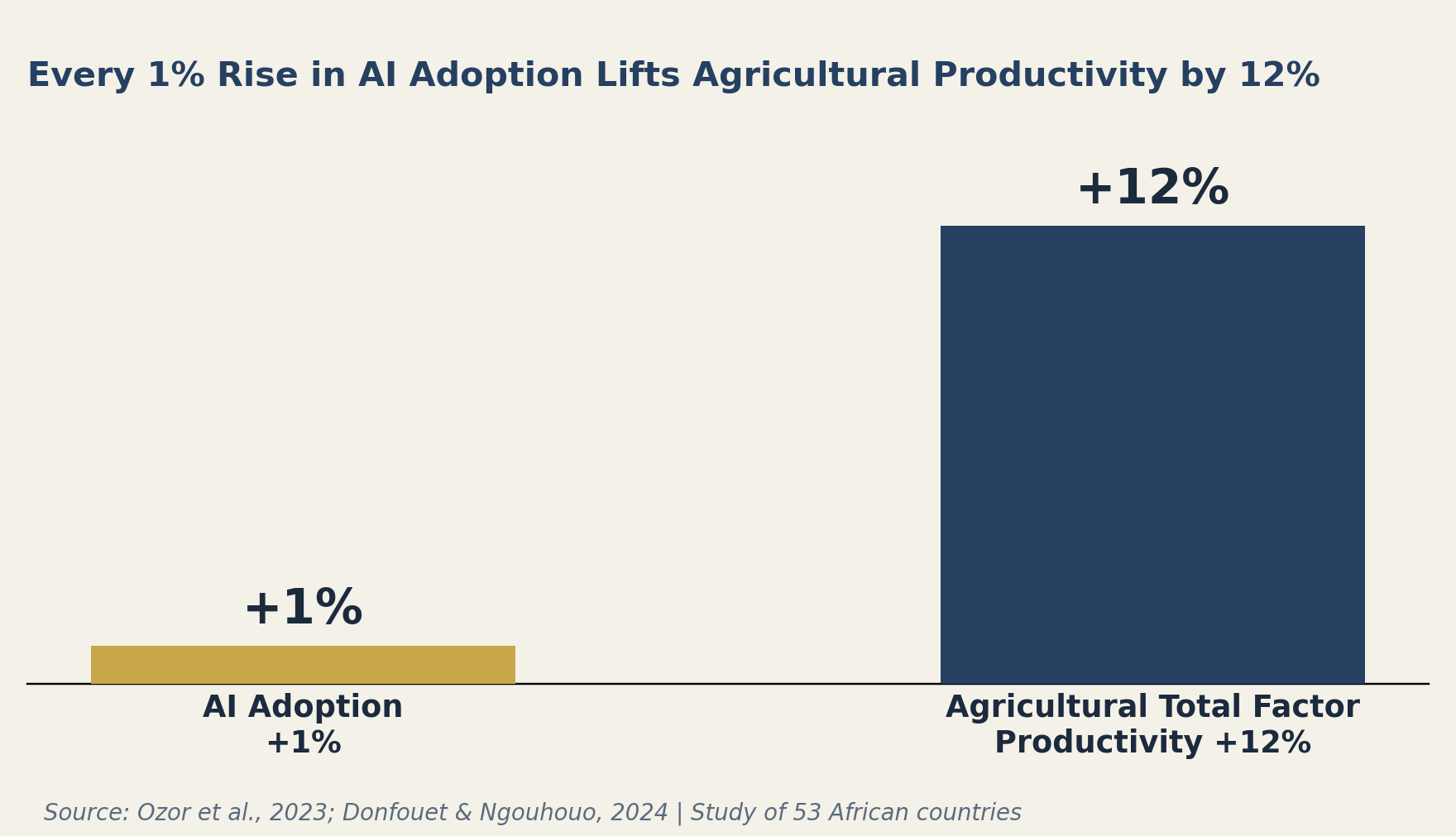
For years, agricultural AI in Africa was framed as promising but unproven. That framing is now outdated. A continent-wide study covering fifty-three African countries found that a one percent increase in AI use corresponded to a twelve percent increase in agricultural total factor productivity. Globally, the AI-in-agriculture market is projected to grow from 1.7 billion dollars in 2023 to 4.7 billion dollars by 2028, a compound annual growth rate of 23 percent.
The strategic issue is not whether AI can lift agricultural output. It can, and the evidence base is now strong enough to underwrite investment committees, not just research grants. Capital should shift from further pilot studies toward deployment and scaling. Organizations still commissioning proof-of-concept trials in 2026 are, in effect, competing against their own delay.
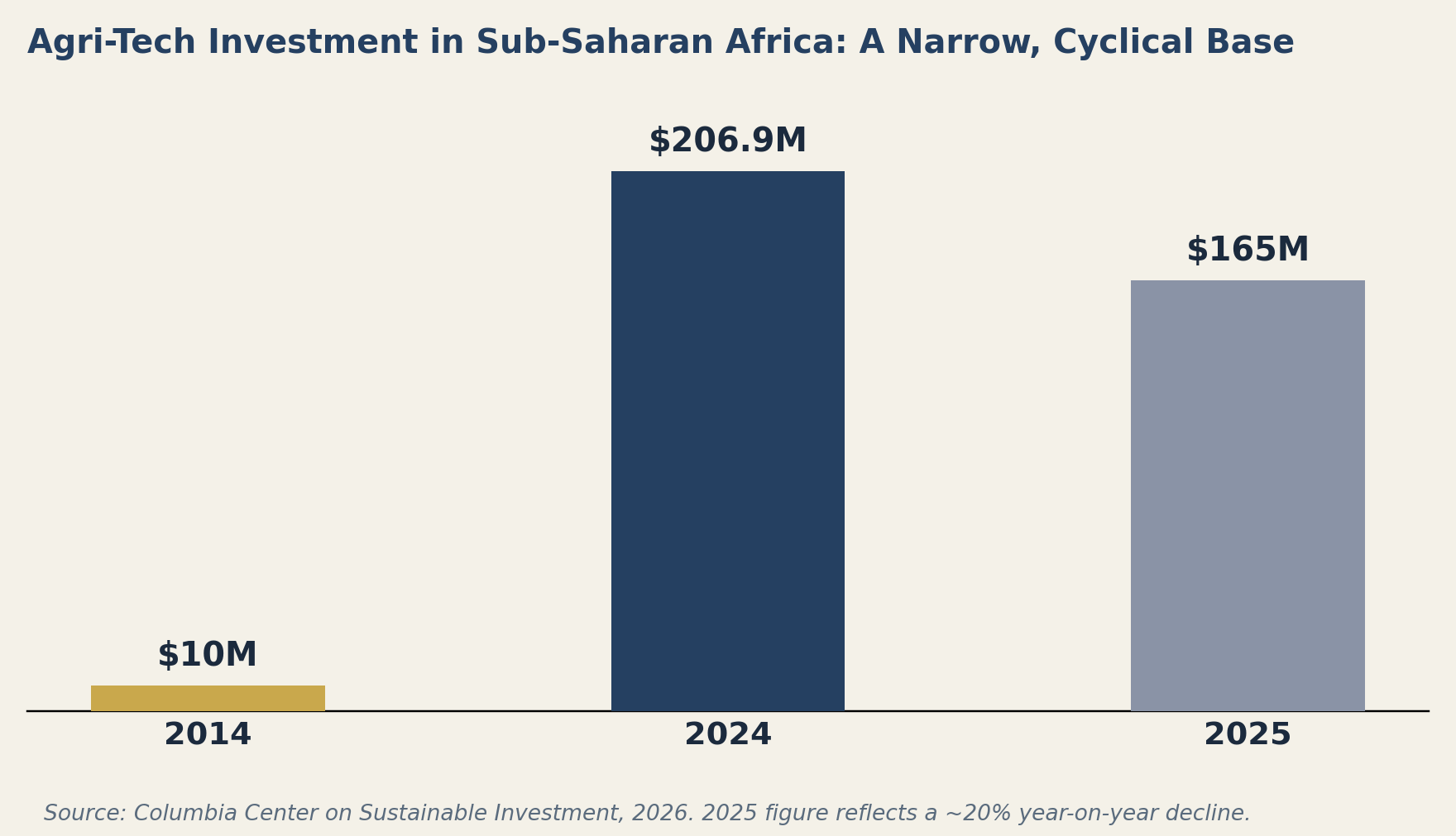
Agri-tech investment in Sub-Saharan Africa grew from under 10 million dollars in 2014 to 206.9 million dollars in 2024, before falling by nearly 20 percent in 2025, a signal of a funding base that remains narrow and cyclical.3 Two national models illustrate the divergence: Rwanda's state-led approach concentrates AI deployment through public institutions, while Nigeria's startup-led ecosystem, the largest in Sub-Saharan Africa by venture count, scales through private capital.
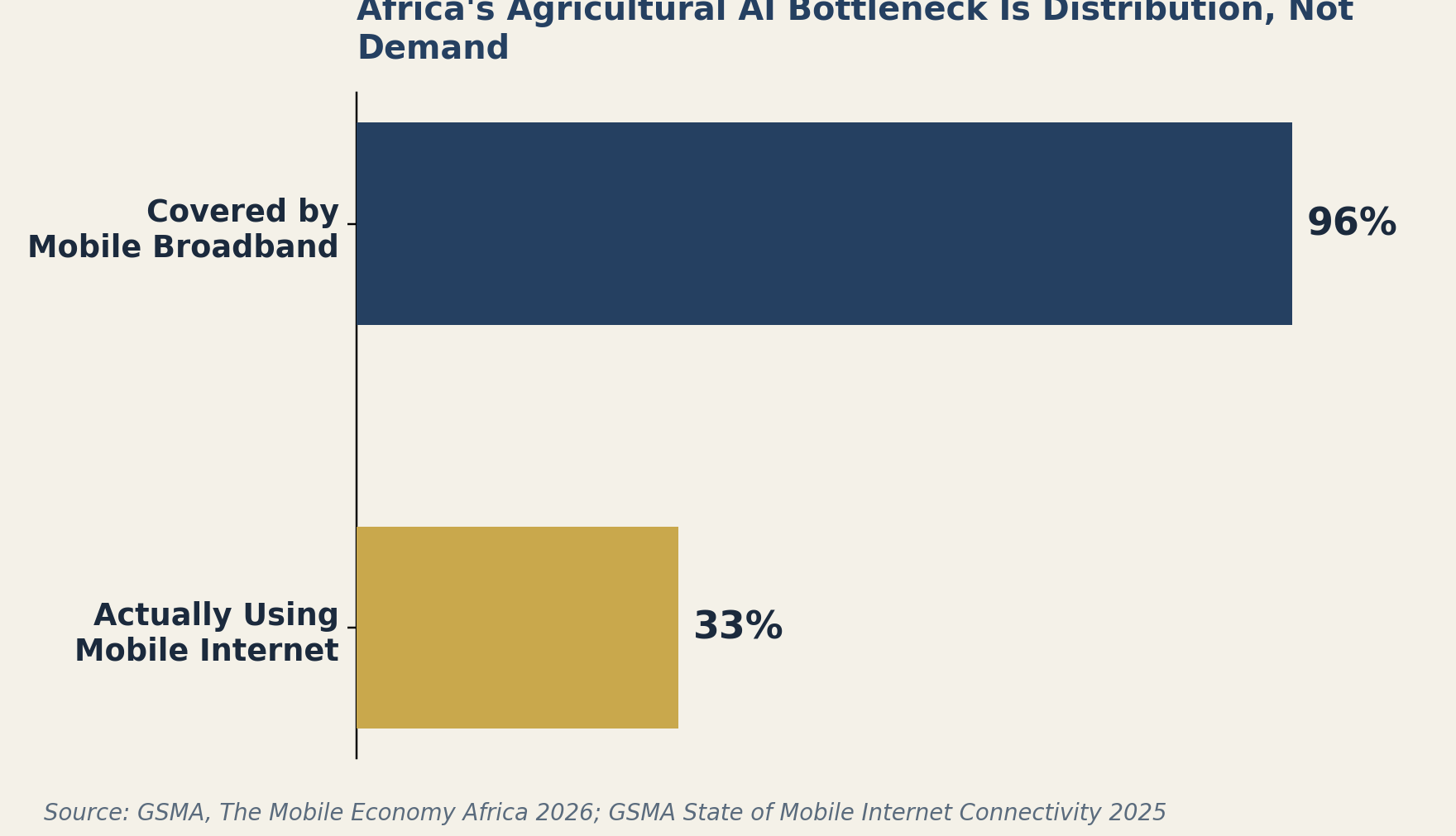
Distribution remains the deeper constraint. Sixty-three percent of Africans living within reach of mobile broadband are still not online,7 and adults in rural Sub-Saharan Africa are roughly 48 to 49 percent less likely to use mobile internet than their urban counterparts.6 Most AI advisory tools are still designed for smartphone applications that a majority of smallholders cannot reliably access.
For African decision-makers, this creates a design constraint before it creates a technology choice. Distribution model, SMS, interactive voice response, and agent-mediated delivery through cooperatives, determines reach more than model sophistication does.
The African Union's Continental AI Strategy, endorsed in Accra in July 2024, names agriculture as one of six flagship sectors for AI-driven transformation. Its implementation timeline runs from 2025 to 2030, with Phase 1, covering 2025 and 2026, dedicated to establishing governance structures and national AI strategies.1,5 As of mid-2025, roughly thirteen of the African Union's fifty-five member states had adopted a national AI strategy or policy framework. This is not a criticism of the pace of reform. Building durable governance in eighteen months is genuinely difficult. It is a statement of fact that matters for planning: the regulatory environment agribusinesses will operate in during 2026 and 2027 is still being written. Organizations that wait for finalized regulation will find themselves several years behind. The more effective posture is active, constructive participation in shaping national and regional AI and data governance frameworks now, while they remain open to input.
AI models trained on large-scale, mechanized monoculture data from the United States or the Netherlands frequently generate unreliable recommendations when applied to African smallholder conditions: mixed cropping, irregular input use, rain-fed cultivation and highly heterogeneous soils. Compounding this, data ownership remains poorly defined; farmers typically have limited visibility into how their data is collected, used or monetized.8,9 A model is only as reliable as the representativeness of the data behind it, and only as trusted as the institution that collects that data. Both conditions are currently unmet across most of the continent's agricultural AI deployments. The real question for leaders is not which AI vendor to select. It is whether their organization can guarantee locally representative training data and a transparent, farmer-respecting data governance regime. Institutions that treat this as a compliance afterthought will build brittle, low-trust systems regardless of model quality.
Agriculture employs an estimated 65 to 70 percent of Africa's labor force and contributes 30 to 40 percent of the continent's GDP.4 Two hundred and eighty-two million Africans face hunger daily, a figure projected to worsen as climate pressure intensifies.2 The stakes attached to getting agricultural AI right are not abstract; they sit at the center of food security and livelihoods for the majority of the continent's population.
From an institutional perspective, the deciding variable is not which algorithm performs best in a controlled trial. It is which institutional model, public, private, or cooperative-anchored, can reliably carry AI-derived insight to a smallholder with no smartphone, limited literacy in a colonial working language, and a single growing season to get it right. This is the same discipline NovaHub Consulting applies across sectors under the AI Firewall™ framework, adapted here to agriculture's specific institutional reality.
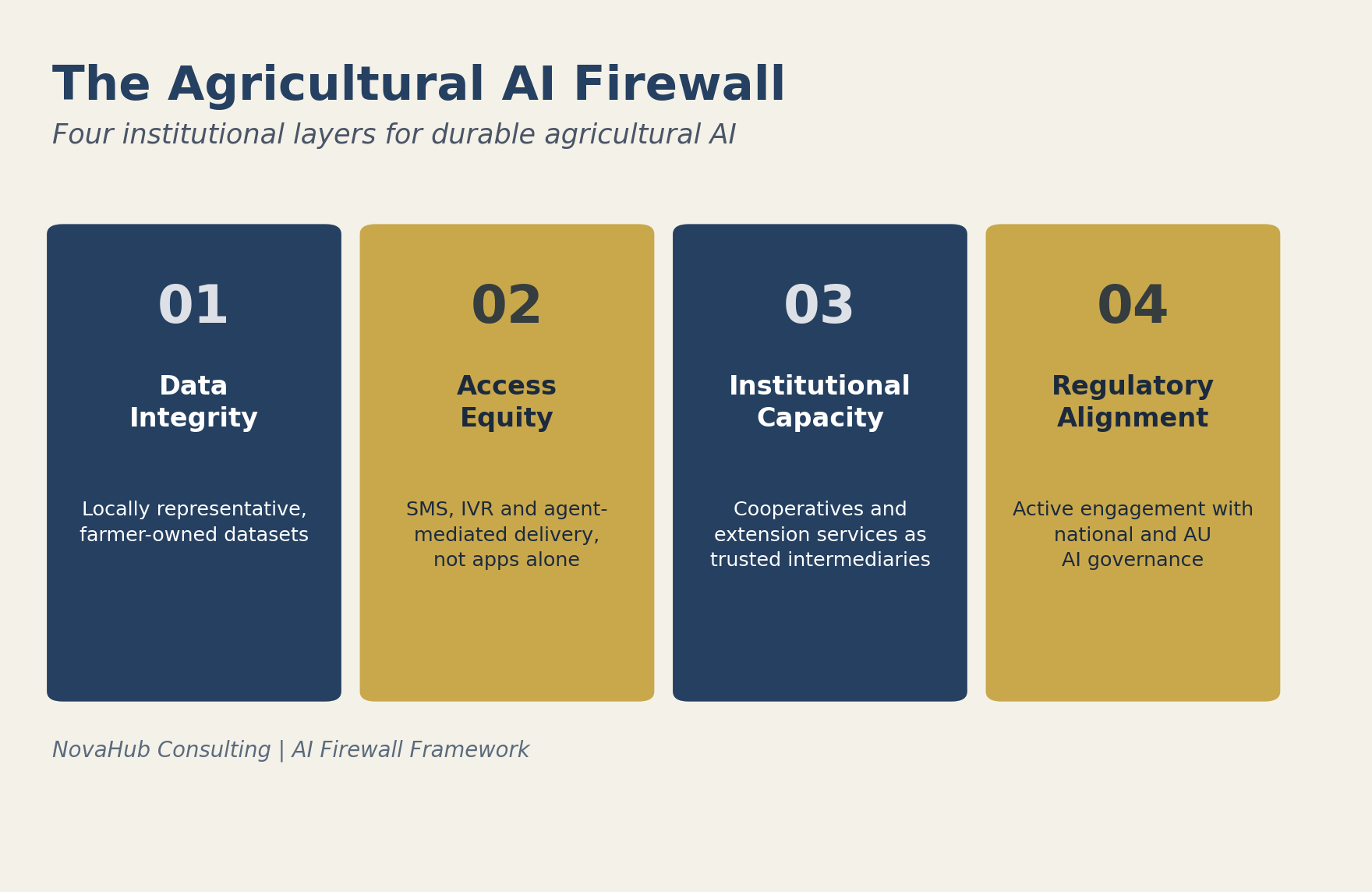
For African decision-makers, this creates a clear mandate: build the institutional layer with the same rigor applied to the technology layer. The winners in agricultural AI over the next decade will be defined less by which model they deploy and more by which institutions they build around it.
“The strategic issue is not whether AI belongs on Africa's farms. It already does. The real question for leaders, in ministries, in agribusiness boardrooms, and in development finance institutions, is whether the institutions meant to carry that technology to 60 to 80 percent of the continent's farmers are being built with the same urgency as the technology itself.”
NovaHub Consulting advises agribusinesses, cooperatives, regulators and development finance institutions on the data governance, distribution design and regulatory engagement questions this article raises, applying the AI Firewall™ framework to agriculture's specific institutional reality.
Book a conversation
A career built at the intersection of business, diplomacy and civic leadership.
Komlan Messie, MBA, is an international executive, entrepreneur and strategic advisor with more than two decades of experience across management, technology, institutional development, strategic transformation and international development. His work focuses on helping organisations, institutions and leaders navigate transformation, innovation, public policy and complex strategic challenges.
Mr. Messie is the founder and Chief Executive Officer of NovaHub Consulting and the Regional Executive Director of WACSOF-FOSCAO, the West African civil society network spanning ECOWAS member states. He is also the cofounder and chairman of the Réseau des Entrepreneurs et Professionnels Africains (REPAF) and the chairman of the Forum Afrique Expansion Canada, and he co-founded Aliments Frunil in Canada. He is a former Vice President of the Project Management Institute Montreal (PMI Montreal) in Canada.
He holds an MBA from HEC Montréal, an M.Sc. in Computer Science and Operations Research from École Polytechnique de Montréal, and a B.Eng. in Electrical Engineering from École Polytechnique de Thiès (Senegal), and is PRINCE2 certified. He works across Canada, Africa and especially the ECOWAS region in French, English, Ewe and Wolof.
Read offline or share with your team, including all charts.
1. African Union. (2024). Continental Artificial Intelligence Strategy. au.int.
2. Brookings Institution. (2025). Foresight Africa 2025-2030: Digital Solutions in Agriculture Drive Meaningful Livelihood Improvements for African Smallholder Farmers. brookings.edu.
3. Columbia Center on Sustainable Investment. (2026). Enabling Smallholder Adoption of Agricultural AI in Sub-Saharan Africa: Lessons from Rwanda and Nigeria. ccsi.columbia.edu.
4. Digital Planet, The Fletcher School, Tufts University. (2025). Getting Real About AI for the Bottom-of-the-Pyramid: Improving the Economic Outcomes of Smallholder Farmers in Africa. digitalplanet.tufts.edu.
5. Future of Privacy Forum. (2024). The African Union's Continental AI Strategy: Data Protection and Governance Laws Set to Play a Key Role in AI Regulation. fpf.org.
6. GSMA. (2025). The State of Mobile Internet Connectivity 2025. gsma.com.
7. GSMA Intelligence. (2026). The Mobile Economy Africa 2026. gsmaintelligence.com.
8. allAfrica. (2026). Africa: AI Offers Promise for Agriculture, but Smallholder Farmers Risk Being Left Behind. allafrica.com.
9. ResearchGate / CCSI Working Paper. (2025). How AI Can Benefit Smallholder Farmers in Africa. researchgate.net.
← Back to Blog & OpinionsCanada's Africa Strategy launched with no new budget, while its economy still sends 72% of exports to a single buyer. Why Africa is a structural necessity, not a preference.
Read the articleAfrican banks posted a return on equity nearly double the global average. No African market has crossed 20% AI adoption. That gap is the strategic story of the next decade.
Read the articleFive deadlines have already come and gone. A sixth is now set for 2027. Seven measurable conditions, not a summit declaration, will decide if it holds.
Read the article