Senegal, Togo, Canada and across Africa
@gonovahub
Blog & Opinions

From Early Warning to Early Action: Can AI Close West Africa's Security Gap?

Four of the world's five most terrorism-affected states are ECOWAS founding members. Three no longer have field monitors.

Komlan Messie, MBA, Polytechnician, CEO of NovaHub Consulting • 2026 • 9 min read

From early warning to early action
Four of the five countries the world ranks as most affected by terrorism sit inside the founding membership of ECOWAS. Only Pakistan separates them at the top of a 163 country list. The mechanism ECOWAS built to see this coming no longer watches three of them.

Burkina Faso ranks second globally on the 2026 Global Terrorism Index. Niger is third. Nigeria is fourth. Mali is fifth. What makes this more urgent than the ranking alone is a second fact that receives far less attention: the ECOWAS Warning and Response Network, ECOWARN, no longer has field monitors inside three of those four countries. The question is not whether West Africa needs early warning. It built one of the continent's more credible systems for that purpose. The question is whether that system can still see clearly enough, and fast enough, to trigger early action rather than after-the-fact response.

4/5of the world's most terrorism-affected countries are ECOWAS founding members. Institute for Economics and Peace, 2026
12/15ECOWARN field-monitor coverage remaining after the AES withdrawal. ECOWAS, 2026
$2.7MAfDB-financed project now modernising ECOWARN with AI interoperability. ECOWAS-AfDB, 2025

The Wake-Up Call

Four of the five countries the world ranks as most affected by terrorism sit inside the founding membership of the Economic Community of West African States. Burkina Faso is ranked second globally in the 2026 Global Terrorism Index. Niger is third. Nigeria is fourth. Mali is fifth. Only Pakistan separates them at the very top of a 163 country list published by the Institute for Economics and Peace.1

That fact alone would justify a regional state of alert. What makes it more urgent is a second fact that receives far less attention. The very mechanism ECOWAS built to see this coming, the ECOWAS Warning and Response Network known as ECOWARN, no longer has field monitors inside three of those four countries. Burkina Faso, Niger and Mali formally left the bloc on 29 January 2025 to form the Alliance of Sahel States. When ECOWAS retrained its network of field monitors in Lomé in February 2026, seventy four monitors attended, drawn from twelve member states, not fifteen.4,6

The Fifteen Nation Ledger

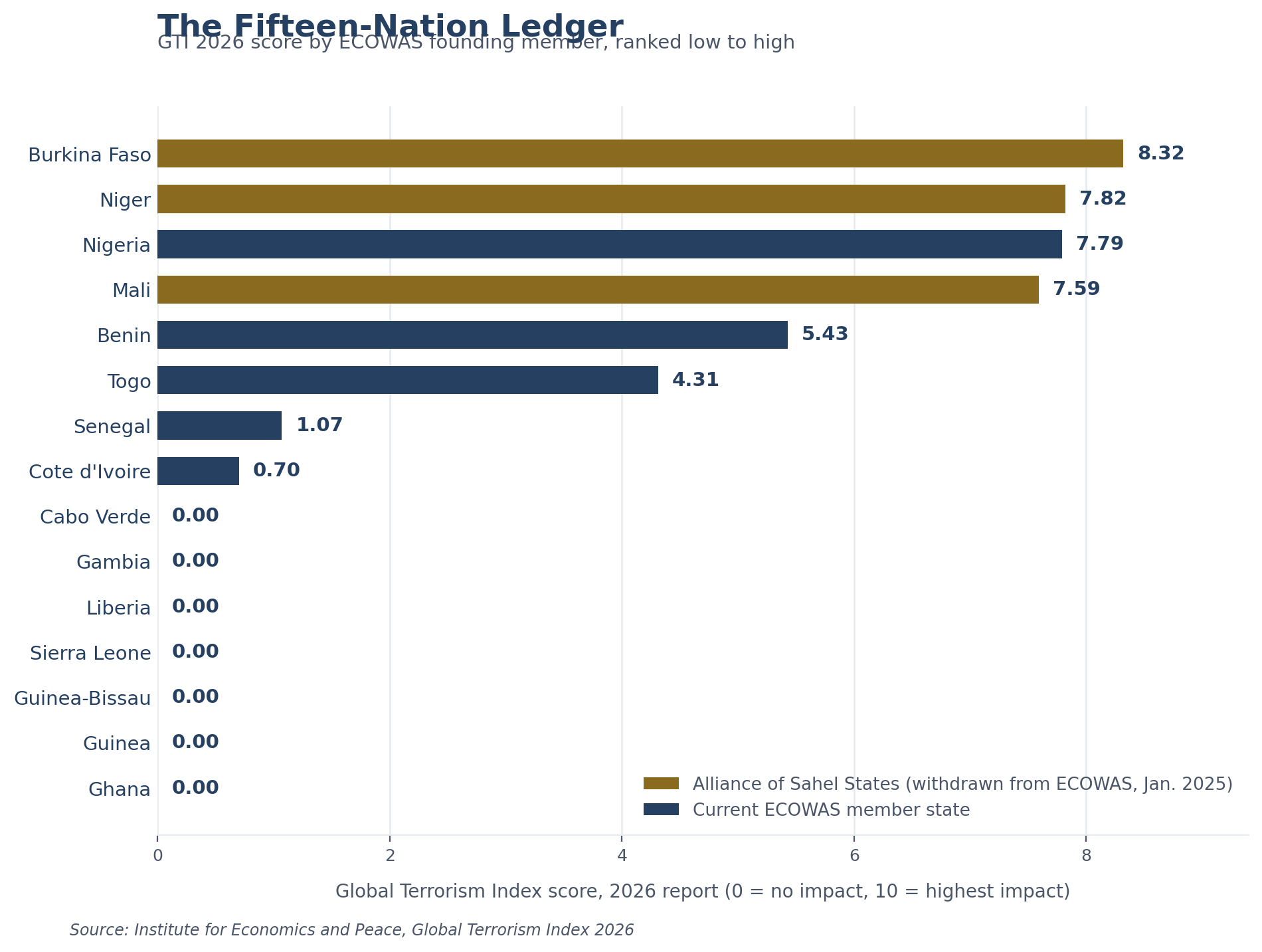
Bar chart ranking the 15 ECOWAS founding states by 2026 Global Terrorism Index score

Ranking the fifteen ECOWAS founding states by their 2026 Global Terrorism Index score produces a picture of extreme concentration rather than even distribution. The three Alliance of Sahel States members average a score of 7.91 out of a possible 10. The remaining twelve ECOWAS member states average 1.61. The gap is not incremental, it is structural.1,2

Nigeria is the outlier worth sitting with. It remains a full ECOWAS member in good standing, yet its score of 7.79 places it within a rounding error of the departed Sahel trio and ahead of Mali. Terrorism linked to Islamic State West Africa Province and Boko Haram does not track membership status. A further seven states, Ghana, Guinea, Guinea-Bissau, Sierra Leone, Liberia, Gambia and Cabo Verde, register at or near zero. The region is not uniformly at risk. It is acutely concentrated, and that concentration is now split across a political fault line.1

The Blind Spot

What ECOWARN was built to do

ECOWARN was established under the 1999 Protocol relating to the Mechanism for Conflict Prevention, Management, Resolution, Peacekeeping and Security. Its model depends on trained field monitors embedded in member states who feed verified, ground-level indicators, troop movements, market disruptions, displacement flows, communal tension signals, into a shared regional platform that analysts in Abuja use to brief decision makers before a crisis, not after one.

What changed on 29 January 2025

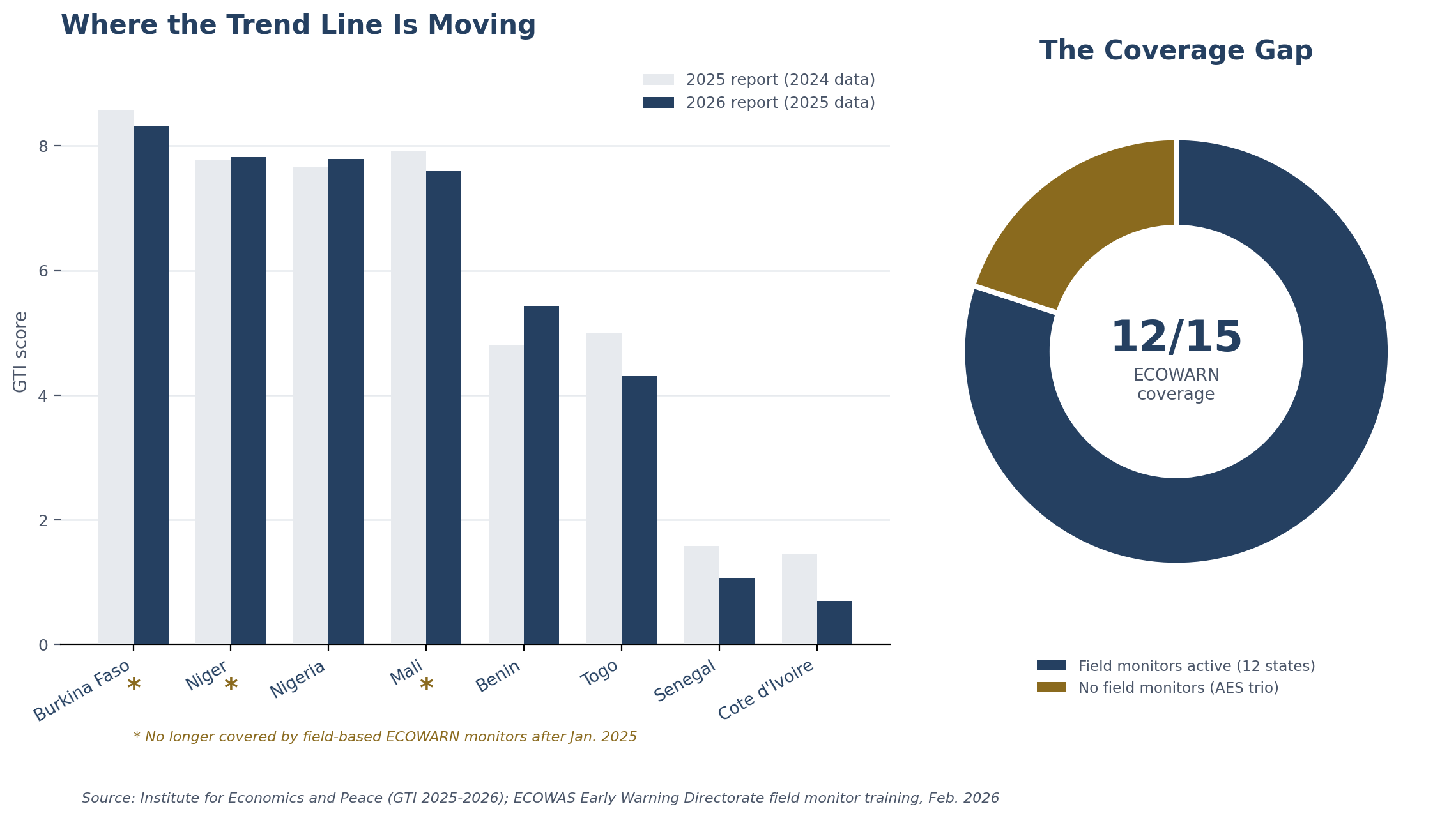
When Burkina Faso, Mali and Niger completed their withdrawal from ECOWAS, they did not simply leave a trade bloc. They removed themselves from the institutional plumbing that feeds ECOWARN. The ECOWAS Commission has kept selective channels open, recognising AES passports and preserving trade treatment, but formal field monitoring inside the three states has lapsed. The Early Warning Directorate's own annual retreat in Lomé this February trained seventy four monitors from twelve states. Three states that between them account for a GTI average nearly five times the regional mean outside the Sahel are no longer part of that monitor network.4,6

Trend chart and ECOWARN field-monitor coverage donut chart
Why this matters beyond the three states

Risk does not stop at a withdrawn membership card. Jama'at Nusrat al Islam wal Muslimin, the al-Qaida affiliated coalition operating across the tri-border area, has extended a fuel and trade blockade strategy into Mali's south west while probing Senegal, Guinea and Mauritania. Losing verified, field-sourced indicators from inside Mali, Burkina Faso and Niger means the region's most reliable warning system is now trying to anticipate that spread using thinner information from precisely the territory where the pressure originates.8

When the Alarm Rings Too Late

The coastal states are already showing what a delayed warning looks like in practice. Benin's GTI score rose from 4.80 to 5.43 in a single year, and the government has deployed roughly 3,000 soldiers along its northern border to intercept infiltration from Burkina Faso and Niger. Togo recorded its highest sustained terrorism impact since the index began tracking the country, before a modest pull-back to 4.31 in the 2026 report. Neither country was a Sahel hotspot five years ago. Both are now allocating scarce fiscal resources to a threat that migrated south while the region's institutional gaze was fixed elsewhere.1,2

This is the practical cost of the blind spot described above. An early warning system is only as useful as its lead time. A system relying on secondary and open-source reporting from inside the AES states, rather than trained monitors with community access, will tend to confirm a threat once it has already crossed a border rather than flag it while it is still forming. Coastal ECOWAS governments are effectively absorbing the intelligence cost of a diplomatic rupture they did not choose.

The Machine in the Watchtower

Artificial intelligence is now a serious candidate for narrowing this gap, and ECOWAS itself has started to say so publicly. The Early Warning Directorate's February 2026 training in Lomé explicitly explored how AI could strengthen data collection and analysis, and a separate ECOWAS-African Development Bank project worth $2.7 million, launched with a two-year implementation window, lists AI interoperability as one of three core pillars of ECOWARN's modernisation.5,6

What AI can plausibly add

  • Satellite and geospatial change detection to flag population displacement, market destruction or new checkpoint activity in areas monitors can no longer reach on the ground.
  • Open-source and social media signal processing, including language models tuned to French, Hausa, Bambara, Zarma and other regional languages, to surface local reporting that would otherwise take days to reach an analyst.
  • Cross-border data fusion that combines conflict event data, displacement statistics and economic indicators such as fuel and cereal prices into a single regional risk register.
  • Predictive risk scoring that flags which districts are trending toward instability weeks ahead, giving diplomats and mediators a lead-time window they currently do not have.
What AI cannot do

None of this replicates the trust a local field monitor builds with a community over years, and none of it works in a vacuum where the governments in question actively restrict information flows, journalist access and internet connectivity, all of which have occurred at various points across the AES states since 2023. AI increases the volume of signal available. It does not, by itself, increase the credibility of that signal, and in a region where misinformation already complicates conflict dynamics, an unverified AI-generated alert can do as much harm as no alert at all.

Building the Bridge

ECOWAS is not starting this modernisation from zero. The Commission's Early Warning Directorate, working with the African Development Bank under an agreement signed in May 2024, has moved into the active implementation phase of a project structured around three pillars: country-level resilience and human security assessments, modernisation of ECOWARN's data infrastructure and analytical tools including AI interoperability, and capacity building for regional analysts. A dedicated project management unit, coordinated by the ECOWARN system administrator at the Commission, now oversees delivery.5

A sequencing framework for the transition

NovaHub Consulting applies its proprietary C-I-D-E-R framework, Context, Intelligence, Diagnose, Execute, Reinforce, to sequence exactly this kind of institutional transition. Context means mapping the coverage gap precisely, twelve states with active monitors against three with none, rather than treating the region as uniformly covered. Intelligence means layering AI-augmented open-source monitoring over the existing ECOWARN feed rather than replacing it. Diagnose means fusing the two streams into one regional risk register analysts can actually use. Execute means routing validated alerts into ECOWAS's existing mediation and preventive diplomacy channels before a flashpoint becomes a headline. Reinforce means institutionalising what is learned, so the next membership shock does not blind the system in the same way.

The Governance Test

Technology alone will not resolve a political rupture, and treating it as though it can carries real risk. AES governments have framed Western and multilateral engagement with suspicion since 2023. An externally funded AI monitoring capability trained on their territory without their consent could easily be read as surveillance rather than assistance, hardening the very rupture ECOWAS is trying to manage. Any AI layer built into ECOWARN needs a data sovereignty protocol that distinguishes technical, humanitarian-focused monitoring from anything resembling intelligence collection.

There is also a coordination question. The African Union operates its own Continental Early Warning System, and national early warning structures exist in several member states. Ghana and Senegal, both with functioning national systems, offer a template worth studying before ECOWAS builds AI tooling that duplicates rather than reinforces what already works. Finally, AI models trained predominantly on English and French language data risk under-representing the Hausa, Fulfulde, Bambara, Zarma, Mooré and Wolof language reporting that carries the earliest signals in rural, high-risk districts. Closing the coverage gap on paper while widening it linguistically would be a step backward disguised as innovation.9

The Next Twenty-Four Months

Shadow monitoringFund and deploy an AI-augmented open-source monitoring unit within the existing AfDB-financed modernisation project, explicitly scoped to shadow-monitor Burkina Faso, Mali and Niger using satellite, market-price and verified social reporting data, distinct from any political reintegration negotiation.
A technical data channelNegotiate a narrow, technical, humanitarian-focused data exchange channel with AES national statistics and civil protection agencies, kept deliberately separate from the political question of ECOWAS membership.
Language capacityRecruit and train regional analysts fluent in Hausa, Bambara, Zarma, Mooré and Fulfulde to validate AI-generated alerts before they reach decision makers, closing the linguistic gap identified above.
Public transparencyPublish a quarterly, public-facing regional risk bulletin, building transparency that can also reassure investors and development partners assessing exposure across the fifteen founding states.
Continental coordinationFormalise a coordination protocol between ECOWARN and the African Union's Continental Early Warning System to prevent duplicated tooling and conflicting risk assessments reaching the same decision makers.

“The choice facing ECOWAS is not warning versus no warning. It already has one of the more credible systems on the continent. The choice is whether that system can be modernised fast enough to convert a warning into action before the next Benin or Togo absorbs a cost that better information, sooner, might have reduced.”

NovaHub Consulting

Where NovaHub fits

NovaHub Consulting advises regional institutions, development partners and governments on the institutional sequencing, data sovereignty and analyst capacity questions this brief raises.

Book a conversation
Komlan Messie
About the author

Komlan Messie, MBA, Polytechnician

A career built at the intersection of business, diplomacy and civic leadership.

Komlan Messie, MBA, is an international executive, entrepreneur and strategic advisor with more than two decades of experience across management, technology, institutional development, strategic transformation and international development. His work focuses on helping organisations, institutions and leaders navigate transformation, innovation, public policy and complex strategic challenges.

Mr. Messie is the founder and Chief Executive Officer of NovaHub Consulting and the Regional Executive Director of WACSOF-FOSCAO, the West African civil society network spanning ECOWAS member states. He is also the cofounder and chairman of the Réseau des Entrepreneurs et Professionnels Africains (REPAF) and the chairman of the Forum Afrique Expansion Canada, and he co-founded Aliments Frunil in Canada. He is a former Vice President of the Project Management Institute Montreal (PMI Montreal) in Canada.

He holds an MBA from HEC Montréal, an M.Sc. in Computer Science and Operations Research from École Polytechnique de Montréal, and a B.Eng. in Electrical Engineering from École Polytechnique de Thiès (Senegal), and is PRINCE2 certified. He works across Canada, Africa and especially the ECOWAS region in French, English, Ewe and Wolof.

Continue the conversation with Komlan Messie
View full profile →
Download this article

Read offline or share with your team, including all charts and sources.

Sources

1.  Institute for Economics and Peace, Global Terrorism Index 2026, March 2026.

2.  Institute for Economics and Peace, Global Terrorism Index 2025, March 2025.

3.  Trading Economics, Terrorism Index country data, sourced from the Institute for Economics and Peace, accessed August 2026.

4.  ECOWAS Commission, Burkina Faso, Mali and Niger's withdrawal from ECOWAS is now a reality, 29 January 2025.

5.  The Point (Gambia), ECOWAS explores use of AI to improve Early Warning data collection, analysis, 27 February 2026.

6.  News Ghana, ECOWAS and AfDB launch active phase of Early Warning strengthening project, 13 November 2025.

7.  Zawya, ECOWAS Warning and Response Network annual retreat to strengthen data collection capacities, 27 February 2026.

8.  Security Council Report, West Africa and the Sahel, monthly forecast, April 2025.

9.  Amani Africa, The withdrawal of AES from ECOWAS, an opportunity for re-evaluating existing instruments for regional integration, January 2025.

← Back to Blog & Opinions
Newsletter

Get the analysis before the decision is made.

Subscribe for new insights, policy briefs and event updates. No noise, unsubscribe at any time.

Download the full paper

Enter your details to receive the secure download link. You will also be added to our newsletter list.

ENGAGE NOVAHUB