Senegal, Togo, Canada and across Africa
@gonovahub
Blog & Opinions

Mobile Money Is Becoming West Africa's New Bank. But Who Controls the Data?

More than two trillion dollars moved through mobile wallets in 2025. The rules governing who owns that data have not kept pace.

Komlan Messie, MBA, Polytechnician, CEO of NovaHub Consulting • 2026 • 8 min read

Mobile money and data governance in West Africa
A woman in Kayes sends her daughter's school fees to Bamako in nine seconds. A trader in Lome pays a supplier in Accra without touching a bank branch. A cocoa farmer outside Abidjan borrows against his mobile wallet history rather than a title deed he does not have. None of this required a bank. All of it required data.

Mobile money has quietly become West Africa's primary financial infrastructure. More than two trillion dollars moved through mobile wallets worldwide in 2025, and Sub-Saharan Africa generated 66 percent of that global transaction value.1,2 The region did what decades of conventional banking could not: it banked the unbanked at continental scale, in a single generation, using a device most households already owned. But a second, quieter transition has been running underneath the first one. Every transfer, every airtime top-up, every merchant payment generates a data trail, and that data trail is now more valuable, and more contested, than the cash it represents. The institutions that hold it, mobile network operators, foreign payment platforms and an emerging layer of credit-scoring fintechs, are not the same institutions West Africa's governments, central banks or citizens can hold accountable through the region's existing regulatory architecture. The financial inclusion story has been told. The data governance story has barely started.

$2.02Tmoved through mobile wallets worldwide in 2025, doubling in four years. GSMA, 2026
66%of global mobile money transaction value was generated in Sub-Saharan Africa. GSMA, 2026
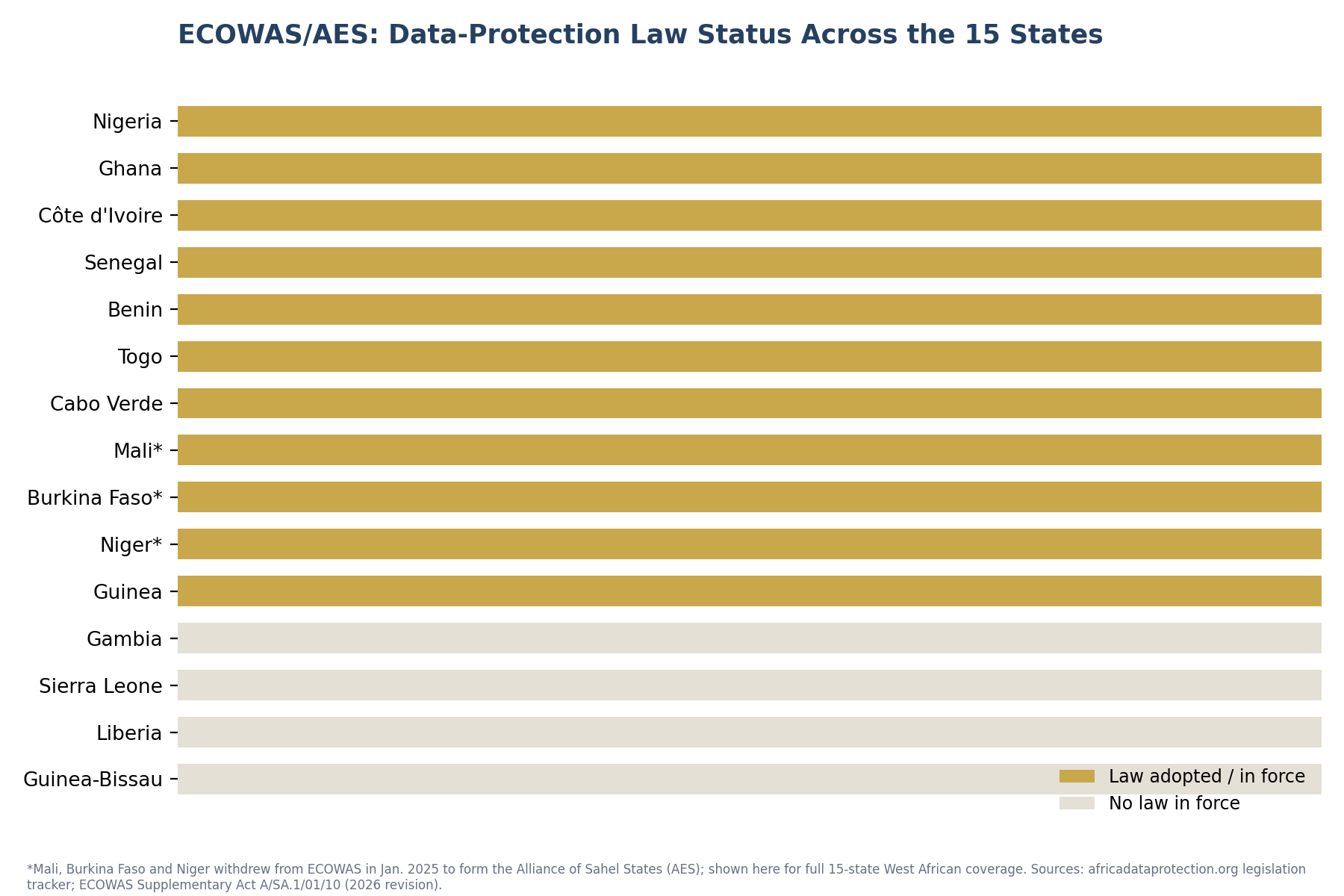
4 of 15West African states still have no data-protection law in force. africadataprotection.org, 2026

1. Scale has outrun governance

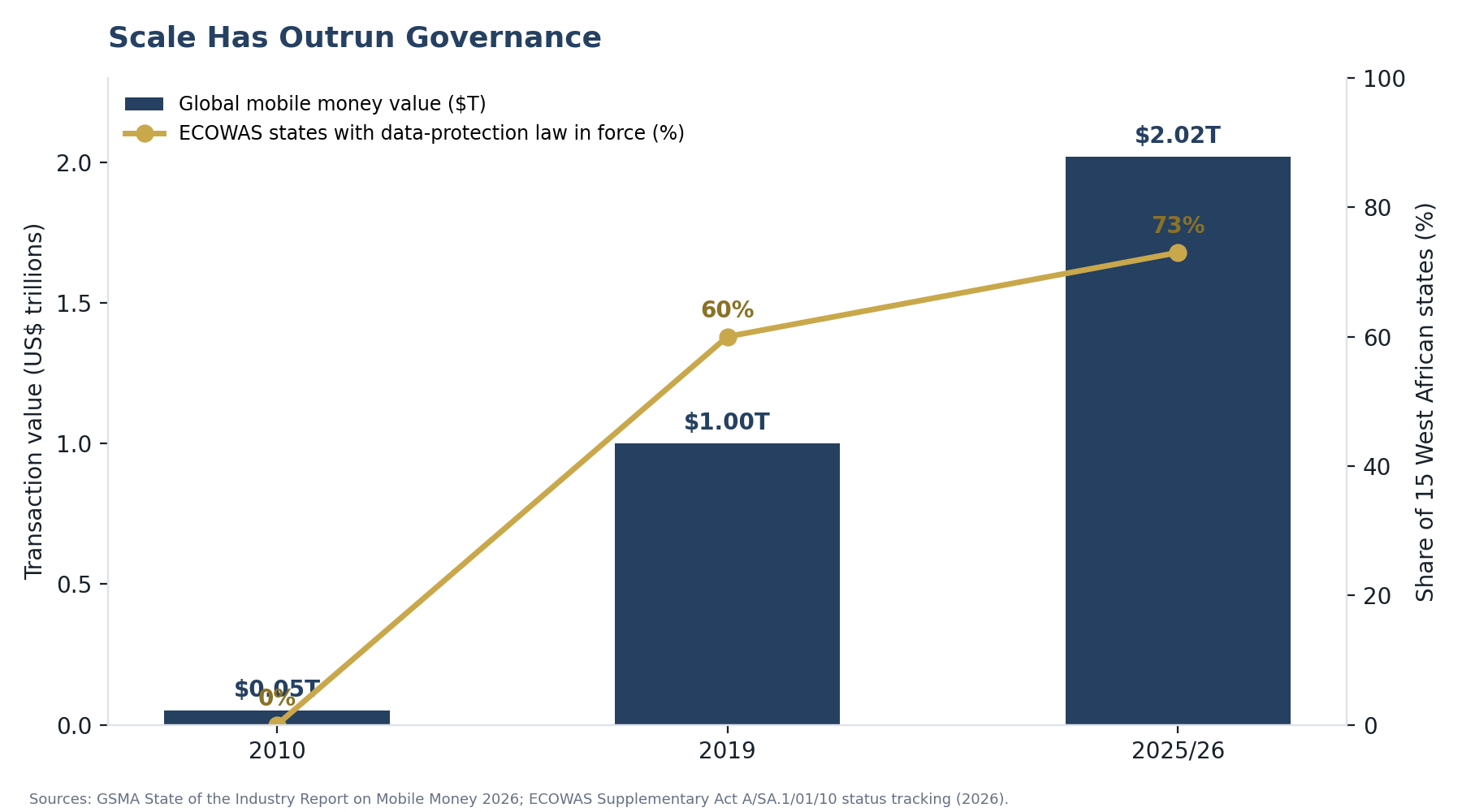
ECOWAS adopted its Supplementary Act on Personal Data Protection in 2010, a legally binding regional framework that predates the smartphone-driven mobile money boom by more than a decade. Fifteen years later, eleven of the fifteen West African states have a data-protection law in force. Four, Gambia, Guinea-Bissau, Liberia and Sierra Leone, still do not.4,5 Global mobile money transaction value went from roughly one trillion dollars in 2021 to just over two trillion in 2025, doubling in four years after taking twenty years to reach the first trillion.1,2,3 Regulatory coverage across the fifteen states has not doubled at the same pace. This is not a story about bad regulators. It is a story about an industry whose growth curve is structurally faster than any legislative calendar, in a region where harmonisation depends on the voluntary alignment of fifteen sovereign legal systems, three of which formally exited the ECOWAS bloc in January 2025 to form the Alliance of Sahel States. The data infrastructure carrying two trillion dollars a year is regionally borderless. The rules governing it are not.

Chart of global mobile money value against ECOWAS data-protection law coverage

2. Who actually captures the value

Ownership of the wallet is not the same as ownership of the account holder's data. Mobile network operators and the fintech platforms built on top of them are the parties actually accumulating, structuring and monetising the transaction history of hundreds of millions of West Africans. Across leading African mobile money operators, financial services now represent a rapidly growing share of total operator revenue, a trajectory that has moved a core telecom business toward something closer to an unlicensed, algorithmically-run bank.8 Mobile network operators are now the primary source of the alternative data used to score borrowers who have no formal credit history, call records, airtime top-up patterns and mobile money transaction flows feeding models that African researchers have shown can outperform traditional credit bureau data in predictive accuracy.9,10 That capability is genuinely valuable for financial inclusion. It is also a capability that sits almost entirely outside the institutions West African regulators, central banks and national credit bureaus were built to supervise. South Africa's MTN-TransUnion telco credit score illustrates where this is heading: proprietary, cross-border data partnerships governed by commercial agreements rather than public institutional oversight.

3. Two regional frameworks, pulling in different directions

West Africa is not short of governing instruments. It has too many that do not yet agree with each other. The ECOWAS Supplementary Act leans toward the European model: consent-based processing, mandatory national data protection authorities and restraint on cross-border transfer. The African Continental Free Trade Area's Digital Trade Protocol, adopted by the African Union in February 2024 with its data-governance annexes finalised a year later, leans the other way: it discourages data localisation as a default position and favours open cross-border data flows as the foundation of a continental digital single market.6,7 Both instincts are defensible. Both are also in genuine tension with each other, and mobile money sits directly at the intersection. A cross-border wallet corridor like the Nigeria-Ghana PAPSS pilot depends on data moving freely between jurisdictions to function at all. A citizen's right to know who holds their transaction history depends on the opposite instinct. Neither ECOWAS nor the African Union has yet published a reconciliation between the two postures, specifically as it applies to financial and mobile money data.

4. Fraud and dormancy are governance failures, not just security problems

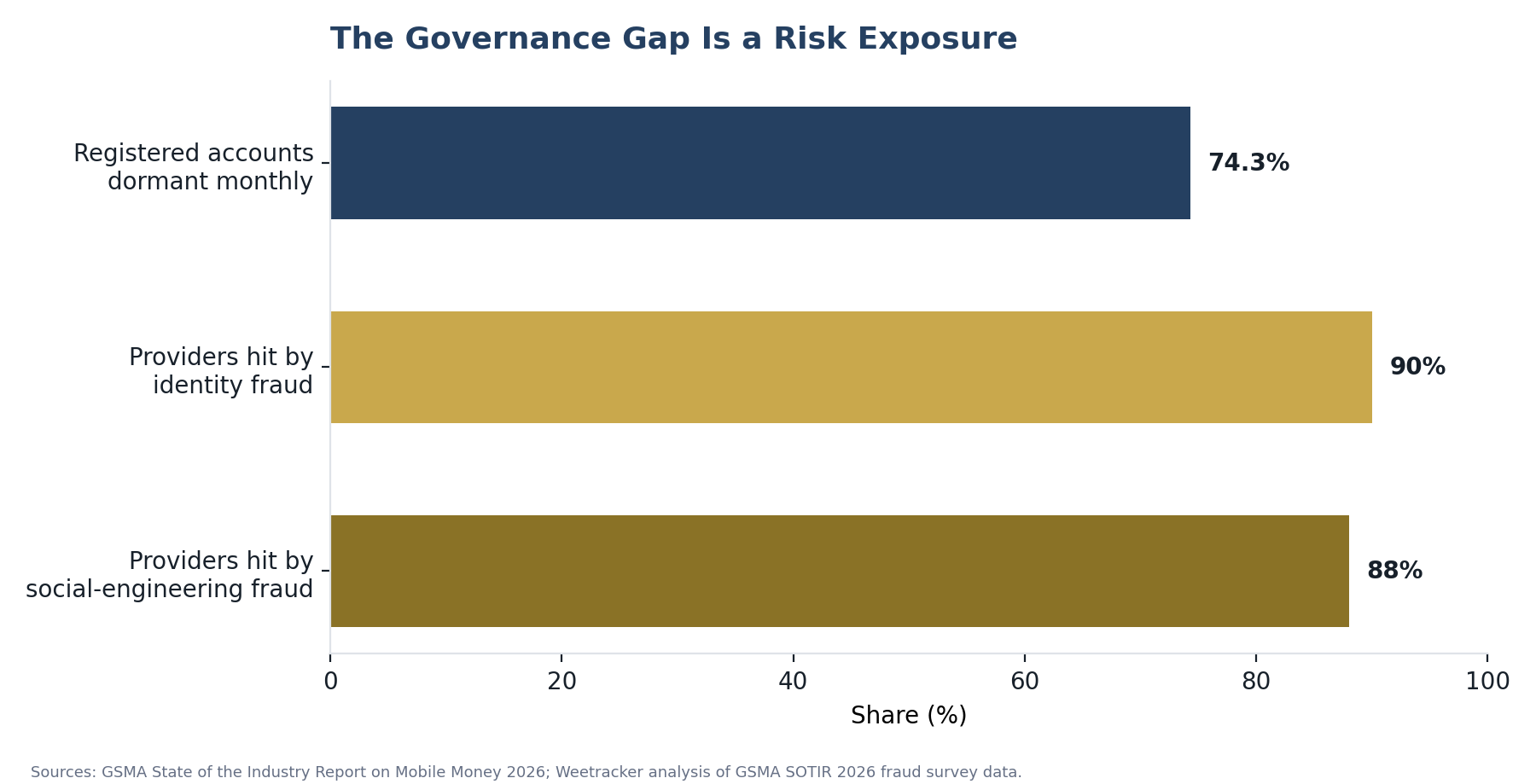
The industry's own data shows what happens when trust in the data layer erodes. Of the 2.3 billion mobile money accounts registered worldwide, fewer than a quarter transact on a monthly basis. Identity fraud affected 90 percent of mobile money providers surveyed globally in the GSMA's 2026 industry report. Social engineering schemes hit 88 percent. In Kenya alone, online theft is estimated to have cost users 883 million dollars in a single year.1,3 These are usually framed as cybersecurity statistics. They are better read as data governance statistics. Identity fraud and social engineering succeed because the data infrastructure verifying who a customer actually is, know-your-customer records, biometric registration, transaction history, is fragmented across operators, thinly regulated and inconsistently protected across the fifteen jurisdictions it operates in. A regional data governance framework is not a compliance exercise layered on top of a functioning system. It is the missing piece of the system's security architecture.

Chart of mobile money account dormancy and fraud rates

5. The sovereignty path forward

Close the coverage gap firstPrioritise data-protection authority capacity building in Gambia, Guinea-Bissau, Liberia and Sierra Leone, using the ongoing revision of the 2010 Supplementary Act as the vehicle.
Reconcile the two frameworks explicitlyThe ECOWAS Commission and the AfCFTA Secretariat should issue a joint technical note on how the two postures apply to mobile money and financial data.
Build public or co-governed data trust infrastructureA regional credit-data utility, jointly governed by ECOWAS central banks and national credit bureaus, would put the predictive value of mobile money data to work without leaving it entirely with a small number of commercial operators.
Treat identity verification as regional infrastructureInteroperable, regionally recognised know-your-customer standards would reduce both fraud exposure and the compliance burden pushing smaller operators toward weaker controls.
Make data governance an investable propositionInvestors and development finance institutions increasingly price regulatory clarity into their cost of capital, not just a compliance cost.
Chart of data-protection law status across the 15 West African states

“West Africa built one of the most consequential financial inclusion stories of the past two decades on the back of mobile money. It did so without fully deciding who owns, controls, and is accountable for the data that makes that system work. The region that answers it first will not just protect its citizens. It will set the terms the rest of the continent follows.”

NovaHub Consulting

Where NovaHub fits

NovaHub Consulting advises governments, regulators and financial institutions on data governance frameworks, digital identity infrastructure and mobile financial services regulation across ECOWAS.

Book a conversation
Komlan Messie
About the author

Komlan Messie, MBA, Polytechnician

A career built at the intersection of business, diplomacy and civic leadership.

Komlan Messie, MBA, is an international executive, entrepreneur and strategic advisor with more than two decades of experience across management, technology, institutional development, strategic transformation and international development. His work focuses on helping organisations, institutions and leaders navigate transformation, innovation, public policy and complex strategic challenges.

Mr. Messie is the founder and Chief Executive Officer of NovaHub Consulting and the Regional Executive Director of WACSOF-FOSCAO, the West African civil society network spanning ECOWAS member states. He is also the cofounder and chairman of the Réseau des Entrepreneurs et Professionnels Africains (REPAF) and the chairman of the Forum Afrique Expansion Canada, and he co-founded Aliments Frunil in Canada. He is a former Vice President of the Project Management Institute Montreal (PMI Montreal) in Canada.

He holds an MBA from HEC Montréal, an M.Sc. in Computer Science and Operations Research from École Polytechnique de Montréal, and a B.Eng. in Electrical Engineering from École Polytechnique de Thiès (Senegal), and is PRINCE2 certified. He works across Canada, Africa and especially the ECOWAS region in French, English, Ewe and Wolof.

Continue the conversation with Komlan Messie
View full profile →
Download this article

Read offline or share with your team, including all charts and figures.

Sources

1.  GSMA, State of the Industry Report on Mobile Money 2026 (data for 2025), gsma.com/sotir.

2.  GSMA Newsroom, Mobile Money accounted for $2 trillion in transactions in 2025 (2026), gsma.com.

3.  Weetracker, Africa Drove Mobile Money To USD 2T. Now Most Accounts Sit Idle (2026), weetracker.com.

4.  ECOWAS Supplementary Act A/SA.1/01/10 on the Protection of Personal Data (2010; under revision 2026), AUDA-NEPAD.

5.  africadataprotection.org, Legislation tracker (2026).

6.  AfCFTA Secretariat, Protocol on Digital Trade and Data Governance Annexes (adopted Feb. 2024; annexes finalised 2025).

7.  Digital Policy Alert, The Year of the Teeth: Data Protection in Africa Roundup 2025, Projections for 2026.

8.  Ecofin Agency, In Africa, Banks Face a New Rival: Telecom Operators (2026), ecofinagency.com.

9.  MTN / TransUnion Africa, New Telco-Powered Credit Score (2025).

10.  IEEE / ResearchGate, Credit Scoring in Africa: Employing Logistic Regression on Alternative Data (2024).

11.  Bloomsbury Intelligence and Security Institute, West Africa's Mobile Money Evolution 2026 to 2030 (2026).

12.  West Africa Internet Governance Forum (WAIGF) 2026, Freetown, Sierra Leone.

← Back to Blog & Opinions
Newsletter

Get the analysis before the decision is made.

Subscribe for new insights, policy briefs and event updates. No noise, unsubscribe at any time.

Download the full paper

Enter your details to receive the secure download link. You will also be added to our newsletter list.

ENGAGE NOVAHUB