Senegal, Togo, Canada and across Africa
@gonovahub
Blog & Opinions

Without Papers, Without Power: Statelessness as West Africa's Silent Strategic Risk

Nearly one million people in West Africa have no recognized nationality. The cost is economic, and it is security.

Komlan Messie, MBA, CEO of NovaHub Consulting • 2026 • 6 min read

Without papers, without power

A person without a birth certificate cannot open a bank account, enrol in secondary school, register a business, or vote. In West Africa, an estimated 47 million children carry no such document. The gap is not a bureaucratic footnote. It is a structural fault line running through the region's economy and its security.

12.7Mforcibly displaced or stateless across West and Central Africa in 2025, up 48% since 2020.UNHCR, 2025
≈1Mpeople in West and Central Africa are stateless, with no recognized nationality.UNHCR, 2025
47Mchildren in the region carry no proof of legal identity at all.UNICEF

The core argument

Statelessness in West Africa is a governance and security liability, not merely a humanitarian one. When close to a million people in the region have no recognized nationality and tens of millions of children remain undocumented, states lose fiscal visibility, financial systems lose customers, and armed groups gain a ready recruitment pool among the excluded. The 2024 African Union Protocol on Nationality and the Eradication of Statelessness, and the accession of ECOWAS states to biometric identity systems, create a rare policy window. Institutions and businesses that act now will shape the region's next decade of inclusion, resilience, and growth.

1. The scale is larger than the headlines suggest

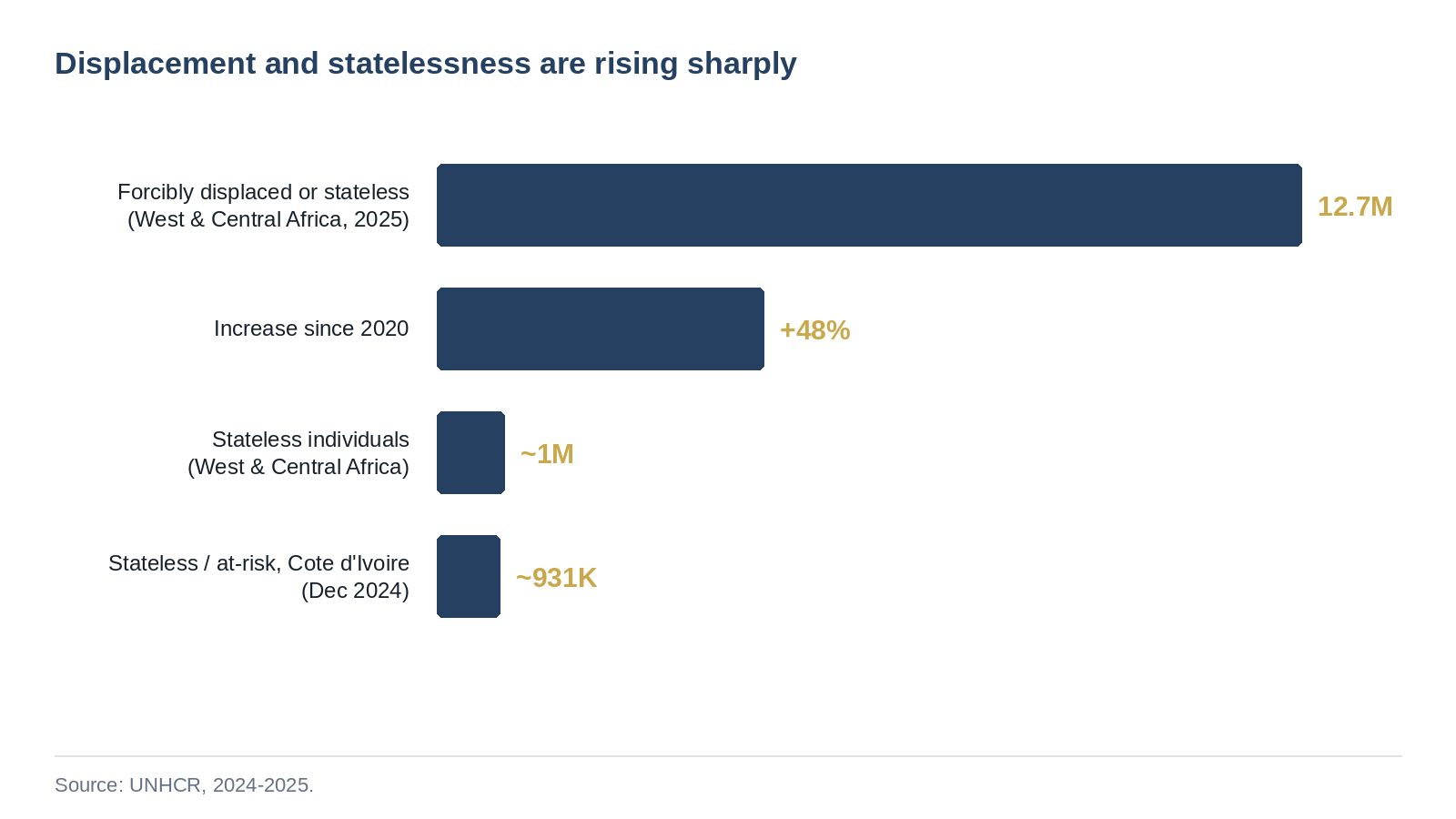
West and Central Africa carries the lowest civil registration coverage in the world. UNHCR's regional bureau reported in June 2025 that forced displacement and statelessness across the region had reached 12.7 million people, a 48 percent increase since 2020, including close to one million individuals who are stateless.1,2 In Côte d'Ivoire alone, the only West African country to have conducted a dedicated national study, UNHCR estimates roughly 931,000 people stateless or at risk of statelessness as of December 2024.1

Bar chart of displacement and statelessness figures, West and Central Africa
These are not isolated cases at the margins of national life. They represent entire communities who exist inside state borders without existing inside state systems.

2. The registration pipeline manufactures tomorrow's statelessness

Statelessness is rarely a single event. It begins at birth. UNICEF reports that West and Central Africa has the lowest birth registration rate in the world at 45 percent for children under five, leaving an estimated 47 million children without legal proof of identity.3 The World Bank's ID4D program estimates that more than half of the one billion people globally without proof of identity live in Africa.4

3. The economic cost is an exclusion cost

Identity is the gateway credential to the formal economy. Without it, individuals cannot open bank accounts, access credit, register land, formalize a business, or receive social transfers. For businesses and investors, an undocumented population is a shadow market: economically active but functionally invisible to banks, insurers, and formal payroll systems.

4. The security cost is a recruitment cost

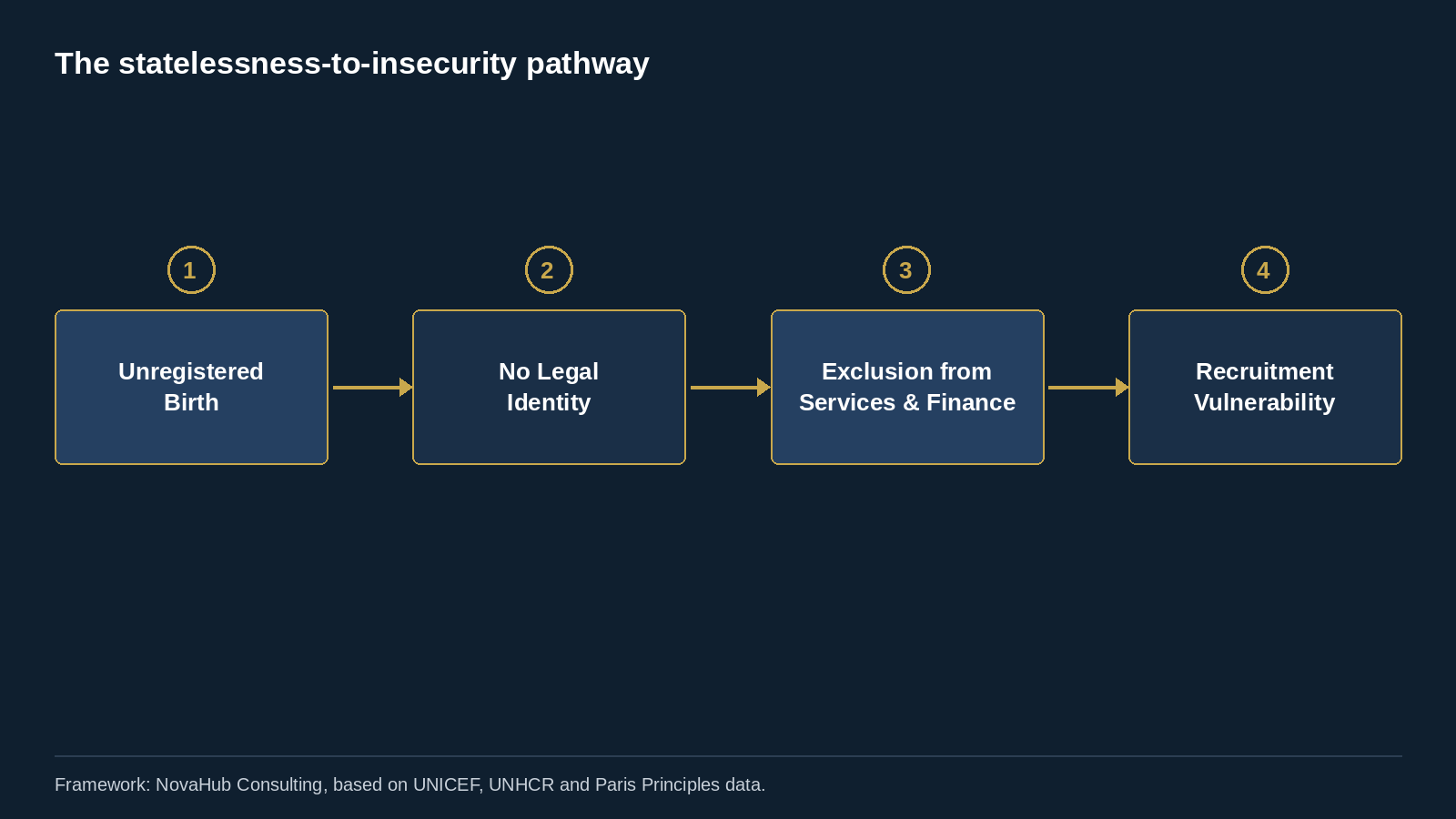
The link between statelessness and insecurity is documented. The Paris Principles, endorsed by 111 states, identify statelessness as a risk factor for the recruitment of children by armed groups. In the central Sahel, a youthful population coming of age without education, employment, or state recognition forms what a 2026 Stimson Center analysis calls a near-inexhaustible recruitment pool for armed actors.7

Diagram of the pathway from unregistered birth to security vulnerability

5. The policy window is open, briefly

The African Union adopted its Protocol on the Right to a Nationality and the Eradication of Statelessness in Africa on 18 February 2024. It requires 15 ratifications to enter into force.5,6 ECOWAS is simultaneously advancing common biometric identity systems to strengthen its free movement protocol.10

What leaders should do now

GovernmentsPrioritize ratification of the AU Protocol and align civil registration budgets with UNICEF and ID4D benchmarks.
Regional InstitutionsEnsure ECOWAS biometric identity rollout includes explicit statelessness-prevention safeguards.
Development PartnersFund birth registration at the point of health and education service delivery.
Investors and BusinessesTreat identity infrastructure as a precondition for market formalization.

“The real question for leaders is whether the region can afford another decade of governing, banking, and securing populations it cannot see.”

NovaHub Consulting

Where NovaHub fits

NovaHub Consulting advises governments, regional institutions and development partners on identity infrastructure, civil registration financing and the institutional design questions this article raises.

Book a conversation
Komlan Messie
About the author

Komlan Messie, MBA, Polytechnician

A career built at the intersection of business, diplomacy and civic leadership.

Komlan Messie, MBA, is an international executive, entrepreneur and strategic advisor with more than two decades of experience across management, technology, institutional development, strategic transformation and international development. His work focuses on helping organisations, institutions and leaders navigate transformation, innovation, public policy and complex strategic challenges.

Mr. Messie is the founder and Chief Executive Officer of NovaHub Consulting and the Regional Executive Director of WACSOF-FOSCAO, the West African civil society network spanning ECOWAS member states. He is also the cofounder and chairman of the Réseau des Entrepreneurs et Professionnels Africains (REPAF) and the chairman of the Forum Afrique Expansion Canada, and he co-founded Aliments Frunil in Canada. He is a former Vice President of the Project Management Institute Montreal (PMI Montreal) in Canada.

He holds an MBA from HEC Montréal, an M.Sc. in Computer Science and Operations Research from École Polytechnique de Montréal, and a B.Eng. in Electrical Engineering from École Polytechnique de Thiès (Senegal), and is PRINCE2 certified. He works across Canada, Africa and especially the ECOWAS region in French, English, Ewe and Wolof.

Continue the conversation with Komlan Messie
View full profile →
Download this article

Read offline or share with your team, including all charts and diagrams.

Sources

1.  UNHCR Multi-Country Office Côte d'Ivoire, Statelessness Report 2024 (2024), data.unhcr.org.

2.  UNHCR, forced displacement trends in West and Central Africa (2025), unhcr.org.

3.  UNICEF West and Central Africa, Birth Registration, unicef.org.

4.  World Bank Group, Digital Identity for All by 2030 (2018), worldbank.org.

5.  African Union, Protocol on Nationality and the Eradication of Statelessness (2024), au.int.

6.  African Commission on Human and Peoples' Rights, press release on the Protocol's first anniversary (2025), achpr.au.int.

7.  Stimson Center, Uncovering the Roots of Crisis in the Sahel (2026), stimson.org.

8.  Journal of Conflict and Security Law, Oxford Academic, on the Paris Principles (2022), academic.oup.com.

9.  UNHCR, response to violence and displacement in the Sahel region, unhcr.org.

10.  United Nations Economic Commission for Africa, ECOWAS Free Movement of Persons, archive.uneca.org.

← Back to Blog & Opinions
Newsletter

Get the analysis before the decision is made.

Subscribe for new insights, policy briefs and event updates. No noise, unsubscribe at any time.

Download the full paper

Enter your details to receive the secure download link. You will also be added to our newsletter list.

ENGAGE NOVAHUB