Senegal, Togo, Canada and across Africa
@gonovahub
Blog & Opinions

The Sahelian Paradox: The Sahel Has the Cattle. The Coast Has the Consumers. So, Where Is the Problem?

Why Sahelian meat is won or lost in trade corridors, infrastructure, markets and public policy, not only in the pastures.

Komlan Messie, MBA, Polytechnician, CEO of NovaHub Consulting • 22 October 2026 • 12 min read

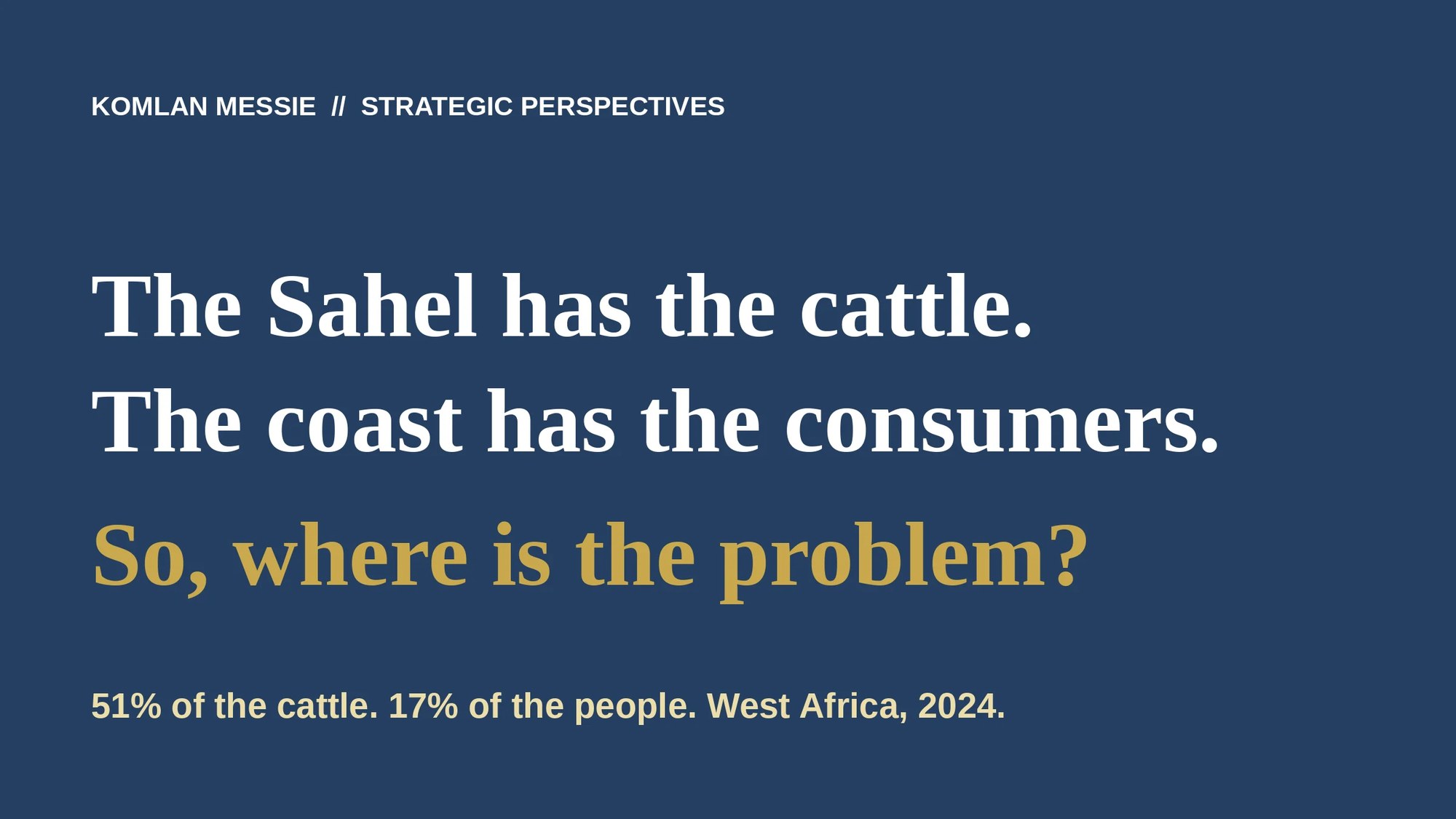
Navy banner reading The Sahel has the cattle. The coast has the consumers. So, where is the problem?
The herd is in the Sahel. The buyers are on the coast. The margin sits somewhere in between, and too often it never reaches the producer.

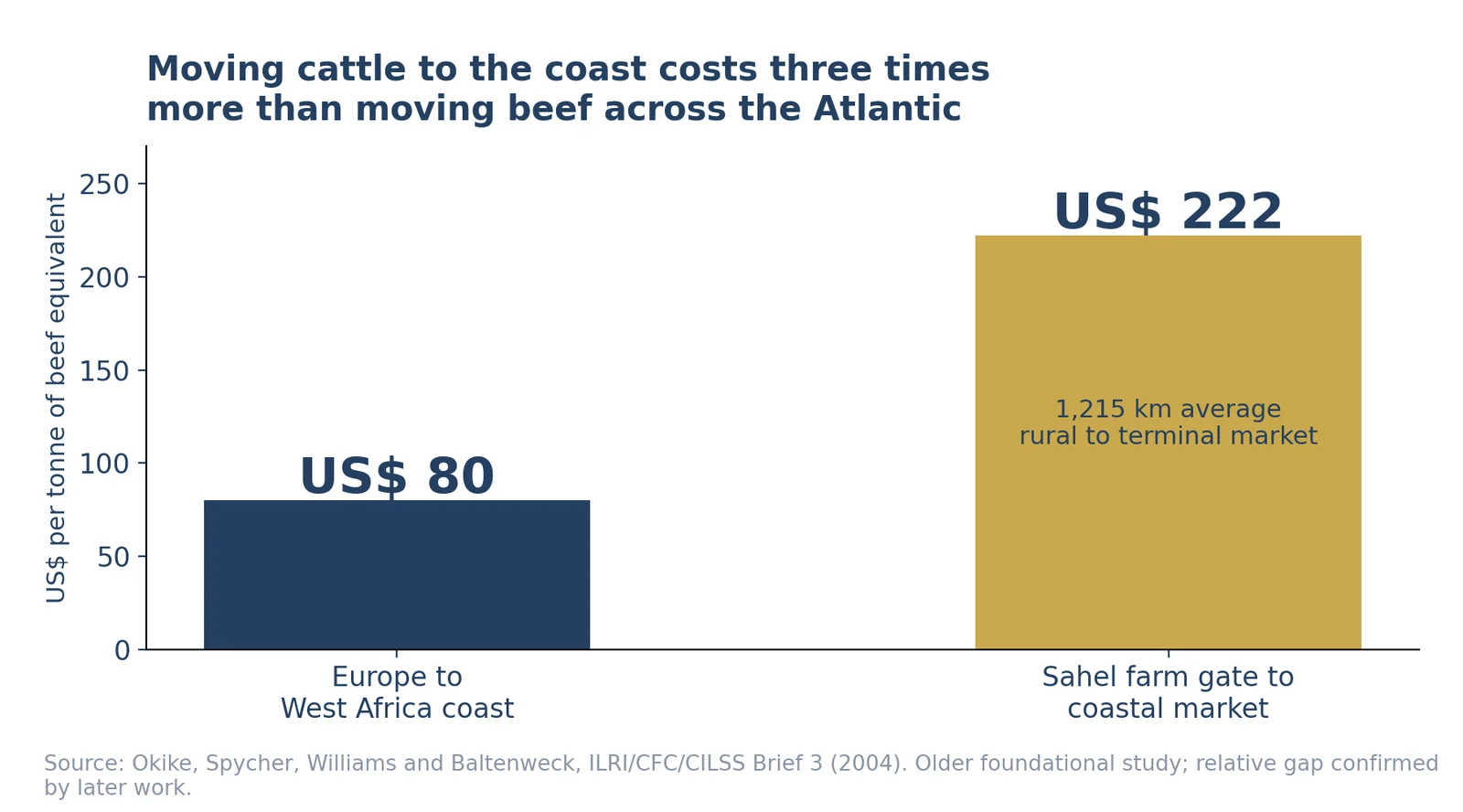
Between a Sahelian farm gate and a coastal terminal market, cattle travel about 1,215 kilometres on average (ILRI, 2004). Moving the beef equivalent of one tonne over that distance costs US$222. Moving the same tonne from Europe to the West African coast costs US$80.

The core argument

Geography gives the Sahel the herd and the coast the market. It does not give the Sahel the margin. Competitiveness is decided between the farm gate and the plate: in transport, paperwork, checkpoints, slaughter capacity and the rules that govern them. Fix the corridor and the herd becomes an economy. Leave it as it is and the market keeps going to imports.

This article follows three questions: what is happening, why it matters, and what leaders should do in the next 12 to 36 months. Figures cover the 15 West African states of ECOWAS as constituted before the 2024 withdrawal announcements.

51%of regional cattle sit in Niger, Mali and Burkina Faso. FAOSTAT, 2024
17%of the regional population lives there. UN WPP, 2024
3xcost of moving cattle to the coast versus beef from Europe. ILRI, 2004

1. The mismatch: half the cattle, one sixth of the people

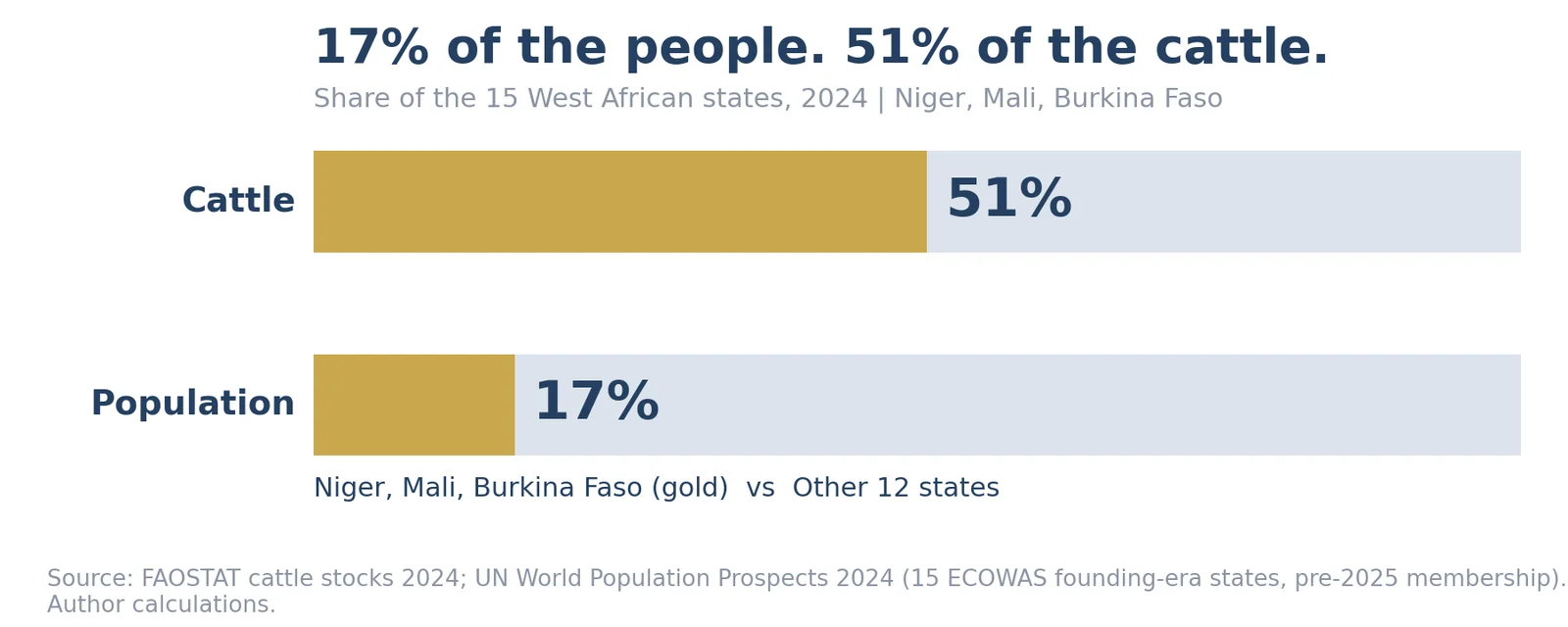
Start with the map, because the map is the whole argument. Niger, Mali and Burkina Faso hold 44.7 million head of cattle, or 51% of the herd of the 15 states, for 17% of their population (FAOSTAT, 2024; UN, 2024; author calculations).

Bar chart: Niger, Mali and Burkina Faso hold 51% of cattle but only 17% of the population of 15 West African states
Figure 1. Half the cattle, one sixth of the people. Source: FAOSTAT 2024; UN WPP 2024; author calculations.

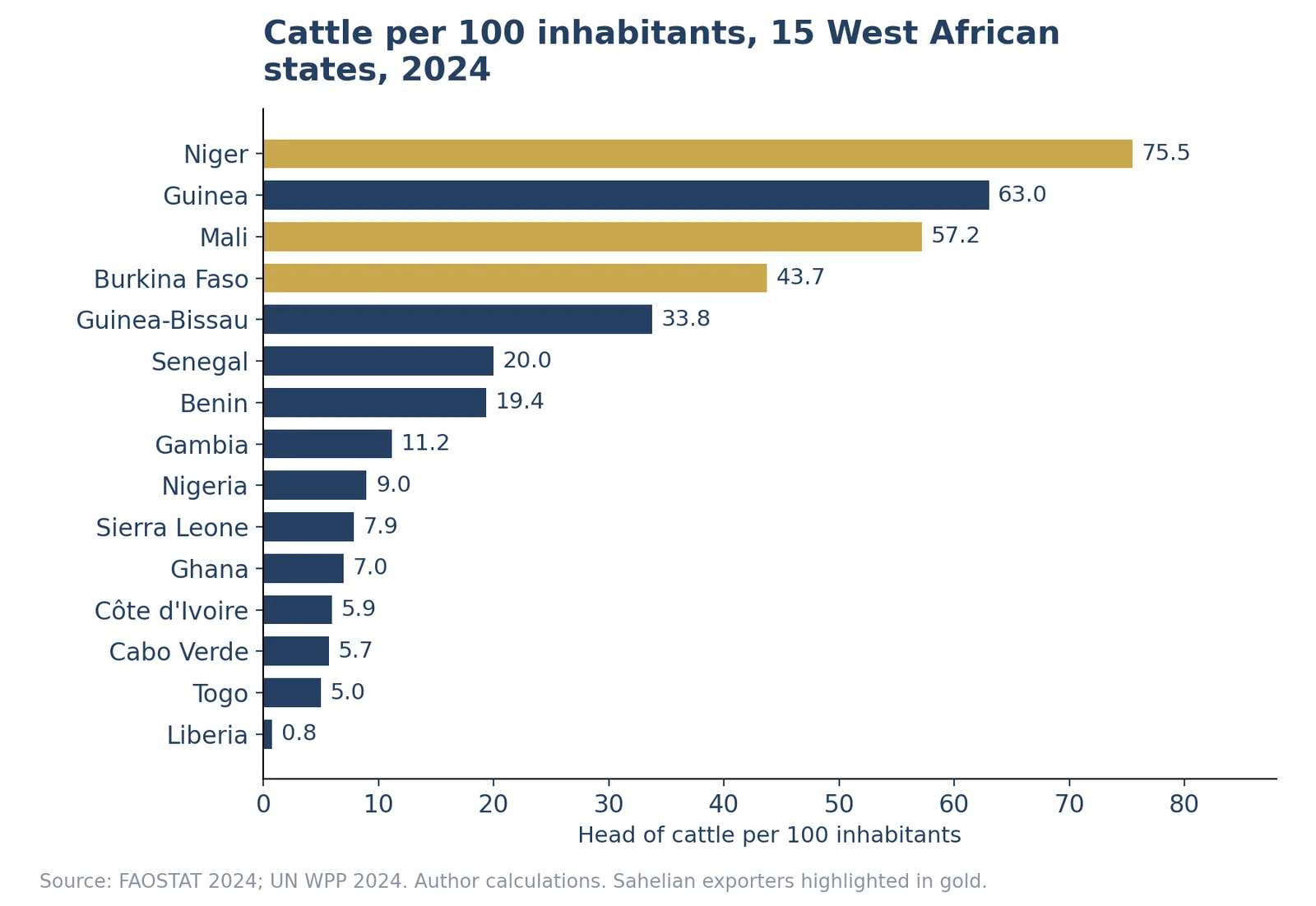
Niger counts 75.5 cattle per 100 inhabitants. Côte d'Ivoire counts 5.9, Ghana 7.0 and Togo 5.0. Nigeria, the region's largest market with 232.7 million people, counts 9.0. Demand sits on the coast; supply sits in the north.

Ranking of 15 West African states by cattle per 100 inhabitants, led by Niger at 75.5, Guinea at 63.0 and Mali at 57.2
Figure 2. Cattle per 100 inhabitants, 2024. Source: FAOSTAT 2024; UN WPP 2024; author calculations.

The trade already exists. Ghana imports an estimated 100,000 cattle a year, with 80% to 90% coming from Burkina Faso (Frontiers in Veterinary Science, 2021).

What is happening

The herd and the consumer are 1,000 kilometres apart, by design of geography.

Why it matters

A natural north to south flow makes coastal markets a strategic outlet for Sahelian producers, not an option.

The strategic implication

Treat the Sahel to coast corridor as one supply chain, with shared standards, shared data and shared targets.

2. The 1,215 kilometre toll: why a live cow costs more to move than beef

Proximity is not a cost advantage. A six-country study by ILRI, CFC and CILSS found that transport and handling make up 40% to 60% of cross-border marketing costs, before the animal is paid for. Cross-border moves cost 129 FCFA per tonne-kilometre, against 54 FCFA inside national borders (ILRI/CFC/CILSS, 2004).

Bar chart comparing US$222 per tonne to move cattle from Sahel to coast versus US$80 for beef from Europe
Figure 3. Moving cattle to the coast costs three times more than shipping beef from Europe. Source: ILRI/CFC/CILSS, 2004.

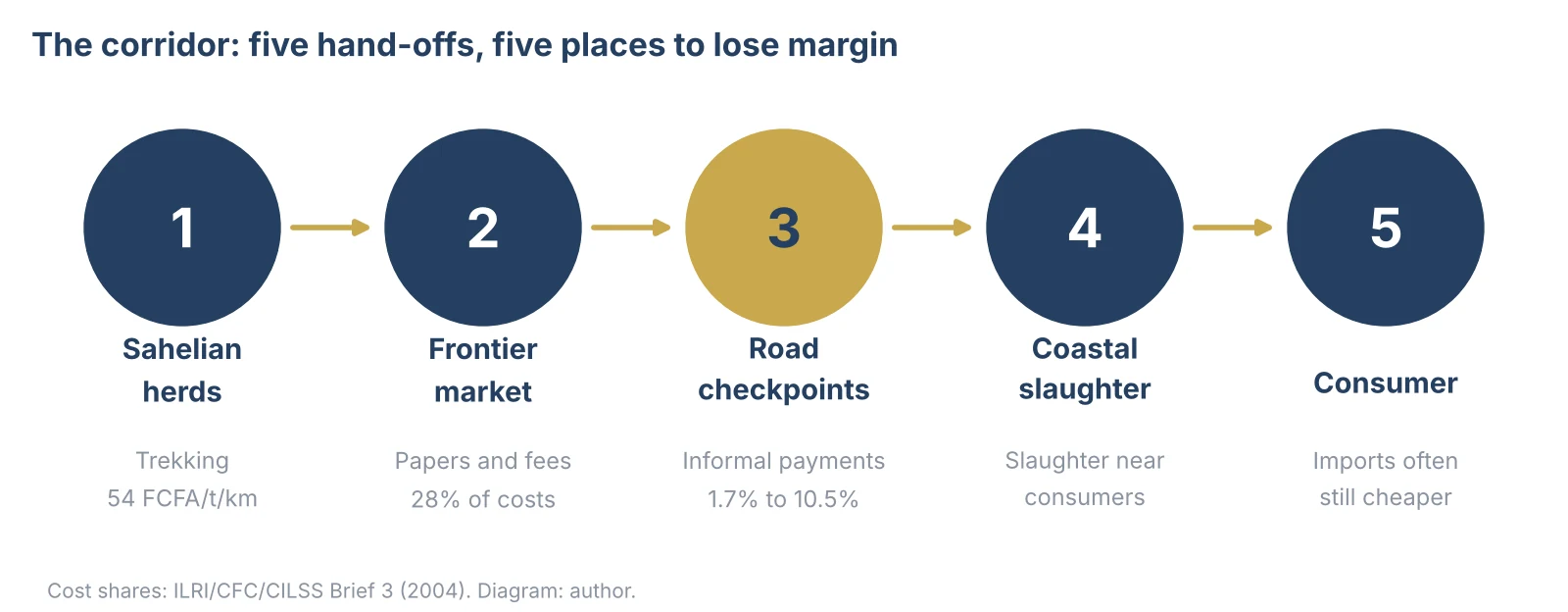
Truck rental is half of cross-border transport and handling costs, driven by truck shortages, fuel taxes of about 36% and poor roads. Live animals add a further burden: drovers' fees of 2,193 FCFA per head, a cost a carcass would never carry.

Diagram of the Sahel to coast corridor in five hand-offs with cost points
Figure 4. The corridor in five hand-offs. Source: ILRI/CFC/CILSS Brief 3 (2004); diagram by the author.
What is happening

Moving a live cow 1,215 km costs US$222 per tonne of beef equivalent, versus US$80 for Europe to coast.

Why it matters

The cost gap erases the advantage of proximity before the animal reaches the market.

The strategic implication

Prioritise truck access, fuel and spare-part taxation, and the shift from live animals to chilled meat.

3. Paper, checkpoints and informal tolls: death by a thousand stops

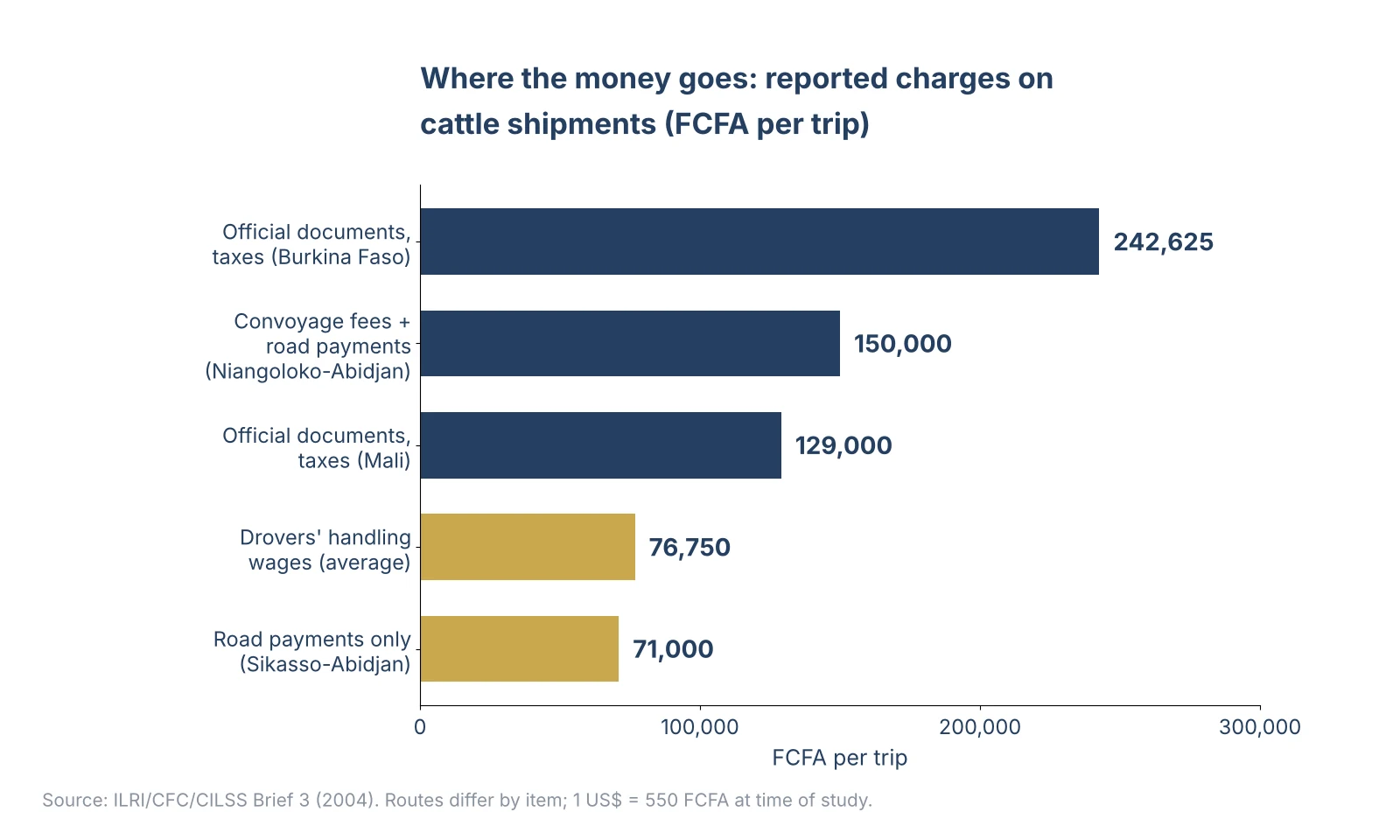
The second leak is administrative. Official documents, duties and taxes represent 28% of cross-border marketing costs. A cattle exporter pays on average 129,000 FCFA in Mali and 242,625 FCFA in Burkina Faso for permits, health certificates and waybills.

Then come the checkpoints. Non-receipted payments range from 12,000 FCFA on the Bittou to Accra route to 71,000 FCFA from Sikasso to Abidjan, or 1.7% to 10.5% of cross-border costs. With conveyance company fees, the total reaches about 150,000 FCFA per trip, the price of hiring a 30-tonne truck from Niangoloko to Abidjan.

Bar chart of reported charges per cattle trip in FCFA, from official documents to road payments
Figure 5. Where the money goes on a cattle shipment. Source: ILRI/CFC/CILSS Brief 3 (2004).

These practices contradict ECOWAS rules on the free movement of goods. The researchers estimate that ending illegal checkpoints, abolishing conveyance fees and halving fuel taxes would save 1,899 to 5,374 FCFA per head, depending on the route.

What is happening

Official fees and informal payments take a double-digit share of cross-border costs on key routes.

Why it matters

Every payment is a tax on the Sahelian producer that imported meat does not pay.

The strategic implication

Enforce free-movement rules and publish a corridor scorecard of checkpoints, delays and charges.

4. The invisible market: what the statistics do not see

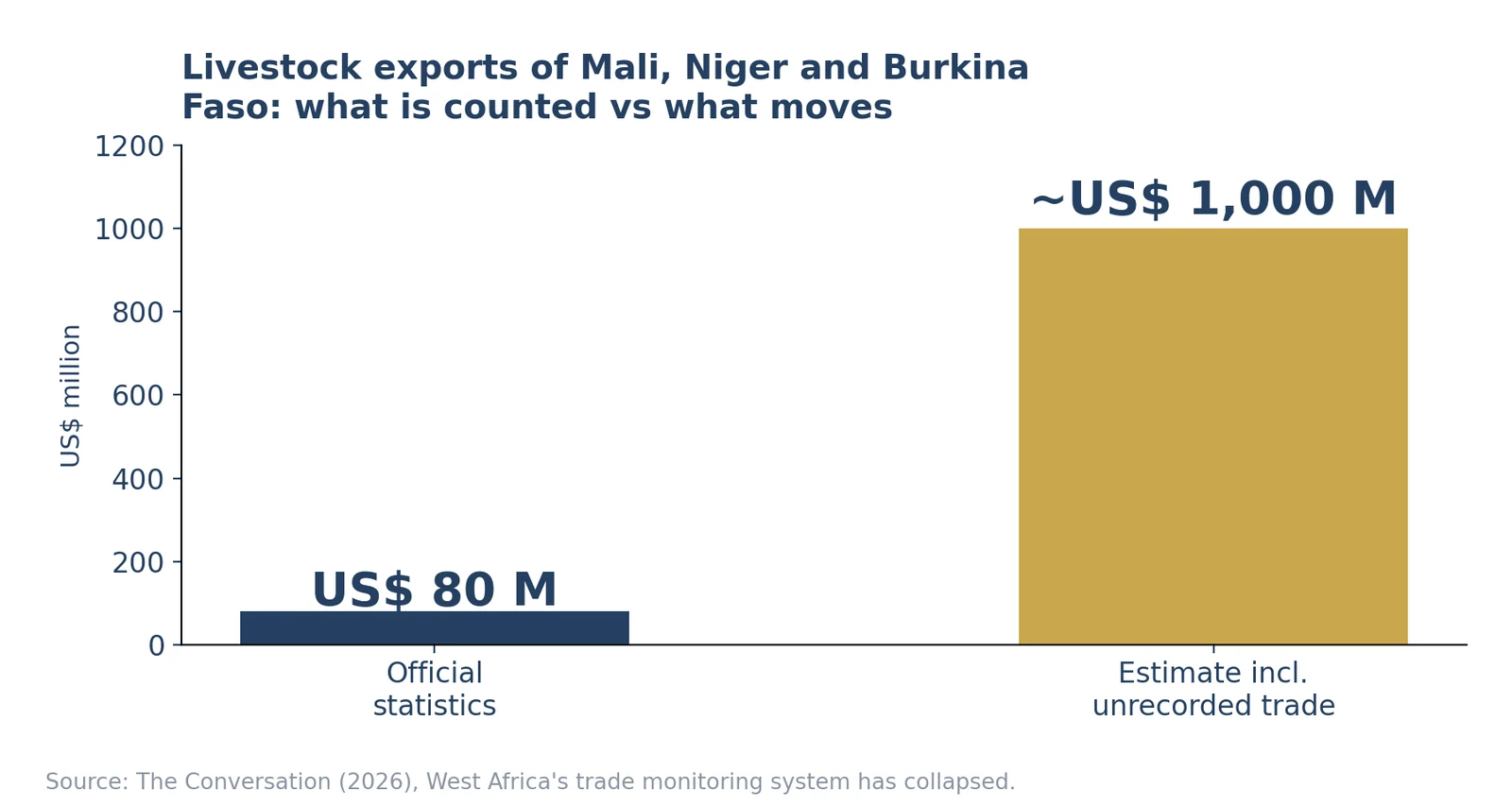
Official statistics capture a fraction of this economy. Recent work estimates informal activity at up to 85% of total trade in the flows studied, about US$10 billion, six times what official figures show. For Mali, Niger and Burkina Faso, livestock exports are close to US$1 billion once unrecorded trade is counted, against US$80 million in official data (The Conversation, 2026).

Bar chart: official livestock exports of Mali, Niger and Burkina Faso at US$80 million versus about US$1 billion including unrecorded trade
Figure 6. What is counted versus what moves. Source: The Conversation, 2026.

Livestock production involves at least 20 million people across West Africa, yet regional livestock trade remains largely unrecorded (PLOS ONE, 2020).

What is happening

Most livestock trade is informal and unmeasured.

Why it matters

Policy designed on official data misjudges the size of the opportunity and the cost of the barriers.

The strategic implication

Rebuild a joint monitoring system that captures formal and informal flows, border markets included.

5. The imported plate: how the coast learned to eat elsewhere

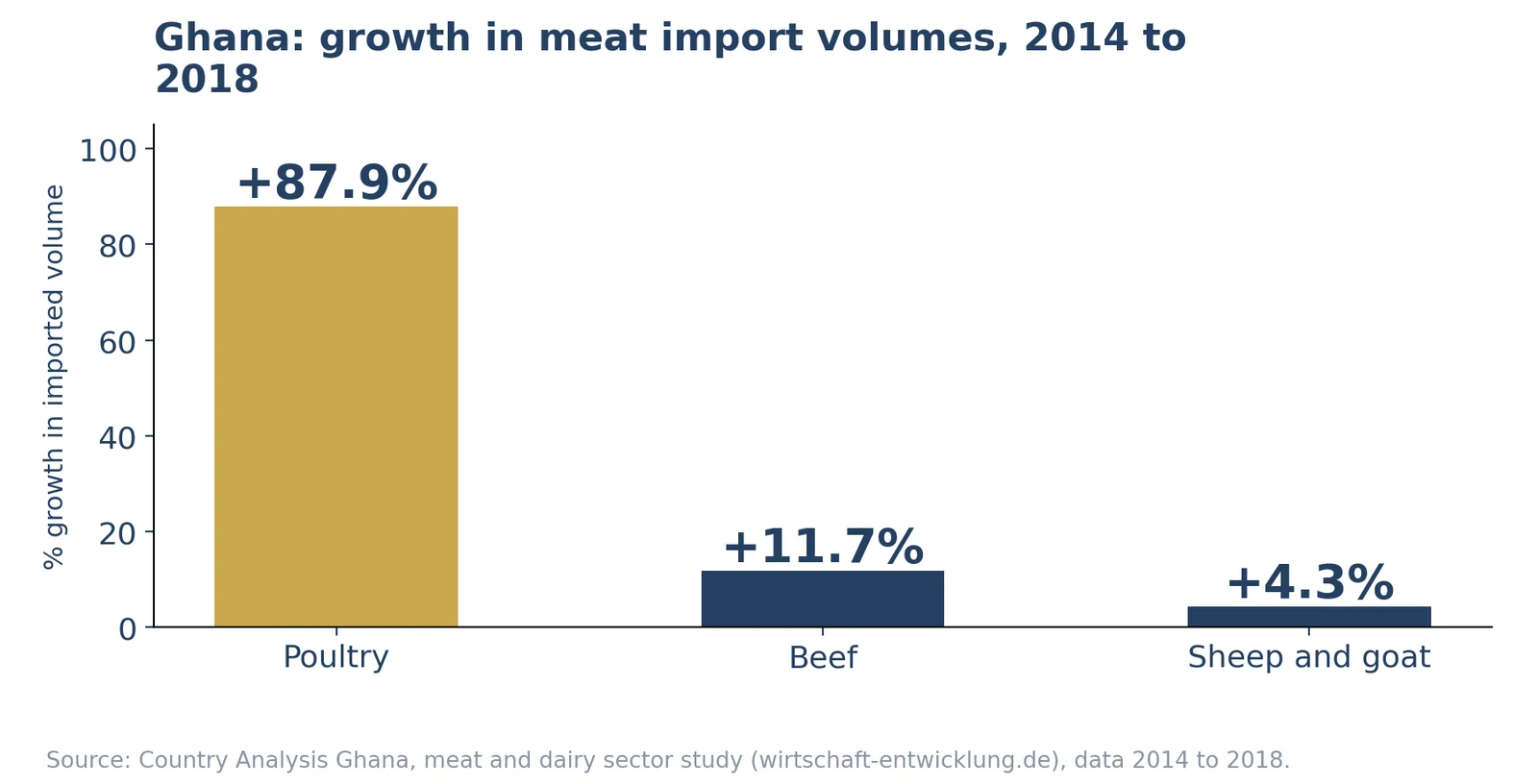
Meanwhile, the coastal plate is changing. In Ghana, imported poultry volumes rose 87.9% between 2014 and 2018, beef imports 11.7% and sheep and goat meat 4.3%, while total meat consumption grew 42.3%, from about 288,300 to 410,200 tonnes (Country Analysis Ghana, wirtschaft-entwicklung.de).

Bar chart of Ghana meat import growth 2014 to 2018: poultry 87.9%, beef 11.7%, sheep and goat 4.3%
Figure 7. Ghana's meat import volumes, 2014 to 2018. Source: Country Analysis Ghana, wirtschaft-entwicklung.de.

The ECOWAS common external tariff already applies a 35% duty to sensitive goods, including meat (same source). Yet a 2021 study found Burkinabe beef offals competitive against Ghanaian offals but still dearer than third-country imports, and most exports still travel as live animals (Frontiers in Veterinary Science, 2021).

A new layer of risk has appeared. Niger, Mali and Burkina Faso announced their withdrawal from ECOWAS on 28 January 2024 (USDA FAS, 2026). The corridor now crosses a political line that did not exist when most trade rules were written.

What is happening

Imports are capturing the growth in coastal meat demand.

Why it matters

Tariffs alone have not protected regional supply; cost and quality at the plate decide.

The strategic implication

Secure bilateral and regional corridor agreements that survive political change, and invest in chilled meat.

The roadmap: three horizons to turn herds into regional value

The strategic issue is not production. It is execution of the corridor. A phased plan can start without waiting for perfect data.

Horizon 1 (0 to 12 months): diagnosis and blueprintLaunch a joint Sahel to coast livestock observatory covering formal and informal flows. Audit checkpoints on three pilot corridors (Bittou to Accra, Niangoloko to Abidjan, Sikasso to Abidjan). Publish a cost per head baseline.Lead actors: ECOWAS Commission, WAEMU, customs and veterinary services, national statistics officesProposed KPI: Baseline published; checkpoints and hours lost mapped per corridor
Horizon 2 (12 to 24 months): pilot and proofSingle livestock waybill and mutual recognition of health certificates. End non-receipted payments on pilots. Tax relief on livestock trucks, fuel and spare parts. First export-grade abattoirs and cold-chain hubs on the Sahelian side with private operators.Lead actors: Finance and transport ministries, private operators, development banksProposed KPI: Cost per head down by one third versus baseline; zero non-receipted payments on pilots
Horizon 3 (24 to 36 months): scale and transferExtend to all major corridors. Adopt a regional sanitary standard for meat. Shift the trade mix from live animals to chilled and frozen meat. Blended finance for cold chain. Annual public scorecard.Lead actors: ECOWAS, AU, AES states, DFIs, investorsProposed KPI: Share of meat in cross-border flows; Sahelian share of coastal beef supply

Targets in the KPI column are the author's proposals for discussion, not forecasts from the cited sources. The cost structure in the ILRI study dates from 2004 and should be refreshed in Horizon 1.

The verdict

The Sahelian paradox is not a paradox of resources. It is a paradox of design. The corridor was built for animals on foot and traders carrying cash, not for a regional protein industry.

For African decision-makers, this creates a clear choice: treat the corridor as shared infrastructure for competitiveness, or keep exporting herds and importing the margin.

“The real question for leaders is not how many cattle the Sahel has. It is how many hand-offs, hours and payments stand between those cattle and a coastal plate.”

The Monday morning test: five questions for decision-makers

1
Do we know the real cost per head from farm gate to coastal market, formal and informal charges included?
2
How many checkpoints and non-receipted payments does a livestock truck face on our corridors?
3
What share of our livestock exports leaves as meat rather than as live animals?
4
Does our corridor agreement survive the current political realignment between the Sahel and the coast?
5
Who owns the corridor scorecard, and when is it published?
NovaHub Consulting

Where NovaHub fits

NovaHub Consulting advises governments, regional bodies, development banks and private operators on cross-border trade corridors, livestock and agri-food value chains, trade facilitation and the design of corridor observatories and public scorecards across ECOWAS and the African Union.

Book a conversation
Komlan Messie
About the author

Komlan Messie, MBA, Polytechnician

A career built at the intersection of business, diplomacy and civic leadership.

Komlan Messie, MBA, is an international executive, entrepreneur and strategic advisor with more than two decades of experience across management, technology, institutional development, strategic transformation and international development. His work focuses on helping organisations, institutions and leaders navigate transformation, innovation, public policy and complex strategic challenges.

Mr. Messie is the founder and Chief Executive Officer of NovaHub Consulting and the Regional Executive Director of WACSOF-FOSCAO, the West African civil society network spanning ECOWAS member states. He is also the cofounder and chairman of the Réseau des Entrepreneurs et Professionnels Africains (REPAF) and the chairman of the Forum Afrique Expansion Canada, and he co-founded Aliments Frunil in Canada. He is a former Vice President of the Project Management Institute Montreal (PMI Montreal) in Canada.

He holds an MBA from HEC Montréal, an M.Sc. in Computer Science and Operations Research from École Polytechnique de Montréal, and a B.Eng. in Electrical Engineering from École Polytechnique de Thiès (Senegal), and is PRINCE2 certified. He works across Canada, Africa and especially the ECOWAS region in French, English, Ewe and Wolof.

Continue the conversation with Komlan Messie
View full profile →
Download this article

Read offline or share with your team, including all charts and figures.

Sources and references

1.  Okike, I., Spycher, B., Williams, T. O., & Baltenweck, I. (2004). Lowering cross-border livestock transportation and handling costs in West Africa (West Africa Livestock Marketing: Brief 3). ILRI/CFC/CILSS. https://cgspace.cgiar.org/server/api/core/bitstreams/7dbfb4d7-8ff1-43d2-8376-c770d3baf3b4/content

2.  FAO, FAOSTAT. (2024 data, accessed October 2026 via Africa API). Cattle Stock by African country. https://africa-api.com/indicators/cattle

3.  United Nations, Department of Economic and Social Affairs. (2024). World Population Prospects 2024 (country figures as compiled by Worldometers). https://srv1.worldometers.info/population/countries-in-africa-by-population

4.  The Conversation. (2026). West Africa's trade monitoring system has collapsed: why this is dangerous for food security. https://theconversation.com/west-africas-trade-monitoring-system-has-collapsed-why-this-is-dangerous-for-food-security-266405

5.  Frontiers in Veterinary Science. (2021). The Competitiveness of Beef Exports From Burkina Faso to Ghana. https://www.frontiersin.org/journals/veterinary-science/articles/10.3389/fvets.2021.619044/full

6.  PLOS ONE. (2020). Network analysis of regional livestock trade in West Africa. https://www.ncbi.nlm.nih.gov/pmc/articles/PMC7224501/

7.  Country Analysis Ghana (meat and dairy sector study, data 2014 to 2018). wirtschaft-entwicklung.de. https://wirtschaft-entwicklung.de/fileadmin/user_upload/Downloads/Studie_Milch-_und_Fleischwirtschaft/Ghana_country_analysis.en.PDF

8.  USDA Foreign Agricultural Service. (2026). Exporter Guide Annual 2026, Ghana (GAIN report GH2026-0023). https://apps.fas.usda.gov/newgainapi/api/Report/DownloadReportByFileName?fileName=Exporter+Guide+Annual_Accra_Ghana_GH2026-0023.pdf

Data notes: the 15 states are Benin, Burkina Faso, Cabo Verde, Côte d'Ivoire, Gambia, Ghana, Guinea, Guinea-Bissau, Liberia, Mali, Niger, Nigeria, Senegal, Sierra Leone and Togo. Mauritania and Chad, also major Sahelian herds, are outside this perimeter. Cattle per 100 inhabitants are author calculations from FAOSTAT 2024 and UN 2024 figures. The ILRI/CFC/CILSS cost study dates from 2004 and is used as a foundational source.

← Back to Blog & Opinions
Newsletter

Get the analysis before the decision is made.

Subscribe for new insights, policy briefs and event updates. No noise, unsubscribe at any time.

Download the full paper

Enter your details to receive the secure download link. You will also be added to our newsletter list.

ENGAGE NOVAHUB