Senegal, Togo, Canada and across Africa
@gonovahub
Blog & Opinions

The World Has Been Rating Africa. Now Africa Will Rate Itself.

Why the African Credit Rating Agency is a bet on better information, not better optics.

Komlan Messie, MBA, Polytechnician, CEO of NovaHub Consulting • Port Louis, 7 October 2026 • 9 min read

Navy banner reading The World Has Been Rating Africa. Now Africa Will Rate Itself.
The rating is the instrument. Capital mobilisation is the objective.

On 7 October 2026, in Port Louis, Mauritius, the African Union formally launches the African Credit Rating Agency (AfCRA), headquartered in Mauritius.1 The launch follows the 2nd African Annual Conference on Credit Ratings, held in Mauritius on 5 and 6 October.2 The ceremony will make headlines. The consequential story begins the next morning. For decades, African borrowers have been judged largely by institutions headquartered elsewhere, and the cost of that judgment shows up in coupons and in the investors who never open the file. Yet Africa is not one risk category. It is more than fifty economies with different fiscal positions, monetary regimes and capital-market ambitions. The real question for leaders is not whether a new agency will be friendlier. It is whether Africa can build the analytical capacity to describe itself accurately.

The core argument

AfCRA matters less as a ratings brand than as financial infrastructure. Its value will rest on three things: independence from the governments it rates, methodological rigor that survives scrutiny, and data that investors can trust. If it delivers, Africa gains better price discovery. If it does not, it becomes one more opinion that markets politely ignore.

11.6%Average African interest cost, 8.5 points above the US benchmark. UNDP, 2026
69.6%Kenya's debt service to revenue in July 2024, against an IMF threshold of 30%. APRM and UNECA, 2025
US$14bn+Raised by nine African sovereigns through ten bond deals in 2026H1. APRM and UNECA, 2026

1. The price of not being seen

What is happening

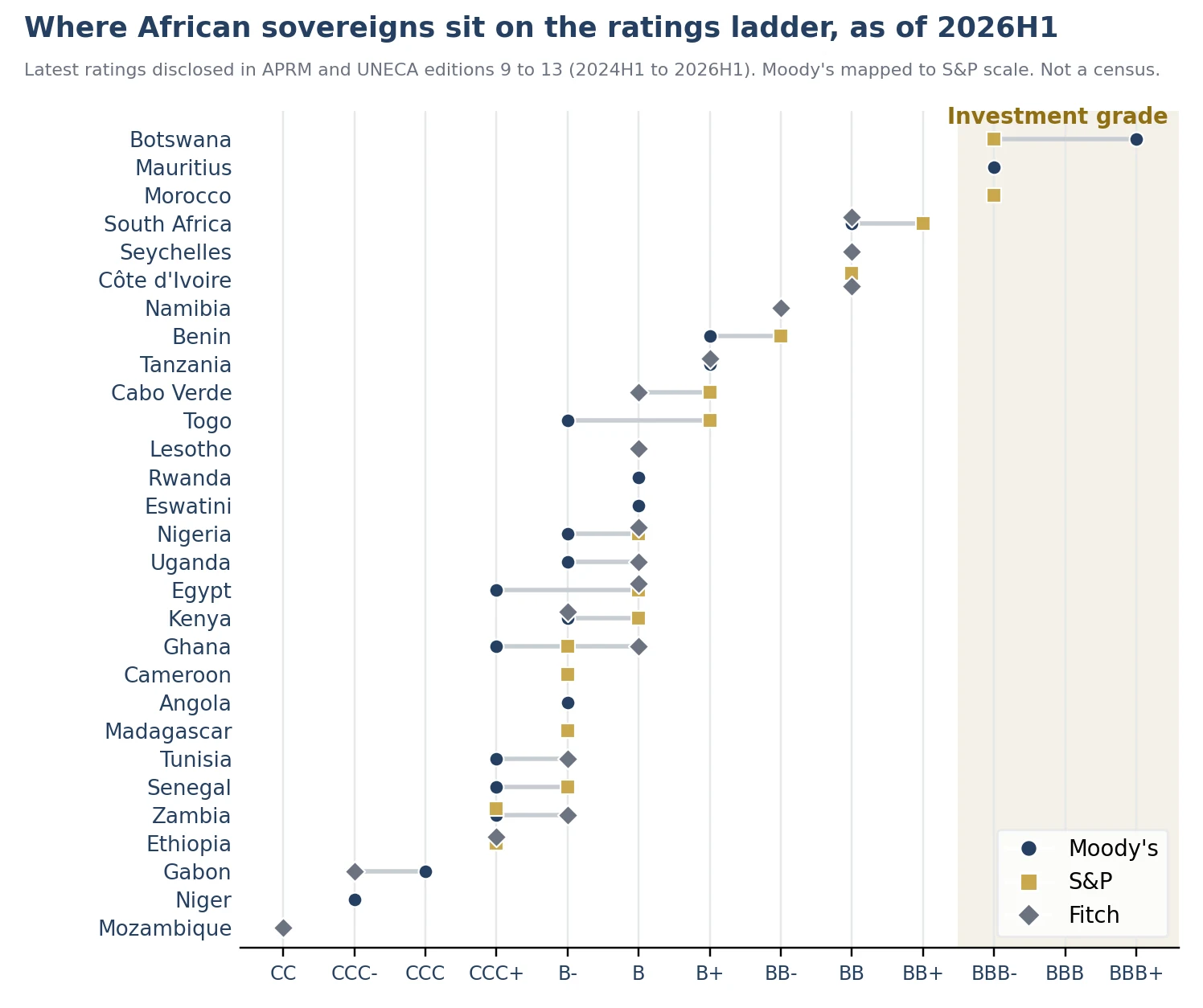
Roughly 32 to 33 African countries hold a sovereign rating from the big three, according to the AU and APRM briefing and press reports.3,4 In the latest APRM and UNECA tables, only Botswana, Mauritius and Morocco hold an investment-grade rating from at least one agency.5,2 African interest costs have averaged 11.6%, which is 8.5 percentage points above the US benchmark.6

Why it matters

Limited information produces higher uncertainty, a narrower investor base and, potentially, higher financing costs. Eurobonds show the stakes: Cameroon paid a 10.75% coupon in 2024, against 5.95% in 2021.5

Dot chart placing African sovereigns on the credit ratings ladder as of 2026H1 by Moody's, S&P and Fitch
Figure 1. Latest big-three ratings disclosed in APRM and UNECA editions 9 to 13, as of 2026H1. Moody's mapped to the S&P scale. Source: APRM and UNECA (2024 to 2026).
The strategic implication

Coverage is a market-access issue, not a prestige issue. Rating more issuers, in local currency and below the sovereign level, widens the set of investors able to participate.

2. Ratings are turning. Opinions still diverge.

What is happening

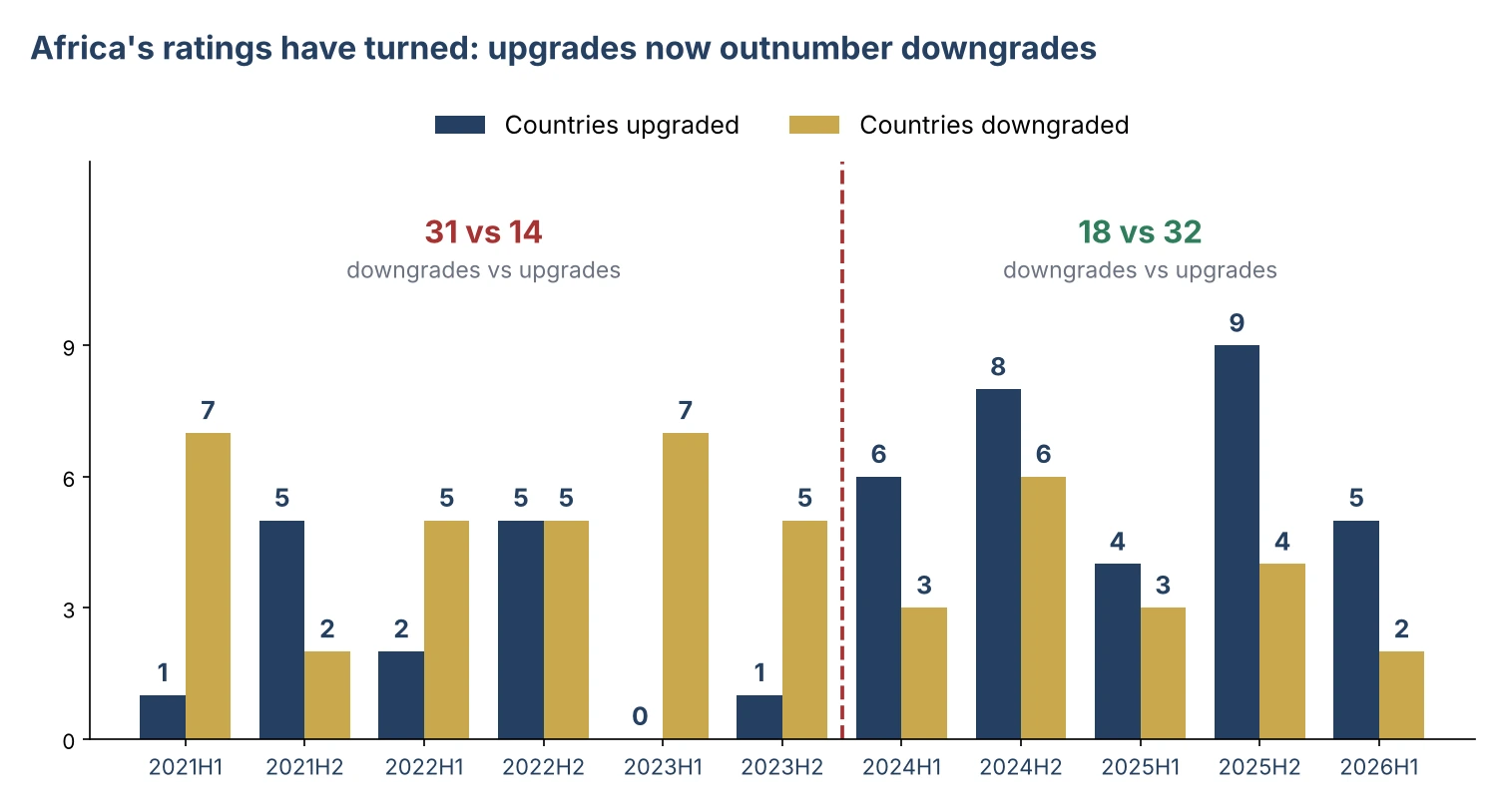
Between 2021H1 and 2023H2, 31 countries were downgraded against 14 upgraded. Since 2024H1, upgrades have outnumbered downgrades in every half-year, 32 to 18 (author's count).7,5,2 Yet opinions diverge. In 2025H2, S&P upgraded South Africa to BB+ while Moody's kept Ba2. Fitch cut Afreximbank to BBB- on a 7.1% non-performing loan estimate, against 2.44% reported by the bank, while JCR, GCR and CCXI kept A-category ratings.2

Why it matters

Divergence is not proof of bias. Moody's argues that, at a given rating level, default probabilities for African and other sovereigns align.8 But divergence shows that ratings are opinions, and opinions depend on information, timing and method. In 2024, Moody's downgraded Kenya on 8 July while S&P waited for its scheduled review on 23 August.5 Senegal raised US$5.3 billion on the WAEMU regional market, every issuance oversubscribed, and was still downgraded.2

Bar chart of African countries upgraded and downgraded per half-year from 2021H1 to 2026H1
Figure 2. Countries upgraded and downgraded by at least one big-three agency, per half-year. Counts of countries, not agency actions; conventions vary slightly across editions. Source: APRM and UNECA, editions 3 to 13 (2021 to 2026); author's compilation.
The strategic implication

The sovereign ceiling compounds the issue: S&P upgraded eight South African banks only after it raised the sovereign.2 Banks and corporates will be judged on their own merits only if credible, locally informed opinions exist alongside the global ones.

3. Borrowing costs are the scoreboard

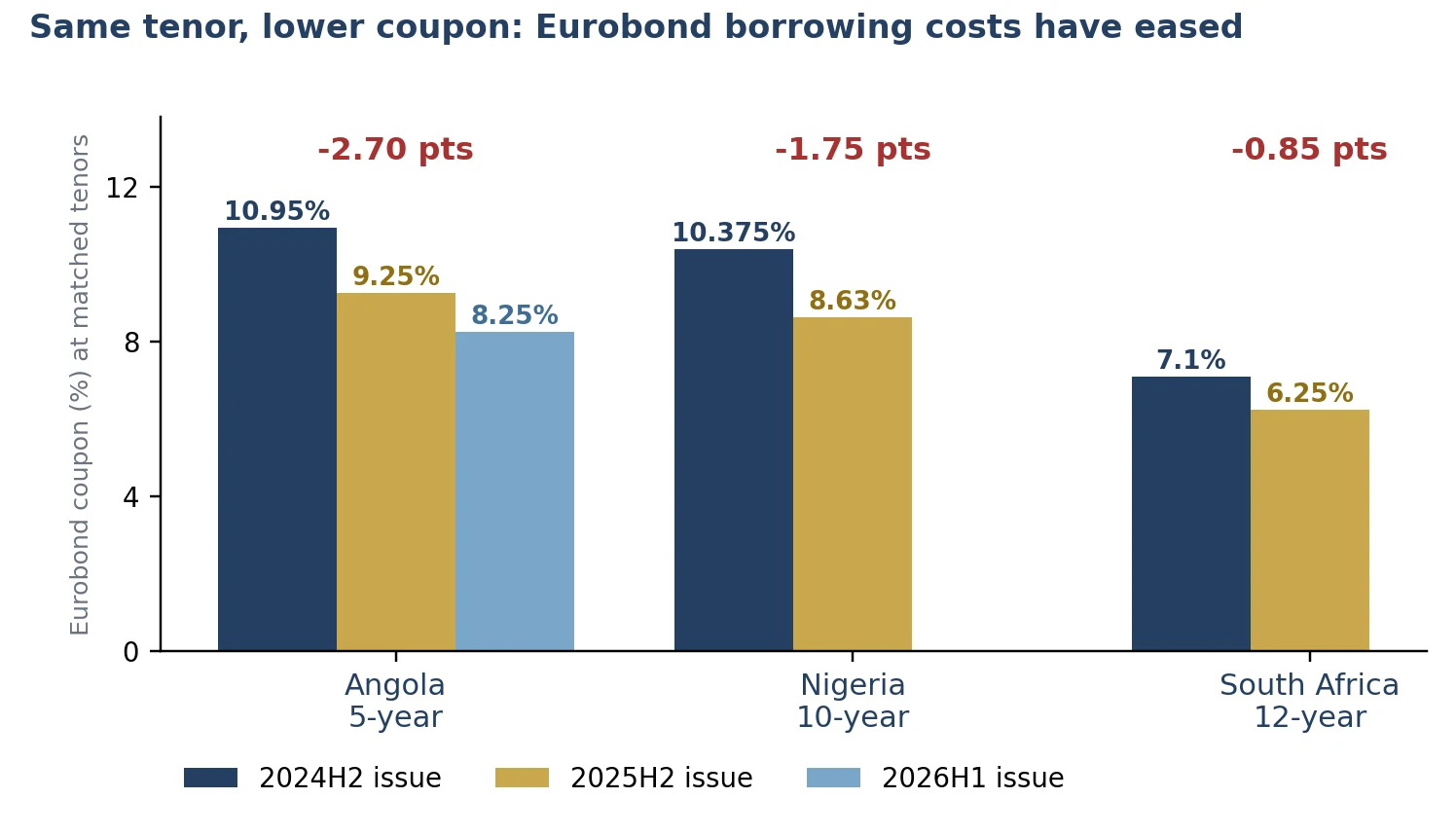
The debate should not stop at the rating AfCRA assigns to a country. The better question is whether better African credit intelligence can contribute to more efficient capital allocation. Eurobond coupons offer the clearest scoreboard available today.

Bar chart of matched-tenor Eurobond coupons for Angola, Nigeria and South Africa
Figure 3. Matched-tenor Eurobond coupons. Falling coupons coincide with rating upgrades and improved markets; this chart does not establish causation. Source: APRM and UNECA, editions 10, 12 and 13 (2025 to 2026).
  • In 2026H1, coupons ran from 4.75% on Morocco's 8-year euro bond to 9.80% on Angola's 11-year dollar bond, a five-point spread that shows Africa is not one risk category.2
  • The APRM and UNECA authors urge governments to treat oversubscription as a bargaining chip for lower rates and longer tenors, not as a victory.5,2
  • Most 2026H1 issuance again served budget financing, refinancing and liability management rather than growth investment.2
  • The UNDP argues that accurate ratings could unlock US$31 billion in extra finance and US$14.2 billion in interest savings, an advocacy estimate that remains contested.9

The implication is clear: judge AfCRA by what follows the rating. Broader investor participation, deeper local-currency markets and narrower spreads are the measures that matter.

4. Independence is the product

What is happening

AfCRA is designed as a private-sector-led agency that will not be owned by African governments, with a primary focus on local-currency ratings.1,10 The launch was first scheduled for September 2025.1 The competition is not standing still: Moody's has expanded in Africa through GCR Ratings, WARA and MERIS.11

Why it matters

African ownership must never become political ownership of analytical conclusions. APRM's lead expert has rejected the idea that AfCRA exists to give Africa favourable ratings.12 Sceptics ask whether it risks Africa “marking its own homework”.8 Both points are fair, and only a track record answers them.

The strategic implication

AfCRA can learn from incumbents' failures as well as their strengths. In 2024, the US SEC charged six agencies, including Moody's, S&P and Fitch, over record-keeping failures, with combined penalties of US$48 million.5 Publish methodologies, rating calendars and conflict-of-interest rules from day one.

Five tests after the ceremony

TestThe questionWhat markets will watch
01 IndependenceCan ratings stay free of political expectation?Ownership structure, committee rules, disclosed conflicts policy
02 MethodologyCan African specificity avoid becoming leniency?Published criteria, back-testing, default and transition studies
03 DataCan it source reliable, timely, comparable data?Data partnerships with central banks and statistical offices
04 Investor confidenceWill investors and regulators actually use it?Recognition in investment guidelines, international uptake
05 Access to capitalDoes it expand financing?Local-currency issuance, spreads, first-time rated issuers

Indicators to watch are the author's framework, not agency commitments.

5. West Africa on the radar

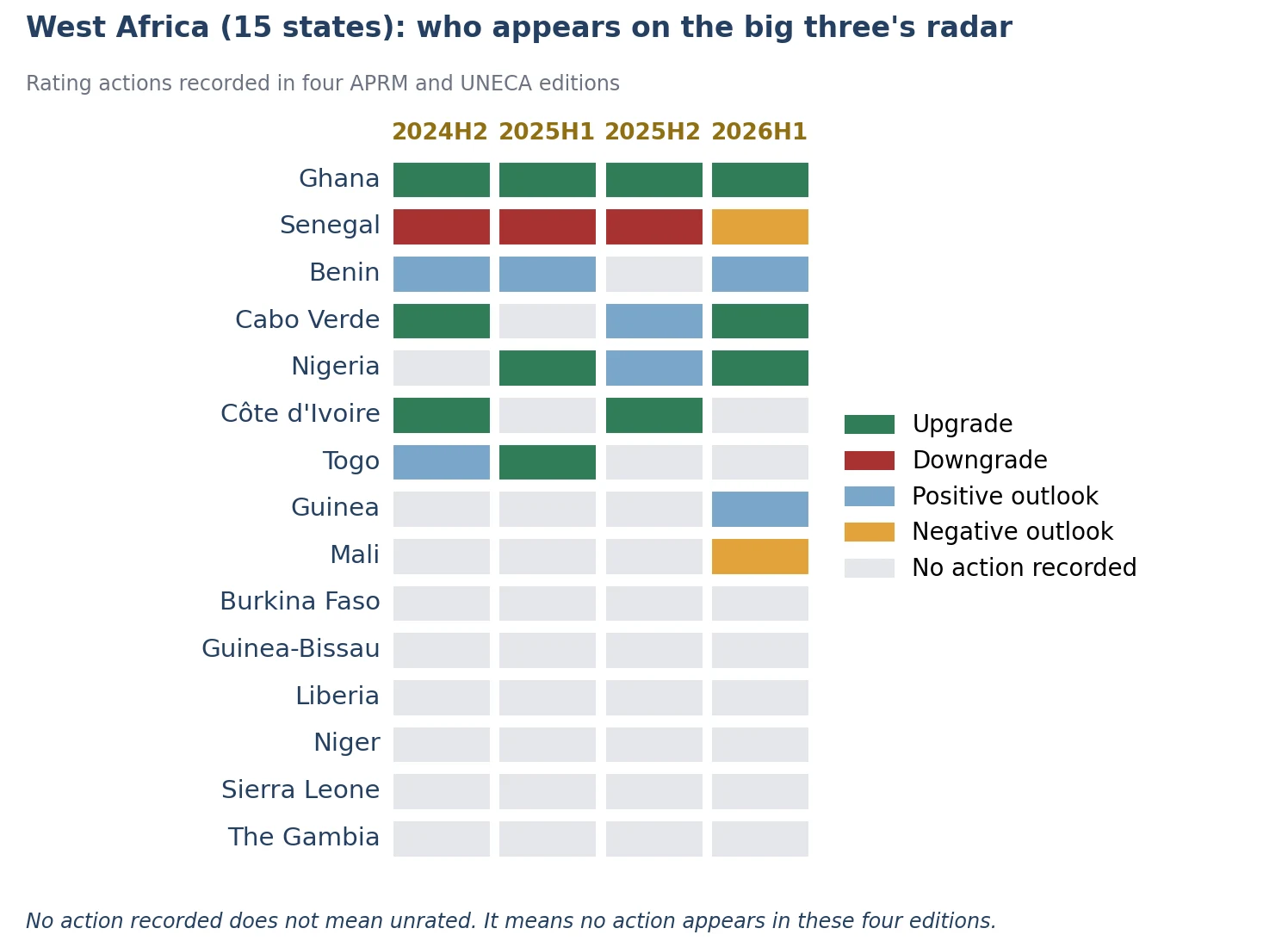
For the 15 states of West Africa, the picture is uneven. Across the four latest editions (2024H2 to 2026H1), nine recorded at least one big-three action: Benin, Cabo Verde, Côte d'Ivoire, Ghana, Guinea, Mali, Nigeria, Senegal and Togo. Six recorded none: Burkina Faso, The Gambia, Guinea-Bissau, Liberia, Niger and Sierra Leone.5,2 No action is not the same as no rating, but it signals thin analytical attention. The trajectories that do appear are sharp:

Matrix of big-three rating actions for 15 West African states, 2024H2 to 2026H1
Figure 4. Big-three rating actions for the 15 West African states, 2024H2 to 2026H1. Each cell shows the main action in that half-year. Source: APRM and UNECA, editions 10 to 13 (2025 to 2026); author's compilation.
  • Ghana: upgraded in each of the four half-years, with S&P moving from selective default to CCC+ in 2025H1, then to B- in 2025H2, and Fitch reaching B in 2026H1.
  • Nigeria: all three agencies moved up within a year, ending with S&P's upgrade from B- to B in 2026H1.
  • Côte d'Ivoire: S&P lifted it to BB in 2024H2 and Fitch followed in 2025H2. It then issued a 15-year Eurobond at 5.39%, 4.8 times oversubscribed.2
  • Senegal: Moody's cut it from Ba3 to Caa1 across 2024H2, 2025H1 and 2025H2, four notches, and S&P moved to CC on 17 September 2026.5,2,6

For ECOWAS and WAEMU decision-makers, AfCRA is a chance to close coverage gaps for regional issuers, especially in local-currency markets.2

The next 36 months: three horizons

A sequence that moves from credibility, to coverage and data, to integration into the capital market.

Horizon 1 (0 to 12 months): credibility foundationPublish criteria and a rating calendar. Adopt conflict-of-interest and record-keeping rules. Deliver the first local-currency ratings.
Horizon 2 (12 to 24 months): coverage and dataExtend to banks, corporates and municipalities. Formalise data sharing with central banks and statistical offices. Publish the first performance studies.
Horizon 3 (24 to 36 months): market integrationPursue recognition in pension and bank frameworks. Support pension funds and development finance institutions in local-currency allocation. Benchmark continuously against global agencies.

What leaders should do now

GovernmentsImprove debt disclosure and data transparency, and engage every agency, global and African, on equal terms.
RegulatorsDefine clear criteria for recognising new rating agencies in investment and capital rules.
InvestorsPilot AfCRA opinions alongside incumbents, not instead of them, and publish what you learn.

The bigger question

The most important question from Port Louis is not “Will Africa's rating be higher?” It is “Will Africa have greater capacity to understand, measure, communicate and finance its own economic potential?” The opportunity is not to replace global institutions. It is to add African analytical depth to the global financial conversation. Vision delivered. Promise honoured. Now comes the harder part: building trust.

“The objective is not a better story. It is better information, better price discovery and, ultimately, better financing for Africa's transformation.”

NovaHub Consulting

Where NovaHub fits

NovaHub Consulting advises governments, regulators, investors and development partners on sovereign debt transparency, credit-information systems, capital-market readiness and the institutional design of new financial infrastructure across ECOWAS and the African Union.

Book a conversation
Komlan Messie
About the author

Komlan Messie, MBA, Polytechnician

A career built at the intersection of business, diplomacy and civic leadership.

Komlan Messie, MBA, is an international executive, entrepreneur and strategic advisor with more than two decades of experience across management, technology, institutional development, strategic transformation and international development. His work focuses on helping organisations, institutions and leaders navigate transformation, innovation, public policy and complex strategic challenges.

Mr. Messie is the founder and Chief Executive Officer of NovaHub Consulting and the Regional Executive Director of WACSOF-FOSCAO, the West African civil society network spanning ECOWAS member states. He is also the cofounder and chairman of the Réseau des Entrepreneurs et Professionnels Africains (REPAF) and the chairman of the Forum Afrique Expansion Canada, and he co-founded Aliments Frunil in Canada. He is a former Vice President of the Project Management Institute Montreal (PMI Montreal) in Canada.

He holds an MBA from HEC Montréal, an M.Sc. in Computer Science and Operations Research from École Polytechnique de Montréal, and a B.Eng. in Electrical Engineering from École Polytechnique de Thiès (Senegal), and is PRINCE2 certified. He works across Canada, Africa and especially the ECOWAS region in French, English, Ewe and Wolof.

Continue the conversation with Komlan Messie
View full profile →

Download this article

Read offline or share with your team, including all charts and figures.

Sources

1.  Nairametrics (2026, 2 September), AU to launch African Credit Rating Agency on October 7, nairametrics.com/2026/09/02/au-to-launch-african-credit-rating-agency-on-october-7/.

2.  APRM and UNECA (2026), Africa Sovereign Credit Rating Review, 12th edition, 2025 End-Year Outlook, aprm.au.int/sites/default/files/files/2026-02/africa-sovereign-credit-rating-outlookend-year-2025.pdf; and 13th edition, 2026 Mid-Year Outlook, aprm.au.int.

3.  African Union and APRM (n.d.), Africa Credit Rating Agency (AfCRA) brief, au.int/sites/default/files/documents/44466-doc-Brief_-_Africa_Credit_Rating_Agency_AfCRA.pdf.

4.  The EastAfrican (n.d.), Africa is banking on own credit rating agency for better debt conditions, theeastafrican.co.ke/tea/business-tech/africa-is-banking-on-own-credit-rating-agency-for-better-debt-5351376.

5.  APRM and UNECA (2025), Africa Sovereign Credit Rating Outlook, 10th edition, 2024 Year-End Review, aprm.au.int/sites/default/files/files/2025-02/10th-edition-csr-eng.pdf; and 11th edition, 2025 Mid-Year Outlook, aprm.au.int.

6.  UNDP (2026), Africa Credit Ratings Resource Platform (accessed 6 October 2026), undp.org/africa/credit-ratings-resource-platform.

7.  APRM and UNECA (2021 to 2024), Africa Sovereign Credit Rating Review, editions 3 to 9 (2021H1 to 2024H1), aprm.au.int.

8.  Institute for Security Studies, ISS Africa (2026), Can an African credit rating agency overcome investor scepticism?, issafrica.org/iss-today/can-an-african-credit-rating-agency-overcome-investor-scepticism.

9.  IPS (2025, 6 May), A premium is what Africa pays for poor credit perception, ipsnews.net/2025/05/a-premium-is-what-africa-pays-for-poor-credit-perception/.

10.  Guardian Nigeria (2026), AU to launch African Credit Rating Agency on October 7, guardian.ng/?p=2909964.

11.  The New Times, Rwanda (2026, 31 July), Africa's first continental credit rating agency set to be launched in October, newtimes.co.rw/article/37827/news/business/africas-first-continental-credit-rating-agency-set-to-be-launched-in-october/amp.

12.  Daily News Tanzania (2026), African Union launching credit rating agency, dailynews.co.tz/?p=158293.

Data note: ratings shown are those disclosed in the APRM and UNECA action tables, editions 3 to 13 (2021H1 to 2026H1), as of 2026H1. They are not a complete census, and some have since changed. The Republic of Congo is omitted because its levels are inconsistent across editions. Edition 12's text and table differ on which agencies upgraded Ghana and Zambia; this article follows the table. Half-year counts are the author's compilation of countries with at least one upgrade or downgrade.

← Back to Blog & Opinions
Newsletter

Get the analysis before the decision is made.

Subscribe for new insights, policy briefs and event updates. No noise, unsubscribe at any time.

Download the full paper

Enter your details to receive the secure download link. You will also be added to our newsletter list.

ENGAGE NOVAHUB