Fintech: West Africa Didn't Wait for Banks. It Built Something Else.
Account ownership in Sub-Saharan Africa rose from 34% to 58% in a decade, led by mobile money. The real bet is on the infrastructure that connects fifteen markets.
Read the articleWhy non-tariff barriers, not tariffs, are now the binding constraint on continental trade.
Komlan Messie, MBA, Polytechnician, CEO of NovaHub Consulting • 2026 • 8 min read
A trader in Lomé can clear a container for Rotterdam faster than one for Accra. That single fact says more about the state of African economic integration than any communiqué.
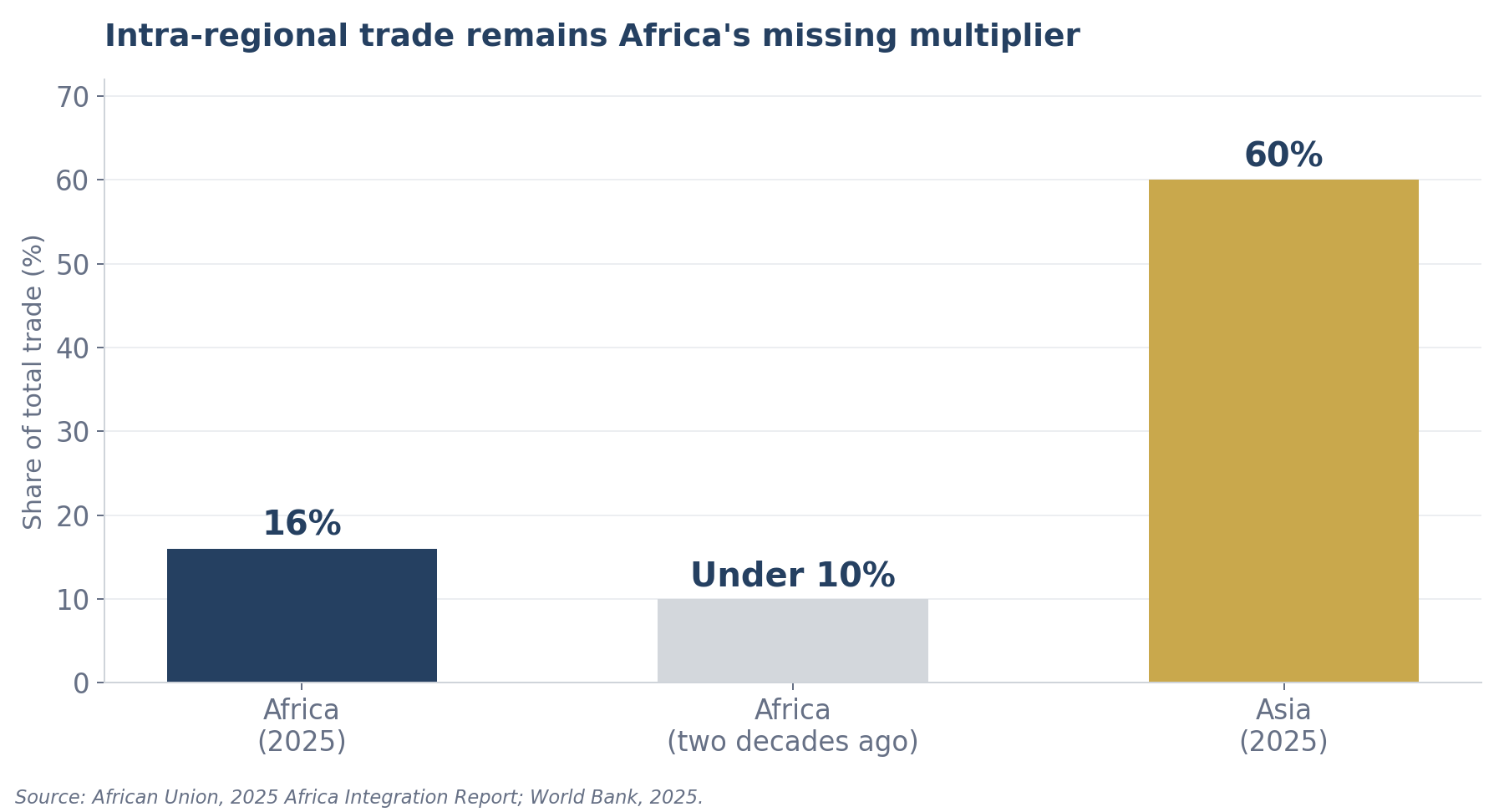
The African Continental Free Trade Area was built to make Africa trade with itself. Six years after entry into force, the tariff schedules are published, 54 of 55 African Union member states have signed on, and the political architecture is largely in place. Yet intra-African trade still accounts for barely 16 percent of the continent's total trade, against 60 percent within Asia.1,2 The gap is not a tariff problem. It is a border problem: non-tariff barriers, incompatible payment systems, and unresolved rules on who may move, work, and invest across African borders. Until leaders treat implementation with the same rigor they applied to negotiation, AfCFTA will remain a legal achievement without a commercial one.
AfCFTA's ratification success has not translated into trade volume. Intra-African trade has risen only marginally, from under 10 percent of the continent's total trade two decades ago to close to 16 percent today, according to the African Union's 2025 Africa Integration Report. Intra-Asian trade, by contrast, reached 60 percent of the region's total trade in 2025, per World Bank data.1,2
Why it mattersA trade agreement's credibility is measured in shipments, not signatures. Intra-African trade did cross an important threshold, exceeding USD 220 billion under the 2024-2025 AfCFTA Implementation Report, but that figure is still a fraction of what a continent of 1.4 billion people and a combined GDP above USD 3 trillion should be generating internally.5
For African governments, the political capital spent ratifying AfCFTA is now a sunk cost unless matched by an equivalent investment in operational capacity: customs modernization, standards harmonization, and dispute resolution. For businesses, the lesson is blunter: market access on paper is not market access in practice, and commercial planning must price in the gap between the two.
As tariffs come down under AfCFTA schedules, the friction has migrated to non-tariff barriers: import bans, ad hoc levies, repeated product testing, inconsistent standards, and certificates that one regulator issues and another refuses to recognize.
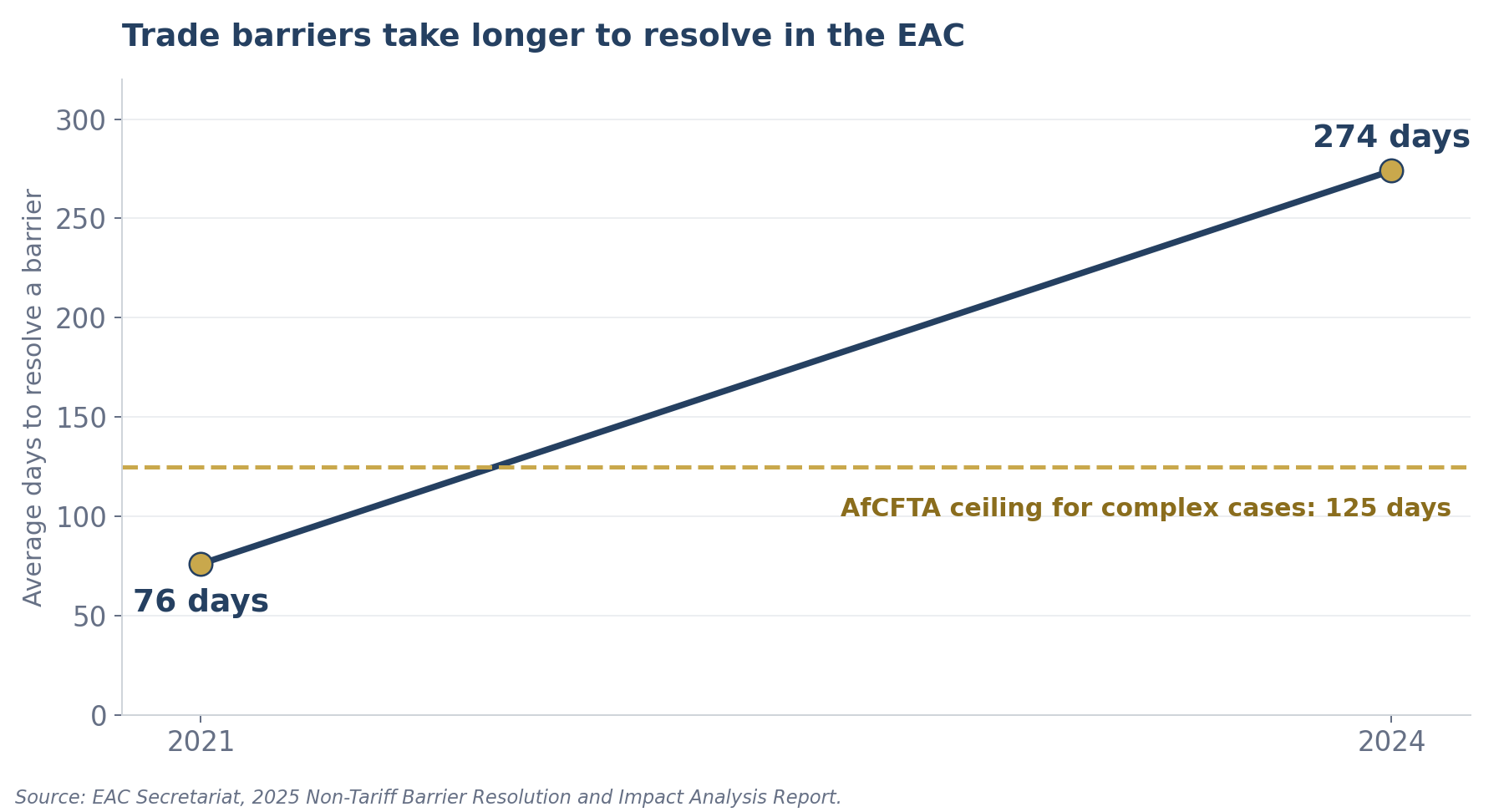
The evidenceThe East African Community Secretariat's 2025 Non-Tariff Barrier Resolution and Impact Analysis Report found that the average time to resolve a trade complaint rose from 76 days in 2021 to 274 days in 2024, more than double the 125-day ceiling AfCFTA sets for complex cases. The same report estimates that non-tariff barriers cost EAC partner states between 1.7 and 2.8 percent of GDP annually, while the East African Business Council puts regional losses from trade restrictions at roughly USD 10 billion a year. Since 2008, the COMESA-EAC-SADC Tripartite Online Mechanism has logged 928 formal non-tariff barrier complaints from traders.4
Why it mattersThese are not abstract inefficiencies. The World Bank's assessment of AfCFTA's economic and distributional effects found that eliminating non-tariff barriers, not just tariffs, could increase intra-African exports by more than 80 percent and raise continental incomes by up to USD 300 billion by 2035. Non-tariff barriers, in other words, carry a larger economic cost than the tariffs AfCFTA was designed to eliminate.3
Regulatory agencies that operate in silos, rejecting each other's certifications, are functioning as an informal second customs union that undercuts the one governments signed. Closing this gap requires mutual recognition agreements between national standards bodies, not further tariff negotiation.
Three structural gaps sit beneath the border friction: fragmented payment systems, uneven digitalization of customs, and an unratified framework for the movement of people.
The evidenceCross-border payments routed through correspondent banks outside the continent can cost 7 to 20 percent of transaction value and take three to five days to clear, according to Brookings' review of Africa's digital trade landscape. The Pan-African Payment and Settlement System, led by Afreximbank and the African Union, is designed to solve this by settling African currencies directly, but adoption remains partial. On mobility, the AU's Commissioner for Economic Development, Trade, Tourism, Industry and Minerals confirmed in October 2025 that the Protocol on Free Movement of Persons, adopted in 2018, has still not reached the minimum ratification threshold required to enter into force. On the operational side, the AfCFTA Guided Trade Initiative, launched with 7 countries in October 2022, expanded to 39 countries by September 2024, evidence that pragmatic, phased trade under AfCFTA rules is possible once the institutional plumbing is in place.6,9
Why it mattersA trader who cannot repatriate payment in local currency, a technician who cannot cross a border to install equipment, and a customs officer who cannot access a shared digital record all represent the same underlying failure: institutions built for national economies applied to a continental market.
From an institutional perspective, digital payment interoperability and the Free Movement Protocol are not adjacent reforms to AfCFTA. They are prerequisites for it. A single market for goods without a functioning system for money and people is a partial market.
The economic case for closing the implementation gap is already quantified, and it is large enough to justify sustained political attention.
The evidenceBeyond the USD 300 billion income gain projected by 2035 if non-tariff barriers are removed, longer-horizon modeling from the Pardee Center for International Futures, cited in a 2025 UNICEF Innocenti analysis, projects that full AfCFTA implementation could raise intra-African trade by 97 percent and foreign direct investment inflows by 28 percent by 2063. The same body of research estimates that comprehensive implementation could lift close to 68 million people out of moderate poverty by 2035, concentrated in economies including Ethiopia, Nigeria, Tanzania, the Democratic Republic of Congo, and Kenya.7,8
Why it mattersThese figures reframe implementation from a technical compliance exercise into the single highest-return policy investment available to most African governments. Few infrastructure or industrial policy programs offer a comparable multiplier for the scale of institutional investment required.
The real question for leaders is no longer whether AfCFTA is worth pursuing. It is why the institutions responsible for implementation are still resourced, staffed, and prioritized as if the answer were still in doubt.
The path from ratification to results runs through three phased horizons.
For businesses and investors, the strategic implication is immediate. Trade corridors and country pairs where non-tariff barriers are actively being resolved, digital single windows are operational, and Guided Trade Initiative participation is active represent materially lower execution risk than the continental average. Due diligence on AfCFTA opportunities should now include implementation readiness as a distinct criterion, alongside market size and tariff exposure.
“Non-tariff barriers now carry a larger economic cost than the tariffs AfCFTA was designed to eliminate.”
NovaHub Consulting advises governments, regional institutions and investors on trade facilitation, implementation readiness and the institutional design questions this analysis raises.
Book a conversationRead offline or share with your team, including all charts and figures.
1. African Union (2025), 2025 Africa Integration Report launch remarks, au.int/en/pressreleases/20251003/au-launches-2025-africa-integration-report-accelerate-agenda-2063.
2. World Bank (2025), Intra-Asia and intra-Africa trade share data, cited in Intra-African trade under AfCFTA, GIS Reports Online, gisreportsonline.com/r/africa-trade-afcfta.
3. World Bank (2020), The African Continental Free Trade Area: Economic and Distributional Effects, cited in TradeMark Africa coverage of non-tariff barriers, trademarkafrica.com/non-tariff-barriers-could-hurt-east-africas-integration-gains.
4. East African Community Secretariat (2025), Non-Tariff Barrier Resolution and Impact Analysis Report, cited in TradeMark Africa, trademarkafrica.com/non-tariff-barriers-could-hurt-east-africas-integration-gains.
5. ITRC (2026), African Continental Free Trade Area 2024-2025 Implementation Report (summary), itrc.org/2026/03/05/african-continental-free-trade-area-2024-2025-implementation-report.
6. Brookings Institution (2026), Realizing Africa's digital trade potential under the AfCFTA, brookings.edu/articles/realizing-africas-digital-trade-potential-under-the-afcfta.
7. UNICEF Innocenti (2025), Unlocking the Potential of AfCFTA for Africa's Young People, citing Pardee Center for International Futures modeling, unicef.org/innocenti/media/11251/file/UNICEF-Innocenti-AfCFTA-Main-Report-Report-2025.pdf.
8. Africa Trade Foundation, The AfCFTA (poverty impact estimates), africatradefoundation.org/the-afcfta.
9. Afronomicslaw, The Guided Trade Initiative (participation expansion data), afronomicslaw.org/print/pdf/node/3223.
10. tralac Trade Law Centre (2026), Seven non-tariff trade barriers in Africa and practical solutions to overcome them, tralac.org/blog/article/17039.
← Back to Blog & OpinionsAccount ownership in Sub-Saharan Africa rose from 34% to 58% in a decade, led by mobile money. The real bet is on the infrastructure that connects fifteen markets.
Read the articleGhana holds a Tier 1 global cybersecurity ranking while Nigeria, Côte d'Ivoire and Senegal sit in Tier 3. AI now enables 55% of reported cybercrimes in Africa. The gap is institutional.
Read the articleMore than $2 trillion moved through mobile wallets in 2025, and Sub-Saharan Africa generated 66% of it. Four of fifteen West African states still have no data-protection law.
Read the article