Senegal, Togo, Canada and across Africa
@gonovahub
Blog & Opinions

Fintech: West Africa Didn't Wait for Banks. It Built Something Else.

Why the region's fintech boom is really a bet on financial infrastructure, not another app.

Komlan Messie, MBA, Polytechnician, CEO of NovaHub Consulting • 2026 • 8 min read

Fintech in West Africa: financial infrastructure, not another app
In 2011, six adults in every hundred in Senegal held a financial account. By 2024, more than half did. Nigeria added twenty percentage points of account ownership in three years alone. Neither country did it by building bank branches. They did it with a SIM card, an agent on a street corner, and a wallet balance that lives on a phone.1

Fintech is not a sector in West Africa. It is the system. The strategic issue is not whether the region will adopt digital finance, because it already has, faster than almost anywhere else on earth. The real question for leaders is whether fintech merely digitises the existing financial system, layering an app on top of the same fragmented, cash-based, nationally siloed structures, or redesigns that system into shared, interoperable infrastructure spanning the region. The answer will determine who captures the next decade of financial-sector value: domestic operators building for fifteen markets, or foreign platforms building for one market at a time. The biggest fintech opportunity in West Africa may not be another payment app. It may be the infrastructure that connects fifteen markets into one digital economic space.

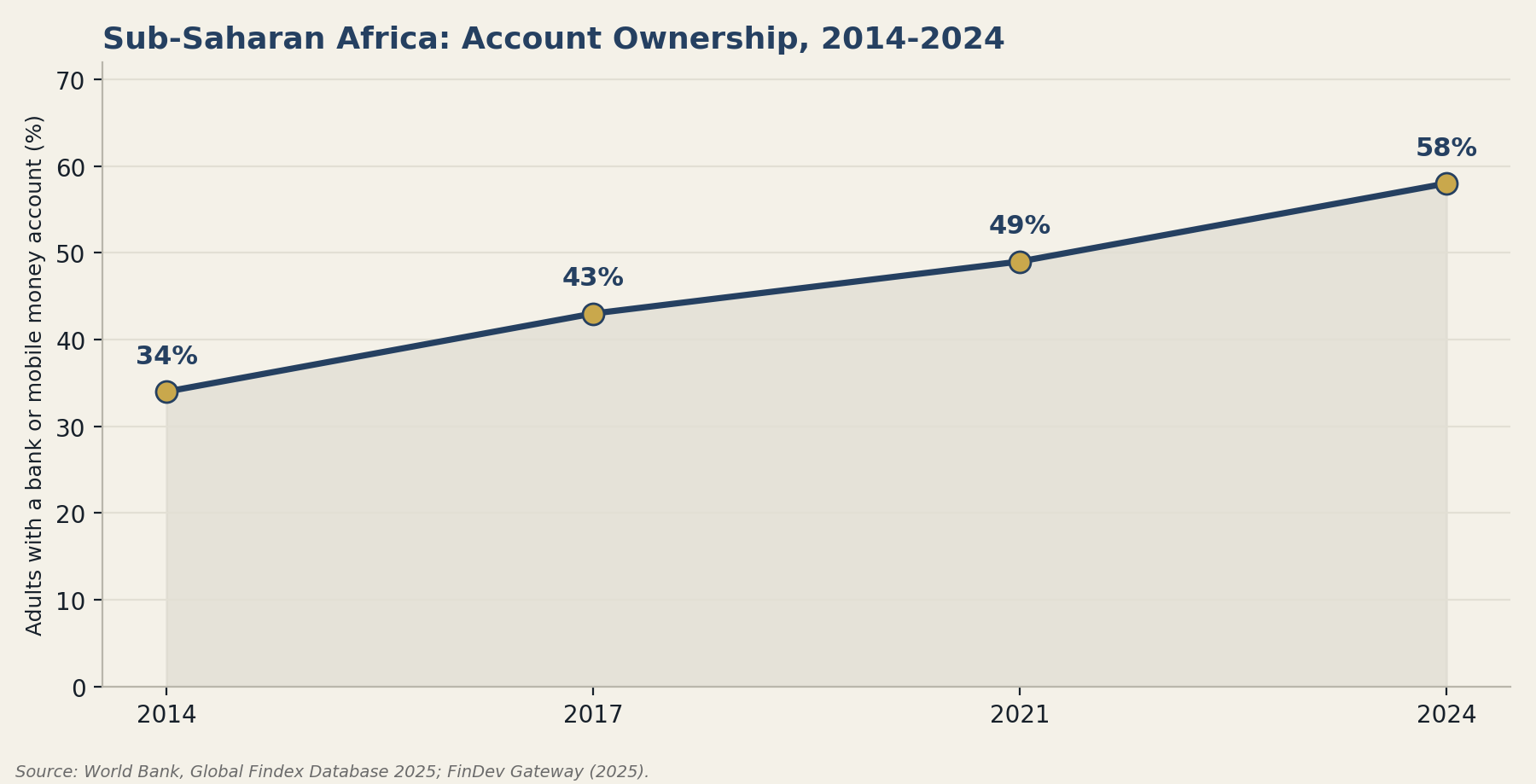
58%of adults in Sub-Saharan Africa held an account in 2024, up from 34% in 2014. World Bank, Global Findex 2025
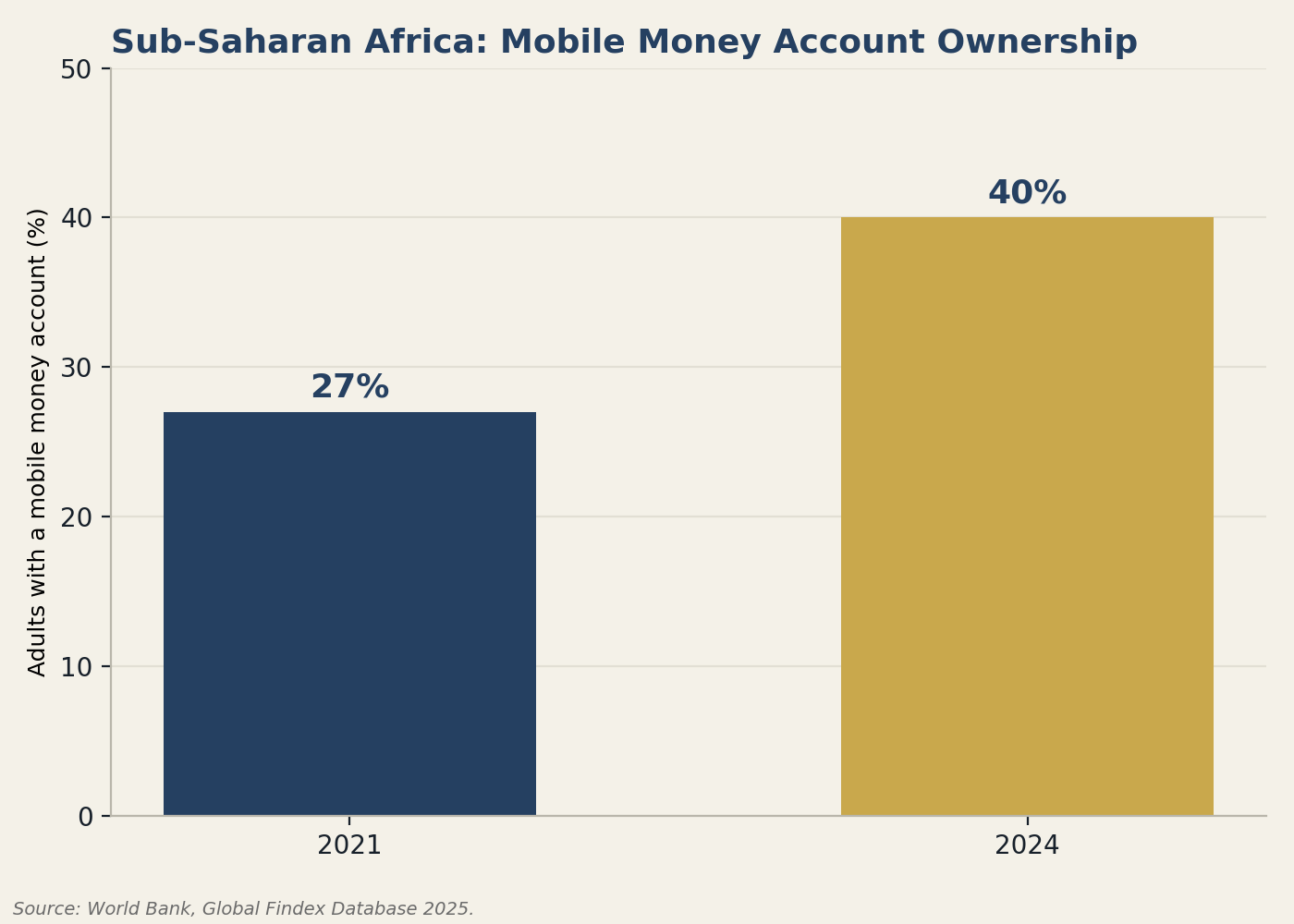
40%hold a mobile money account, up from 27% in 2021, the highest of any world region. World Bank, Global Findex 2025
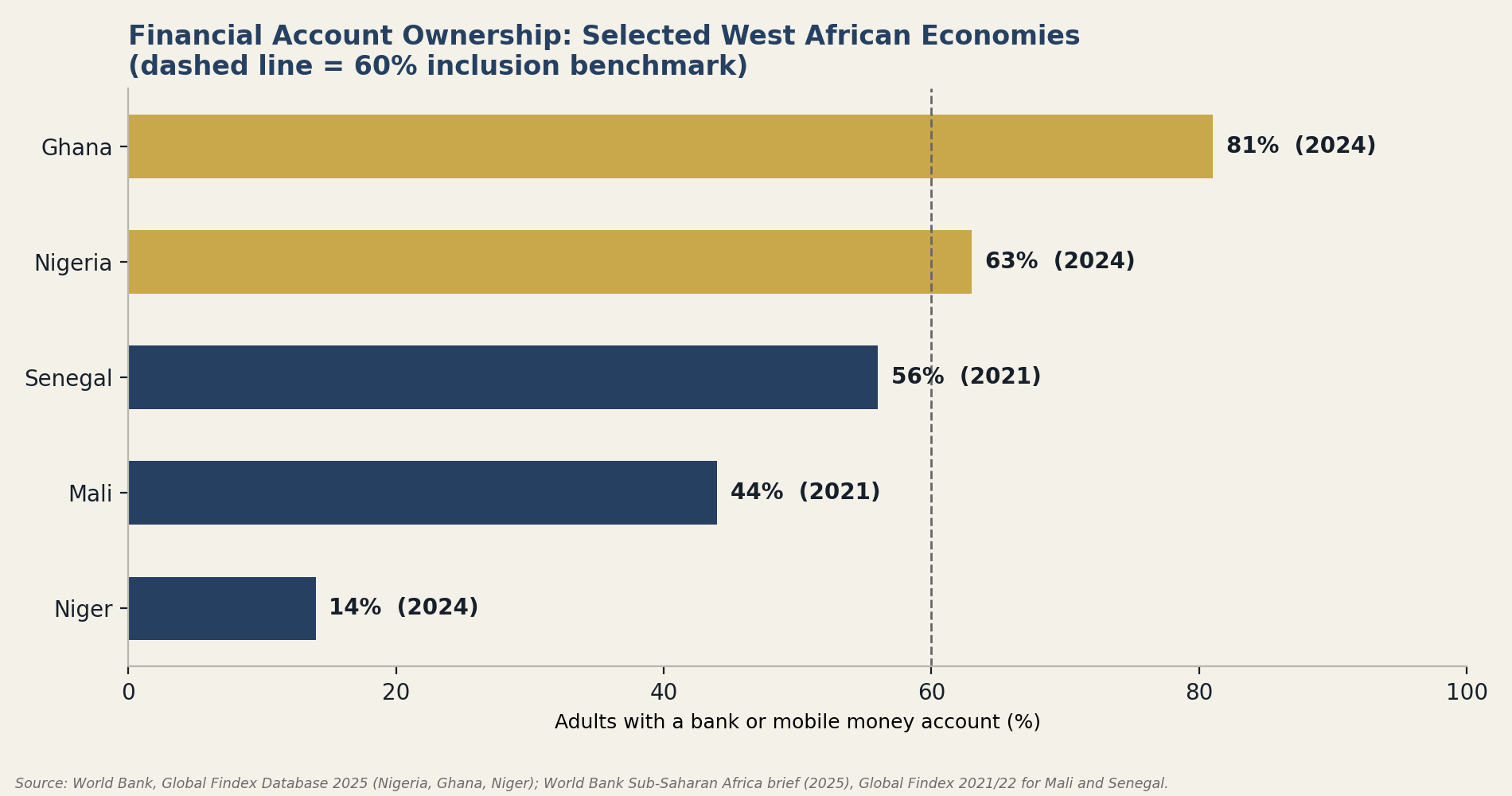
67 ptsseparate Ghana (81%) from Niger (14%) inside one economic bloc. World Bank, Global Findex 2025

1. The old model is running out of road

What is happening

For decades, financial access followed one sequence: a bank opens a branch, a customer opens an account, a card is issued, and payments move over traditional rails built for that single institution. That model never reached most of the region. Fewer than one in seven adults in Niger holds a financial account today.1

Why it matters

Branch-based banking has a fixed cost structure that does not clear at low-income, rural or informal-economy price points. A branch built for a market of thirty million people in one country was never going to serve a smallholder trader moving goods across three borders.

The strategic implication

The region does not need to catch up to a legacy model. It can skip it. The new sequence is mobile phone, wallet, digital payment, and increasingly embedded finance and alternative credit and savings products, without a branch ever entering the picture.

2. The numbers behind the shift

What is happening

Account ownership across Sub-Saharan Africa rose from 34% of adults in 2014 to 58% in 2024, the fastest sustained gain of any world region over that period.1,3

Chart of account ownership in Sub-Saharan Africa, 2014 to 2024Why it matters

Mobile money is doing almost all of the work. The share of adults with a mobile money account rose from 27% in 2021 to 40% in 2024, the highest of any region worldwide. Bank account growth has been comparatively flat.1,2,4

Chart of mobile money account ownership, 2021 and 2024Chart of account ownership across five West African economies
The strategic implication

The gap between the region's fastest and slowest movers is now the more important number. Ghana sits at 81% account ownership and Niger at 14%. That 67-point spread inside a single bloc is the real fintech opportunity: closing it, market by market, is worth more than any single product launch.1,2

3. Why West Africa is fertile ground

What is happening

Several structural features make West African economies unusually receptive to mobile-first financial infrastructure. Mobile money transaction volumes are still climbing at double digits year on year.5

A large, young population entering economic life mobile-first, with no legacy attachment to branch banking
Historically underserved rural and low-income adults, for whom a wallet is the first financial product they have ever held
High levels of informal economic activity that formal banking never priced for, but a low-fee wallet can serve profitably
Dense cross-border trade among ECOWAS states, which formal banking rails were never built to support
Rapid, continuing adoption of digital payments across the region
Why it matters

These are not temporary conditions that fade as incomes rise. A young, mobile-first, cross-border, informally employed population is the natural client base for financial infrastructure that is digital by default, not digital as an add-on to a branch network.

The strategic implication

The region's comparative advantage in fintech is structural, not a catch-up story. Investors and policymakers should treat West Africa's fintech growth as durable market formation, not a cyclical bump that will normalise once real banking arrives.

4. One region, fifteen rulebooks

What is happening

The fifteen ECOWAS states each maintain their own licensing regime, KYC standards and payment-interoperability rules. More than 60% of mobile money providers globally report that interoperability, KYC and consumer-protection regulation directly shape whether their service can scale.5

Why it matters

Fragmentation is the binding constraint on the next stage of growth, not consumer demand and not technology. A fintech that has proven its model in Ghana must rebuild trust, licensing and agent networks almost from zero to enter Côte d'Ivoire or Senegal.

The strategic implication

The highest-leverage policy action available is not a new digital-inclusion programme. It is regulatory harmonisation: shared KYC standards, mutual recognition of licensing and interoperable payment rails, following the model under construction through the Pan-African Payment and Settlement System (PAPSS). That single move would do more for inclusion than any consumer-facing subsidy.

5. Digitise the old system, or redesign it

What is happening

Two futures are visible in the data. In the first, mobile money digitises the existing system: the same national silos and correspondent-banking dependencies, now reachable from a phone. In the second, embedded finance, alternative credit scoring and cross-border rails redesign the system around the wallet rather than the branch.

Why it matters

The first path caps the sector at the size of its most advanced national market. The second lets it operate at the scale of the full ECOWAS economic space, more than 400 million people and one of the largest under-served consumer financial markets left on earth.

The strategic implication

The winning position is not the best national app. It is the platform, partnership or policy framework that treats the fifteen ECOWAS markets as one digital economic space from day one.

The next 36 months: three horizons

For leaders across government, business and investment, the roadmap is sequential, not simultaneous.

Horizon 1 (0-12 months): Diagnose and alignNational regulators and ECOWAS institutions map existing KYC, licensing and interoperability gaps and agree a shared standard, using PAPSS as the reference architecture.
Horizon 2 (12-24 months): Pilot and connectCross-border payment corridors go live between early-mover markets such as Nigeria, Ghana, Côte d'Ivoire and Senegal, with mutual recognition of licensed operators and agent networks.
Horizon 3 (24-36 months): Scale as one marketEmbedded finance, alternative credit and regional wallets scale across the ECOWAS bloc, with capability transfer to lagging markets closing the 67-point inclusion gap.

“West Africa has already answered the adoption question. What remains open is whether the rails connecting those wallets are built market by market, or built once, for fifteen countries at a time.”

NovaHub Consulting

Where NovaHub fits

NovaHub Consulting advises governments, regulators, investors and financial institutions on regulatory harmonisation, payment interoperability and digital financial infrastructure across ECOWAS.

Book a conversation
Komlan Messie
About the author

Komlan Messie, MBA, Polytechnician

A career built at the intersection of business, diplomacy and civic leadership.

Komlan Messie, MBA, is an international executive, entrepreneur and strategic advisor with more than two decades of experience across management, technology, institutional development, strategic transformation and international development. His work focuses on helping organisations, institutions and leaders navigate transformation, innovation, public policy and complex strategic challenges.

Mr. Messie is the founder and Chief Executive Officer of NovaHub Consulting and the Regional Executive Director of WACSOF-FOSCAO, the West African civil society network spanning ECOWAS member states. He is also the cofounder and chairman of the Réseau des Entrepreneurs et Professionnels Africains (REPAF) and the chairman of the Forum Afrique Expansion Canada, and he co-founded Aliments Frunil in Canada. He is a former Vice President of the Project Management Institute Montreal (PMI Montreal) in Canada.

He holds an MBA from HEC Montréal, an M.Sc. in Computer Science and Operations Research from École Polytechnique de Montréal, and a B.Eng. in Electrical Engineering from École Polytechnique de Thiès (Senegal), and is PRINCE2 certified. He works across Canada, Africa and especially the ECOWAS region in French, English, Ewe and Wolof.

Continue the conversation with Komlan Messie
View full profile →
Download this article

Read offline or share with your team, including all charts and figures.

Sources

1.  World Bank, The Global Findex Database 2025: Connectivity and Financial Inclusion in the Digital Economy (2025), worldbank.org/en/publication/globalfindex.

2.  World Bank, Financial Inclusion in Sub-Saharan Africa: An Overview (2025), worldbank.org.

3.  FinDev Gateway, Financial Inclusion in Sub-Saharan Africa (2025), findevgateway.org.

4.  AfricaNenda Foundation, The Global Findex 2025: Could Instant Payments Be Driving Financial Inclusion in Africa? (2026), africanenda.org.

5.  GSMA, State of the Industry Report on Mobile Money 2026 (2026), gsma.com/sotir.

6.  GSMA, State of the Industry Report on Mobile Money 2025 (2025), gsma.com.

7.  EFInA, Beyond Access: Turning Financial Inclusion into Financial Resilience in Nigeria (2025), efina.org.ng.

Note on scope: this brief presents individually verified figures for the ECOWAS economies with recent Global Findex or GSMA country-level data (Niger, Mali, Senegal, Nigeria, Ghana). A complete 15-country ranking can be built from the World Bank Global Findex country database.

← Back to Blog & Opinions
Newsletter

Get the analysis before the decision is made.

Subscribe for new insights, policy briefs and event updates. No noise, unsubscribe at any time.

Download the full paper

Enter your details to receive the secure download link. You will also be added to our newsletter list.

ENGAGE NOVAHUB