15 Countries, 15 Markets: The West African Mobile Telecom Battle
Senegal reports 125.8% mobile penetration, Guinea-Bissau 128.1%, yet real internet usage differs by a factor of two. Who is winning mobile connectivity in West Africa?
Read the articleThe last mile of energy: why power generation alone will not transform West Africa.
Komlan Messie, MBA, Polytechnician, CEO of NovaHub Consulting • 2026 • 8 min read
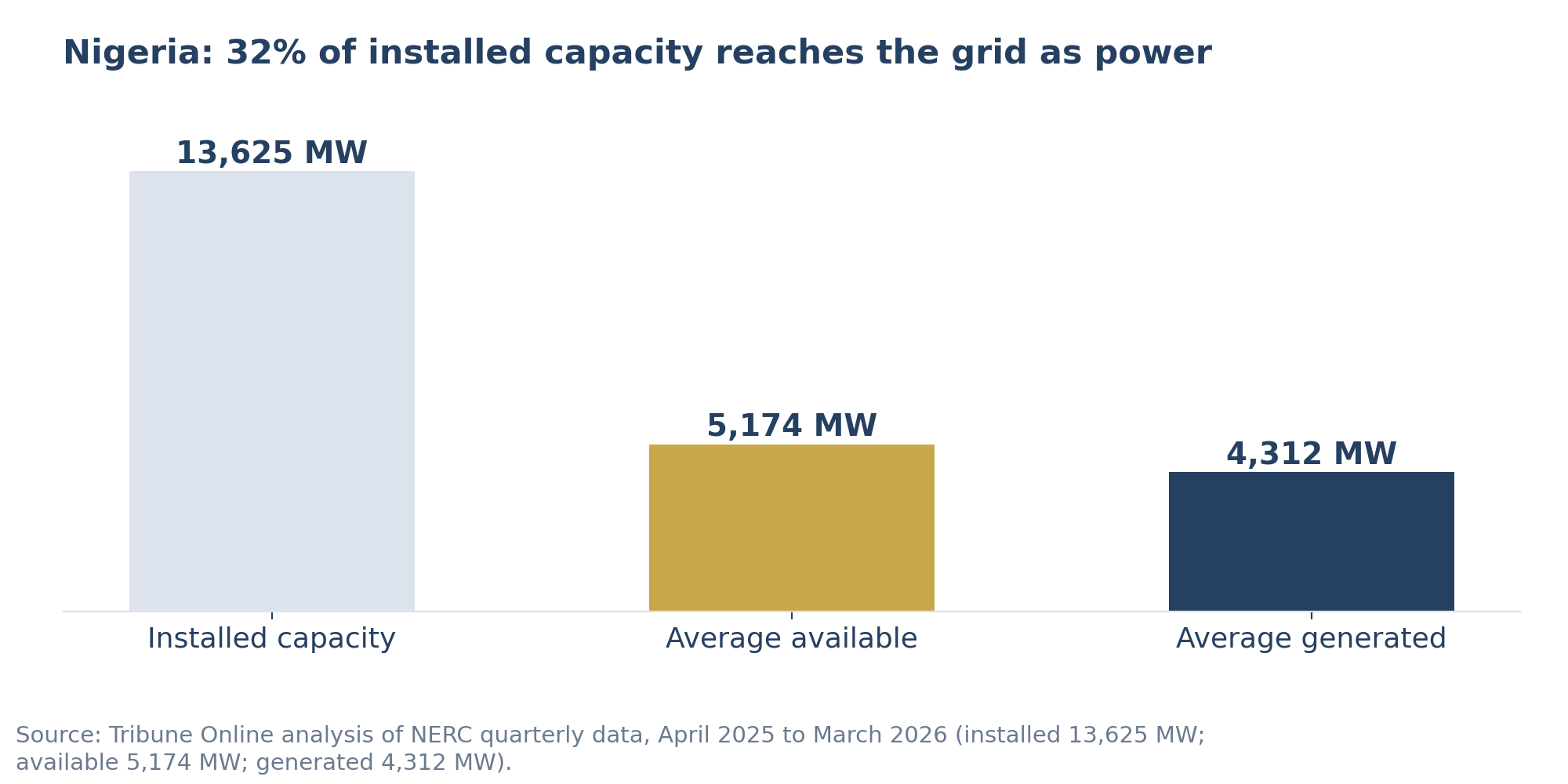
Nigeria has 13,625 MW of installed grid capacity. Over the twelve months to March 2026 it generated 4,312 MW on average. The region has not run out of energy. It has run out of working wires, solvent utilities and connected customers.7
Across West Africa, the share of people with electricity runs from 98.4 percent in Cabo Verde to 21.3 percent in Niger.1 Those two facts, installed capacity that never arrives and access that never expands, describe the same failure. Every minister announcing a new power plant should be asked a plainer question: how many more households will it light, and who will pay for the poles in between? In Nigeria and Ghana, the two largest generators in the West African Power Pool, distribution networks fail to turn between 27 and 37 percent of the electricity they receive into revenue.8,9,17 Regional grids trade only about 8 percent of regional electricity.11 A megawatt that never reaches a meter is a stranded asset. The decisive investments of the next decade sit in distribution, metering, utility finance and regional markets.
Installed capacity is a headline. Delivered energy is the outcome. In Nigeria, an average of 5,174 MW was available and 4,312 MW generated against 13,625 MW installed.7 The regulator adds that, across the four quarters of 2025, between 7.19 and 9.00 MWh of every 100 MWh injected into the grid was lost in transmission alone.5
Why it mattersThe pattern is global, not only Nigerian. Worldwide, 45 percent of installed renewable capacity, 1,733 GW out of 3,832 GW, is connected to inefficient grids (SEforALL, 2025, drawing on World Bank and IRENA data).3 Cheap solar on a leaking grid is still expensive electricity.

Judge energy programmes by delivered kilowatt-hours per connected customer, not by megawatts announced. Attach every new generation contract to a funded plan for the network that carries it.
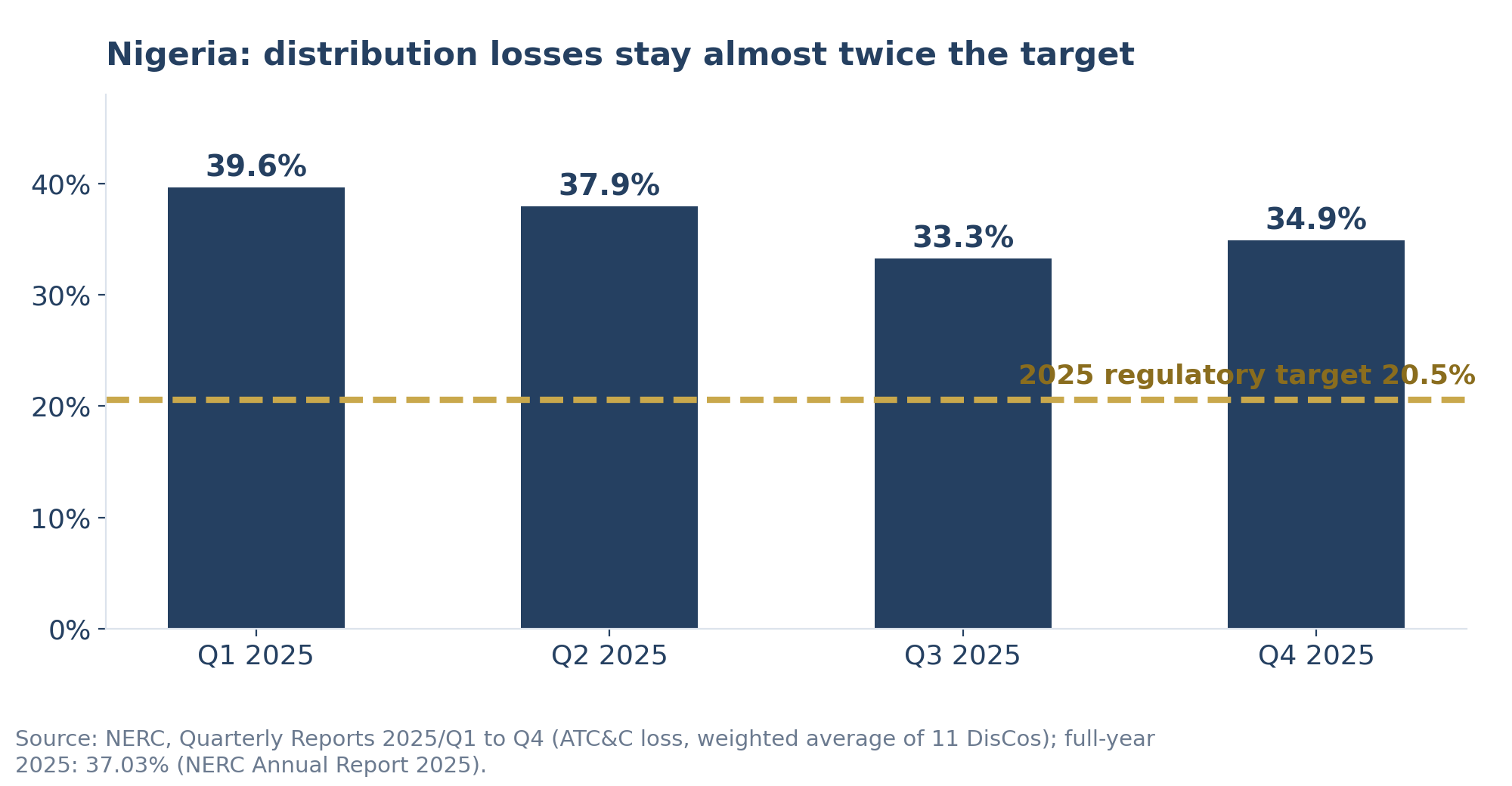
Nigeria's distribution companies lost 37.03 percent of the energy they received in 2025, measured as aggregate technical, commercial and collection (ATC&C) loss, against a regulatory target of 20.54 percent.4 In plain terms, this is the share of electricity that is never billed or never paid for. Behind the average sits a wide spread: Eko DisCo recorded about 15.4 percent, Kaduna about 70.3 percent.7
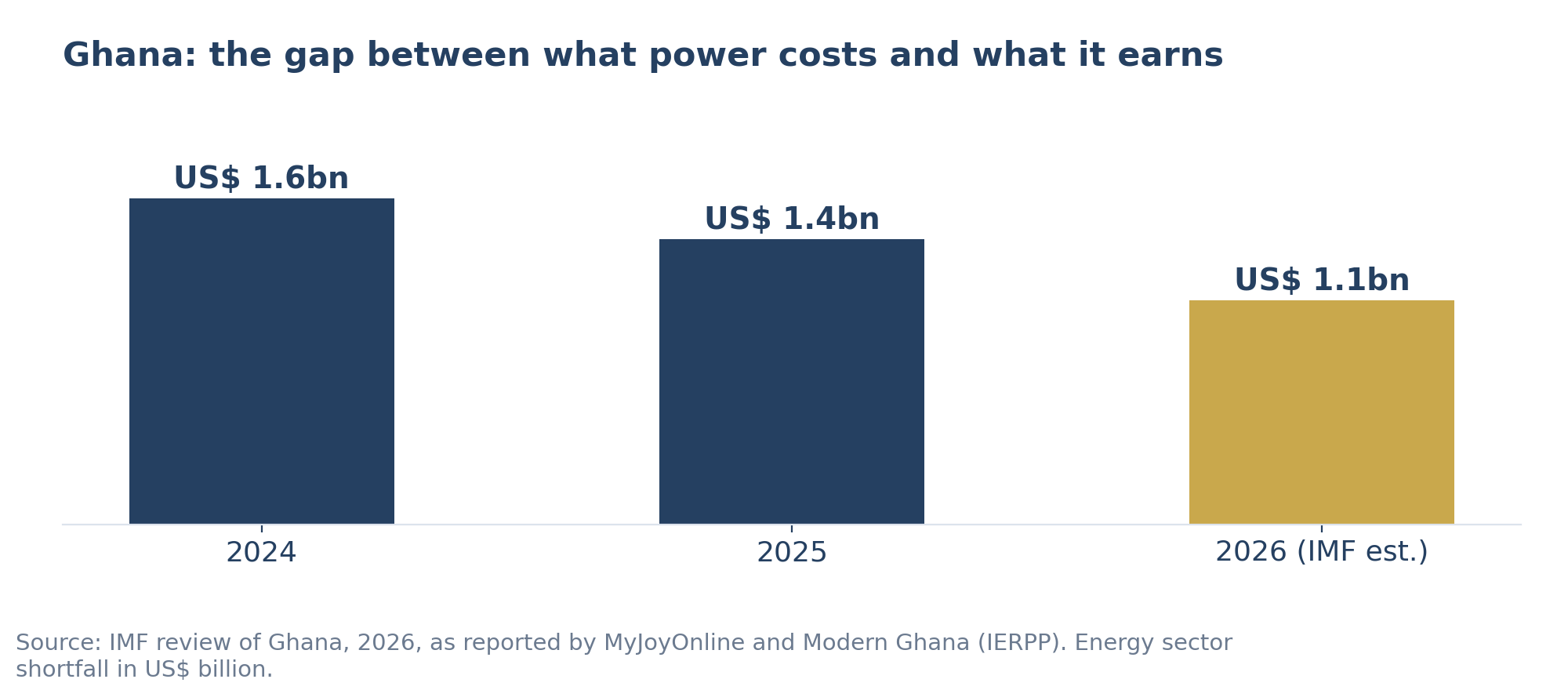
Why it mattersLeakage is the financial engine of the crisis. In Ghana, the IMF puts the energy sector shortfall at US$1.6 billion in 2024 and US$1.4 billion in 2025, while distribution losses stay near 27 percent despite cumulative tariff increases of about 40 percent since March 2025.8,9

Tariff increases alone cannot repair a bucket with holes. Metering, billing, collection and enforcement come first, and results must be published feeder by feeder so that regulators, lenders and citizens can see them.
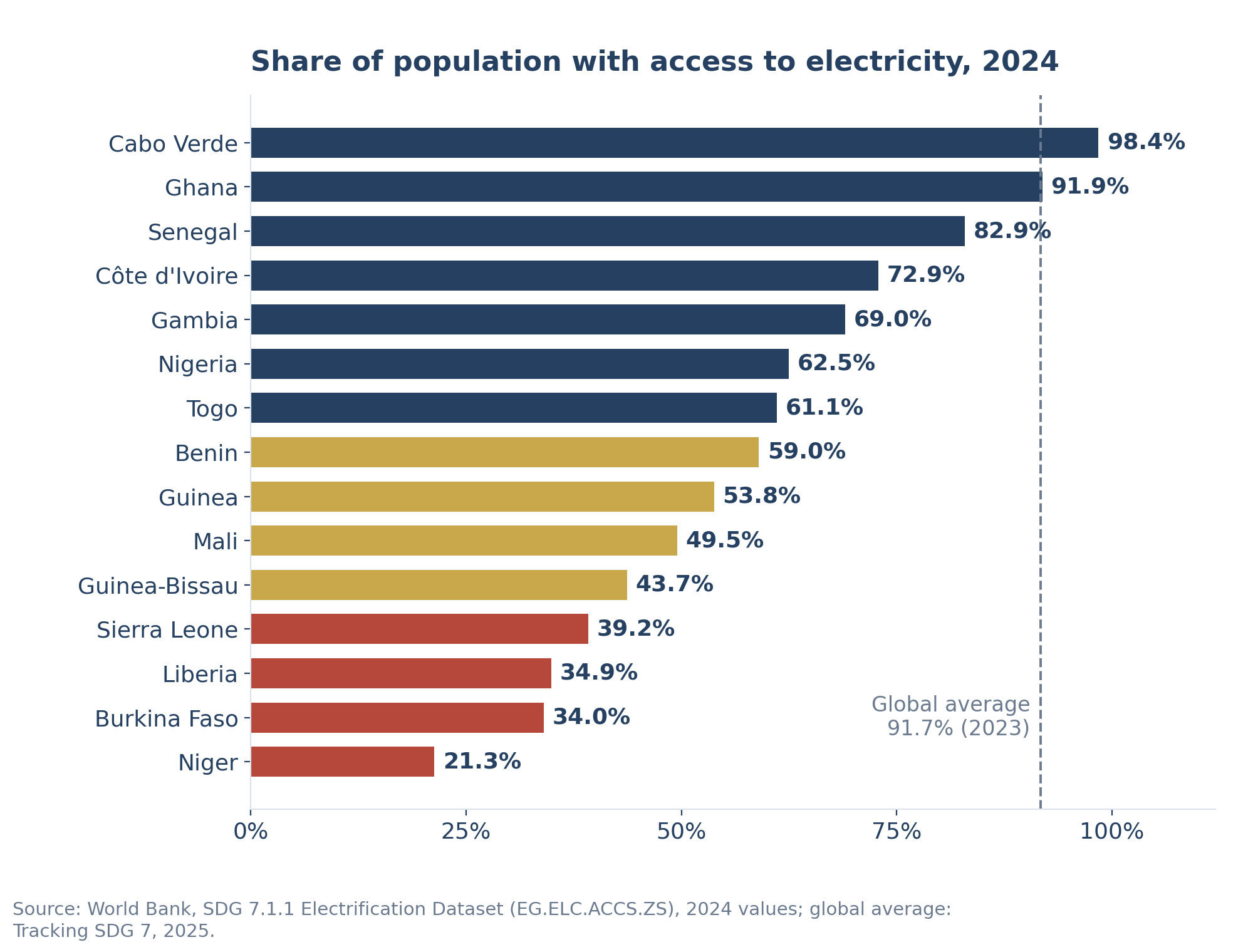
Electricity access across the 15 countries of West Africa spans 77 percentage points: 98.4 percent in Cabo Verde, 91.9 percent in Ghana, 21.3 percent in Niger.1 Four countries remain below 40 percent: Sierra Leone, Liberia, Burkina Faso and Niger.
Why it mattersWithin countries, the divide is sharper. Across Sub-Saharan Africa, urban access reaches 80 percent while rural access is about 37 percent, and urban supply is often unreliable.3 Surveys confirm it: fewer than one household in three is connected to the grid in Niger (32 percent), Burkina Faso (31 percent) and Sierra Leone (31 percent).15

A national average hides two realities: a connected urban core that is often unreliable, and an unconnected periphery that is rarely planned. Set separate targets for connection, quality of supply and affordability, by geography.
Who is closing the last mile, and who is still waiting? The 15 countries are the 15 ECOWAS members until January 2025. Burkina Faso, Mali and Niger formally left the bloc on 29 January 2025 but remain part of the region's electricity geography and are kept here for comparability.18
| Rank | Country | Access 2024 | Gap to 100% | Vs world avg. | Tier |
|---|---|---|---|---|---|
| 1 | Cabo Verde | 98.4 % | 1.6 pts | +6.7 pts | Leading |
| 2 | Ghana | 91.9 % | 8.1 pts | +0.2 pts | Leading |
| 3 | Senegal | 82.9 % | 17.1 pts | -8.8 pts | Leading |
| 4 | Côte d'Ivoire | 72.9 % | 27.1 pts | -18.8 pts | Leading |
| 5 | Gambia | 69.0 % | 31.0 pts | -22.7 pts | Leading |
| 6 | Nigeria | 62.5 % | 37.5 pts | -29.2 pts | Leading |
| 7 | Togo | 61.1 % | 38.9 pts | -30.6 pts | Leading |
| 8 | Benin | 59.0 % | 41.0 pts | -32.7 pts | Catching up |
| 9 | Guinea | 53.8 % | 46.2 pts | -37.9 pts | Catching up |
| 10 | Mali | 49.5 % | 50.5 pts | -42.2 pts | Catching up |
| 11 | Guinea-Bissau | 43.7 % | 56.3 pts | -48.0 pts | Catching up |
| 12 | Sierra Leone | 39.2 % | 60.8 pts | -52.5 pts | Critical |
| 13 | Liberia | 34.9 % | 65.1 pts | -56.8 pts | Critical |
| 14 | Burkina Faso | 34.0 % | 66.0 pts | -57.7 pts | Critical |
| 15 | Niger | 21.3 % | 78.7 pts | -70.4 pts | Critical |
World average: 91.7% (2023). Tiers: Leading 60% and above; Catching up 40% to 59.9%; Critical below 40%. Source: World Bank, SDG 7.1.1 Electrification Dataset, 2024 values; Tracking SDG 7, 2025.
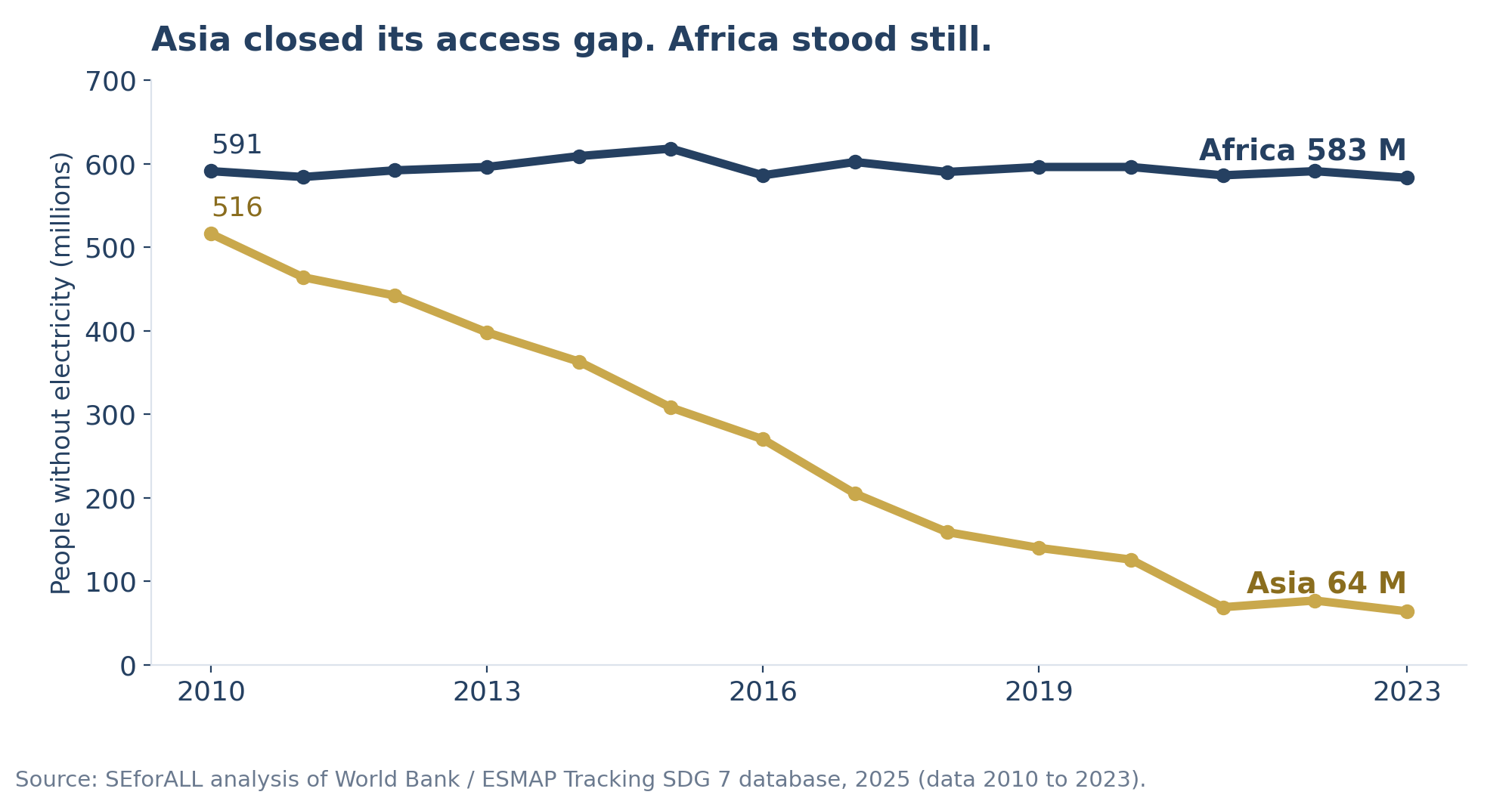
Asia cut its unelectrified population from 516 million to 64 million between 2010 and 2023. Africa moved from 591 million to 583 million.3 On current trends, 572 million Africans will still lack electricity in 2030.
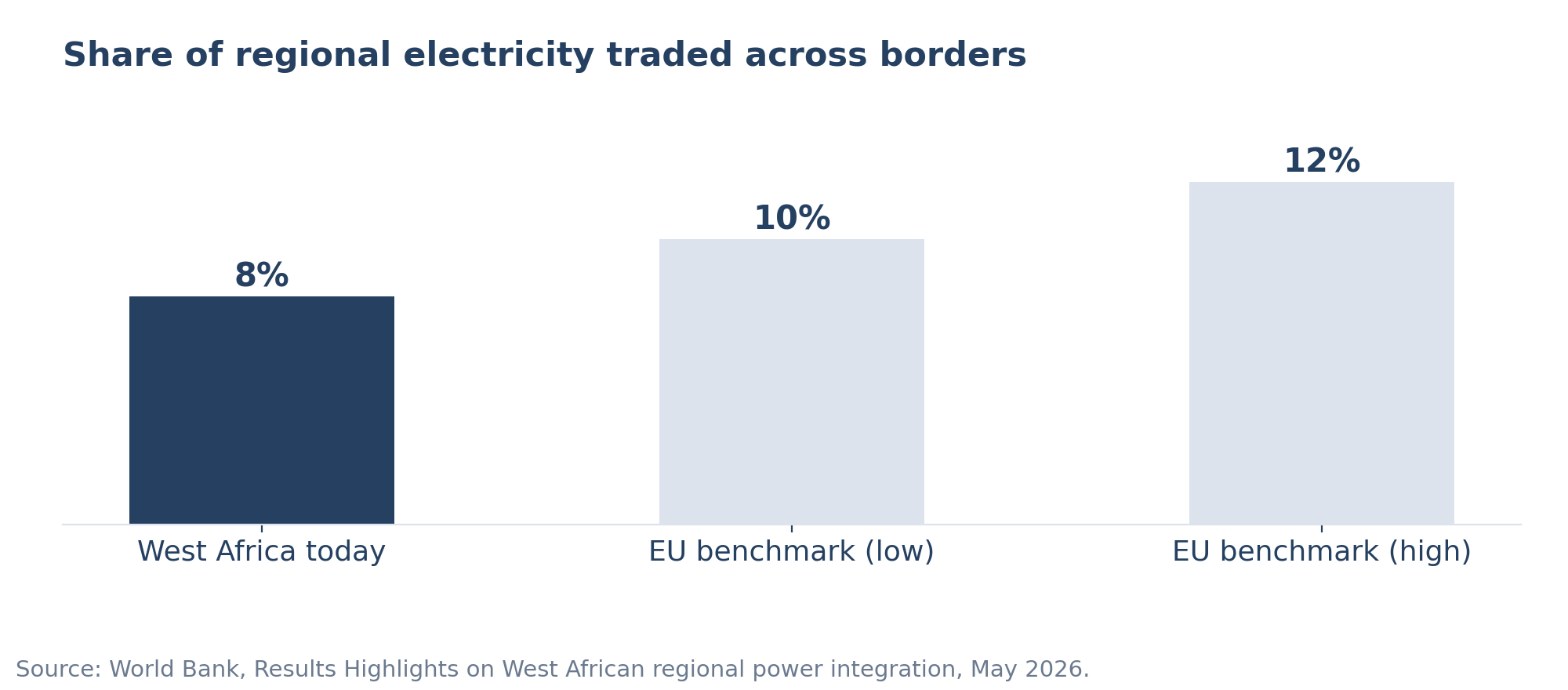
More than 4,000 km of high-voltage lines now link the grids of 15 West African countries through the West African Power Pool (WAPP). About 8 percent of regional electricity is traded across borders, approaching the 10 to 12 percent benchmark in the European Union.11 The CLSG line (1,303 km across Côte d'Ivoire, Liberia, Sierra Leone and Guinea) and the OMVG loop (1,677 km) are built, and Senegal exports to The Gambia and Guinea-Bissau while importing from Guinea.12
Why it mattersWires are necessary, not sufficient. University College London modelling shows that more cross-border trade reduces unserved demand, but can raise fuel-based generation when regional supply is thin.16 Politics adds a second risk: Burkina Faso, Mali and Niger left ECOWAS on 29 January 2025, which turns power-trade agreements into a diplomatic asset to protect.18

Interconnectors move power. They do not create it.
Treat the regional market as infrastructure with a governance layer: a harmonised grid code, bankable payment guarantees between utilities, and bilateral agreements that survive political cycles, including with the Sahel states.
Mission 300, led by the World Bank Group and the African Development Bank, aims to connect 300 million Africans to electricity by 2030: 250 million through the World Bank Group and 50 million through the AfDB. It works through National Energy Compacts that pair connections with utility reform, and 36 countries have launched one. Compact metrics include utilities reaching at least 100 percent operational cost recovery.13
Why it mattersUniversal access requires reaching about 136 million people a year and, in the IEA's net-zero scenario, about US$30 billion of annual investment in developing economies.3 Public money cannot carry that alone. Ghana shows the stakes: the IMF estimates a US$1.1 billion sector shortfall in 2026 and urges private operators into distribution, with government planning private firms for metering and billing.10 Mission 300 has also created Project Zafiri, a US$300 million equity vehicle for private distributed energy companies.14

The affordability trap is real: a tariff too low bankrupts the utility, a tariff too high locks out the customer. The exit is lower cost: fewer losses, better collection, cheaper financing, and subsidies aimed at connection costs for poor households rather than at the whole tariff.
A sequence that moves from stopping leaks, to fixing the middle of the chain, to reaching the last customer.
Governance and risk. Each ministry of energy runs a programme office reporting to the head of government, with quarterly public reviews. Main risks: tariff reversals (mitigate with transparent roadmaps and targeted social tariffs), weak data (independent verification) and regional rupture (bilateral power agreements).
Trained as an electrical engineer, I read a power system the way current flows: from source to load. West Africa's debate mostly stops at the source. The next decade will reward the leaders who finish the circuit: reliable wires, utilities that get paid, regional markets that work and households that can afford the connection.
“The region does not have to choose between generation and distribution. It has to stop financing one while neglecting the other.”
NovaHub Consulting advises governments, regulators, utilities, investors and development partners on distribution reform, utility performance, regional power markets and results-based energy financing across ECOWAS.
Book a conversationRead offline or share with your team, including all charts and figures.
1. The Global Economy (2026), Access to electricity, percent of the population, Africa, 2024 (source: World Bank), theglobaleconomy.com/rankings/access_to_electricity/Africa/.
2. IRENA, IEA, UNSD, World Bank and WHO (2025), Tracking SDG 7: The Energy Progress Report 2025, irena.org/Publications/2025/Jun/Tracking-SDG-7-The-Energy-Progress-Report-2025.
3. SEforALL (2025), Tracking SDG7: The Energy Progress Report 2025, Deep Dive Perspective, seforall.org.
4. NERC (2026), Annual Report and Accounts 2025, nerc.gov.ng/wp-content/uploads/2026/08/2025-Annual-Report_Pub.pdf.
5. NERC (2025), Quarterly Reports 2025/Q1, Q2 and Q3, nerc.gov.ng.
6. Legit.ng (2026), NERC 2025/Q4 report: ATC&C loss of 34.90%, legit.ng.
7. Tribune Online (2026), The physical and financial losses in Nigeria's power sector (Part III), tribuneonlineng.com.
8. MyJoyOnline (2026), IMF cautions Ghana over energy sector despite progress made in reducing energy debt, myjoyonline.com.
9. Modern Ghana, IERPP (2026), Ghana's energy sector lost $1.4 billion in 2025, modernghana.com.
10. Ecofin Agency (2026), IMF pushes Ghana to bring private operators into power distribution, ecofinagency.com.
11. World Bank (2026), Connecting West Africa through regional power integration and expanded electricity access, worldbank.org.
12. World Bank (2025), Powering Africa: the transformational impact of regional energy projects in West Africa, worldbank.org.
13. World Bank (2026), Mission 300: Frequently Asked Questions; and Mission 300 Overview (2025), worldbank.org/en/programs/energizing-africa/faq.
14. Rockefeller Foundation (2025), Mission 300: we've built the boat, now let's row quickly, rockefellerfoundation.org.
15. Afrobarometer (2024), Dispatch No. 793: Slight and uneven progress still leaves many Africans without electricity, afrobarometer.org.
16. Adeoye, O. and Spataru, C. (2020), Quantifying the integration of renewable energy sources in West Africa's interconnected electricity network, UCL Discovery, discovery-pp.ucl.ac.uk/id/eprint/10087773.
17. Global Energy Monitor (2026), Power Sector Transition in the West African Power Pool, gem.wiki.
18. allAfrica (2025), ECOWAS Council of Ministers on the withdrawal of Burkina Faso, Mali and Niger (effective 29 January 2025), allafrica.com/stories/202504250276.html.
Note on scope: distribution loss figures are published on a comparable basis only for Nigeria (NERC) and Ghana (IMF, IERPP). No 15-country loss ranking is shown because comparable official data was not found for the other countries. Access figures are World Bank 2024 values as listed by The Global Economy.
← Back to Blog & OpinionsSenegal reports 125.8% mobile penetration, Guinea-Bissau 128.1%, yet real internet usage differs by a factor of two. Who is winning mobile connectivity in West Africa?
Read the articleIntra-African trade is 16% of the continent's total, against 60% in Asia. Resolution of trade barriers now takes 274 days. Non-tariff barriers, not tariffs, are the binding constraint.
Read the articleAccount ownership in Sub-Saharan Africa rose from 34% to 58% in a decade, led by mobile money. The real bet is on the infrastructure that connects fifteen markets.
Read the article