Senegal, Togo, Canada and across Africa
@gonovahub
Blog & Opinions

The Blue Blind Spot: Why West Africa's Ocean Economy Is Still an Afterthought

Ninety percent of regional trade already moves through West Africa's ports and coastal waters. The blue economy still is not part of the conversation that decides regional strategy.

Komlan Messie, MBA, Polytechnician, CEO of NovaHub Consulting • 2026 • 6 min read

West Africa's ocean economy and maritime governance
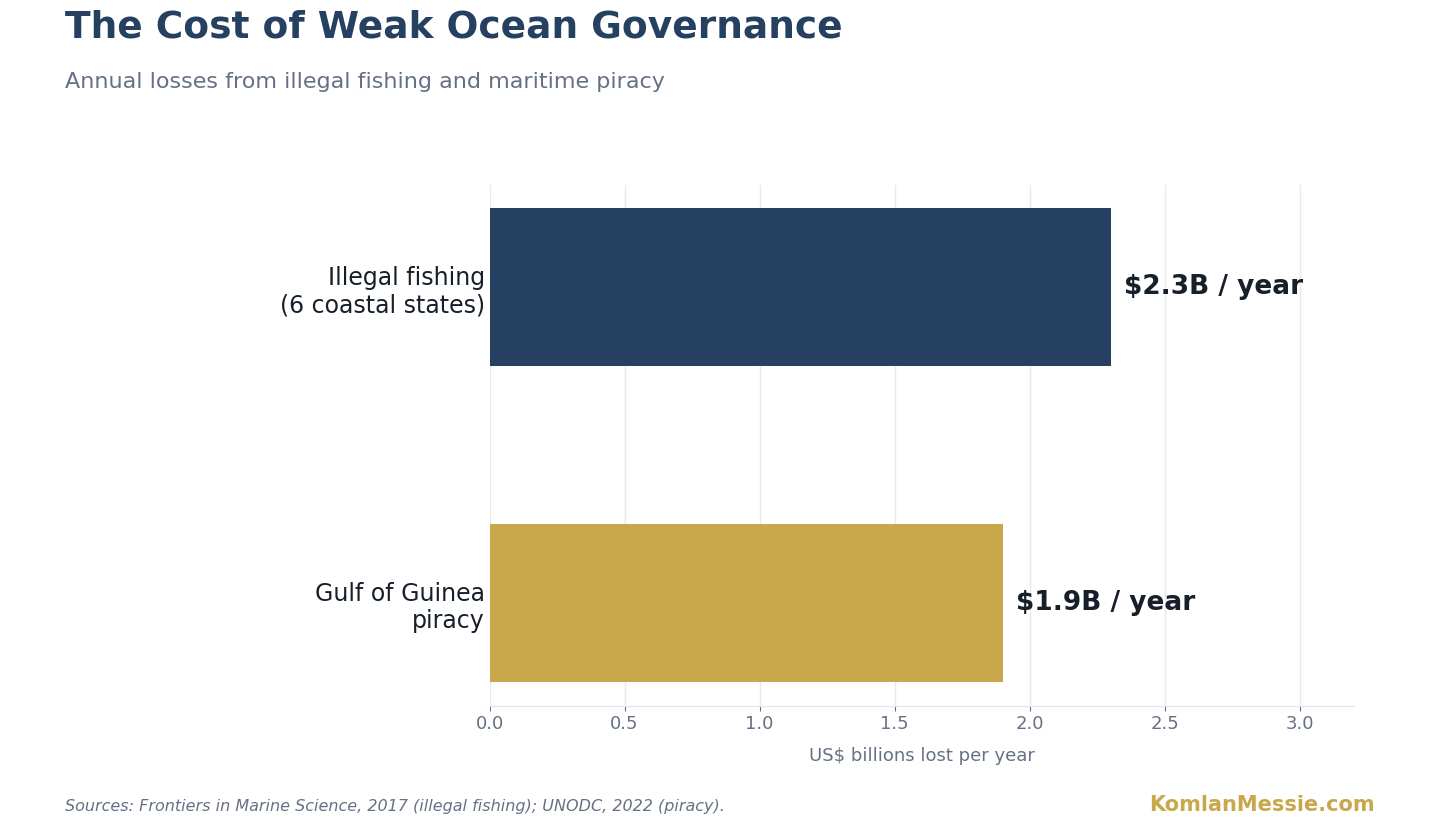
Ninety percent of West Africa's international trade already moves by sea. Illegal fishing drains more than two billion dollars a year from just six coastal states. Piracy in the Gulf of Guinea adds close to two billion dollars more in annual losses. Yet in most national development plans across the region, the ocean is still treated as a security problem or a fisheries footnote, not as an economic asset in its own right.

That gap, between what the ocean already generates and how little it is governed, is the subject of this brief. West Africa's blue economy, its ports, fisheries, offshore energy, shipping corridors and coastal tourism, is already one of the region's largest sources of trade value and one of its most under-governed sources of growth. The strategic issue is not whether the ocean matters to West Africa's economy. It clearly does. The real question for leaders is whether the region will build the institutions, data systems and capital pipelines needed to capture that value, before it is captured, or lost, by others.

90%of West Africa's international trade already moves by sea. WMU Journal of Maritime Affairs, 2026
$2.3Blost every year to illegal fishing across just six coastal states. Frontiers in Marine Science, 2017; ISS Africa
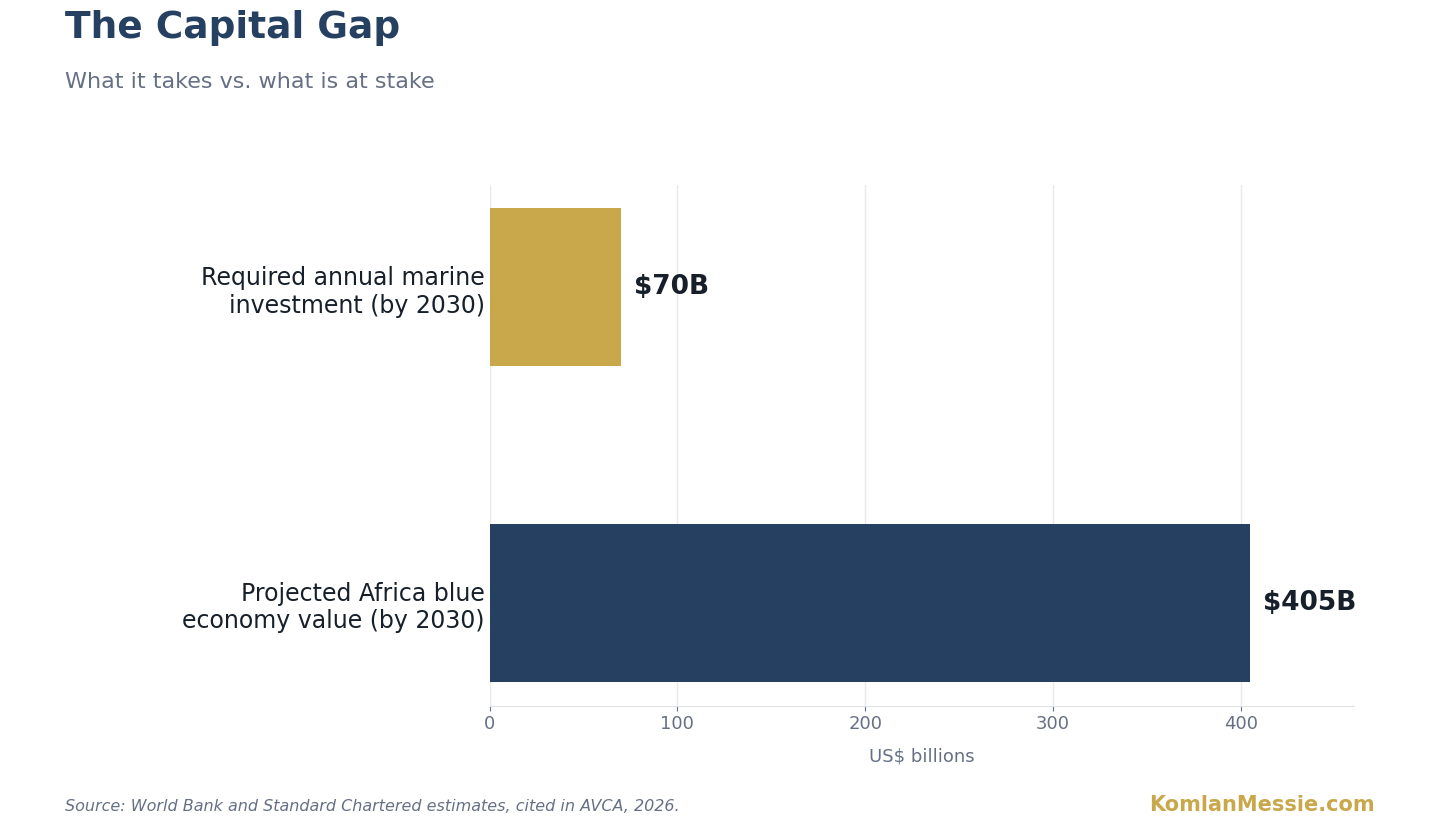
$405Bprojected value of Africa's blue economy by 2030. Blue Africa Conference, cited in The Guardian Nigeria, 2026

1. The ports paradox

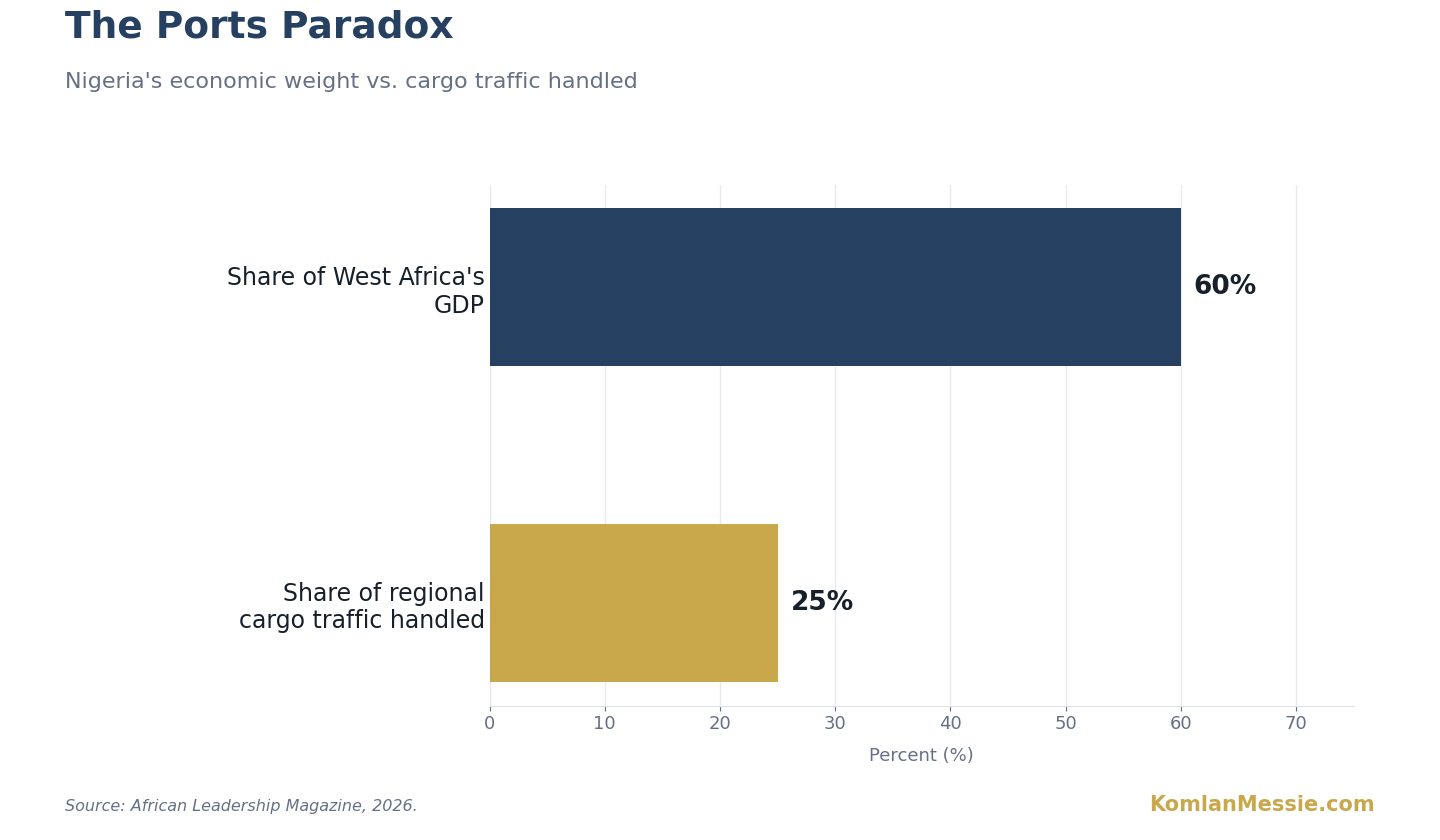
Trade concentration in the region's largest economy far exceeds the infrastructure capacity available to move it. Nigeria generates more than 60 percent of West Africa's GDP but handles only about 25 percent of regional cargo traffic.1 Across the continent, ports already handle approximately 90 percent of international trade.2 Cargo that should move through modern, competitive terminals instead moves through congested, higher-cost corridors, adding time and cost to nearly every container in the region. Port modernization, single-window trade systems and digitalization are not technical upgrades. They are the precondition for the region actually capturing the trade volumes its economies already generate.

Bar chart of Nigeria's share of West Africa's GDP versus its share of regional cargo traffic

2. The billion-dollar leak

Fisheries, one of the region's oldest blue sectors, is bleeding value through weak enforcement. Illegal, unreported and unregulated fishing costs six West African states, Mauritania, Senegal, The Gambia, Guinea-Bissau, Guinea and Sierra Leone, an estimated $2.3 billion a year.3,4 Regional catch levels are estimated to run roughly 40 percent above what is officially reported. Fisheries employ hundreds of thousands of people directly and indirectly across the region. What is lost to illegal fishing is lost twice: once as revenue, once as food security.

3. The security tax

Instability at sea is priced into every transaction that crosses it. The United Nations Office on Drugs and Crime estimates that piracy costs Gulf of Guinea states more than $1.9 billion a year in direct and indirect losses.5 Insurance premiums, security contracting and rerouted vessels raise the cost of doing business for the entire region, not only the countries directly targeted. Maritime security is trade policy. Full operationalization of the Yaoundé Code of Conduct is an economic priority, not only a defense one.

Bar chart of annual losses from illegal fishing and Gulf of Guinea piracy

4. The missing framework

ECOWAS has built a Blue Economy Strategic Framework; most member states have not yet built the national capacity to match it. ECOWAS counts 12 coastal and island member states, plus three landlocked states with access to major river systems, all falling under the ECOWAS Blue Economy Strategic Framework, ECOBESF.6 A regional framework only creates value once it is translated into harmonized national regulation, shared data standards and joint enforcement mechanisms. The coming test for ECOWAS is not writing another strategy. It is building the institutional capacity to implement the one it already has.

5. The capital gap

The capital required to build the sector is well above what currently flows into it. Africa's blue economy is projected to reach $405 billion in value by 2030,7,8 while the World Bank and Standard Chartered estimate the continent needs roughly $70 billion a year in marine investment to get there.7 Without blended finance structures and de-risking instruments, most of that gap will not close on its own. For investors and development partners, the blue economy is one of the more clearly under-capitalized infrastructure classes on the continent.

Bar chart comparing required annual marine investment to the projected value of Africa's blue economy by 2030

What leaders should do now: a 12 to 36 month path

This is a sequencing question, not an ambition question, from governance repair to capital mobilization.

Horizon 1, 0 to 12 monthsOperationalize ECOBESF nationally with harmonized reporting, fund joint monitoring and surveillance capacity, and publish transparent fisheries and port throughput data.
Horizon 2, 12 to 24 monthsFully resource the Yaoundé Code of Conduct architecture, establish a regional port coordination mechanism, and create a blended-finance vehicle for blue infrastructure.
Horizon 3, 24 to 36 monthsStructure blue bonds and de-risked instruments to mobilize private investment, build regional capacity-transfer programs, and position AfCFTA implementation to include maritime value chains.

“For African decision-makers, the blue economy is not a future opportunity. It is a present one: already generating value, already leaking value, and already being priced by markets whether or not governments are in the room. The countries and regional bodies that move first on governance and data will set the terms for everyone who follows.”

NovaHub Consulting

Where NovaHub fits

NovaHub Consulting advises governments, regional institutions and investors exploring blue economy strategy, maritime governance and investment readiness.

Book a conversation
Komlan Messie
About the author

Komlan Messie, MBA, Polytechnician

A career built at the intersection of business, diplomacy and civic leadership.

Komlan Messie, MBA, is an international executive, entrepreneur and strategic advisor with more than two decades of experience across management, technology, institutional development, strategic transformation and international development. His work focuses on helping organisations, institutions and leaders navigate transformation, innovation, public policy and complex strategic challenges.

Mr. Messie is the founder and Chief Executive Officer of NovaHub Consulting and the Regional Executive Director of WACSOF-FOSCAO, the West African civil society network spanning ECOWAS member states. He is also the cofounder and chairman of the Réseau des Entrepreneurs et Professionnels Africains (REPAF) and the chairman of the Forum Afrique Expansion Canada, and he co-founded Aliments Frunil in Canada. He is a former Vice President of the Project Management Institute Montreal (PMI Montreal) in Canada.

He holds an MBA from HEC Montréal, an M.Sc. in Computer Science and Operations Research from École Polytechnique de Montréal, and a B.Eng. in Electrical Engineering from École Polytechnique de Thiès (Senegal), and is PRINCE2 certified. He works across Canada, Africa and especially the ECOWAS region in French, English, Ewe and Wolof.

Continue the conversation with Komlan Messie
View full profile →
Download this article

Read offline or share with your team, including all charts and figures.

Sources

1.  African Leadership Magazine. (2026). Blue Economy: Unlocking Africa's Maritime Wealth. africanleadershipmagazine.co.uk.

2.  WMU Journal of Maritime Affairs, Springer Nature. (2026). Effective and Sustainable Shipping and Port Development in Africa. link.springer.com.

3.  Belhabib, D. et al., Frontiers in Marine Science. (2017). Assessing the Effectiveness of Monitoring, Control and Surveillance of Illegal Fishing: The Case of West Africa. frontiersin.org.

4.  Institute for Security Studies (ISS Africa). Illegal Fishing: Another Target in West Africa's Maritime Battleground. issafrica.org.

5.  United Nations Office on Drugs and Crime (UNODC), UN Security Council briefing. (2022). press.un.org.

6.  ECOWAS. ECOWAS Blue Economy Strategic Framework (ECOBESF). comhafat.org.

7.  AVCA. (2026). A Race to Unleash Africa's US$405 Billion Blue Economy Has Begun. avca.africa.

8.  The Guardian Nigeria. (2026). Fragmented Markets, Weak Governance Threaten Africa's $405b Blue Economy. guardian.ng.

9.  UN Trade and Development (UNCTAD). Maritime Trade and Africa. unctad.org.

← Back to Blog & Opinions
Newsletter

Get the analysis before the decision is made.

Subscribe for new insights, policy briefs and event updates. No noise, unsubscribe at any time.

Download the full paper

Enter your details to receive the secure download link. You will also be added to our newsletter list.

ENGAGE NOVAHUB