Senegal, Togo, Canada and across Africa
@gonovahub
Blog & Opinions

The ECOWAS Single Currency Test: Seven Conditions That Will Determine Whether It Succeeds

Five deadlines have already come and gone. A sixth is now set for 2027. Seven measurable conditions, not a summit declaration, will decide if it holds.

Komlan Messie, MBA, CEO of NovaHub Consulting • August 2026 • 8 min read

The seven-condition path to the Eco
In July 2026, West African heads of state did something their predecessors never dared: they abandoned the rule that every member state must qualify before the Eco can launch. That single decision may be the most consequential monetary policy choice ECOWAS has made in thirty years, and it will not be enough on its own.

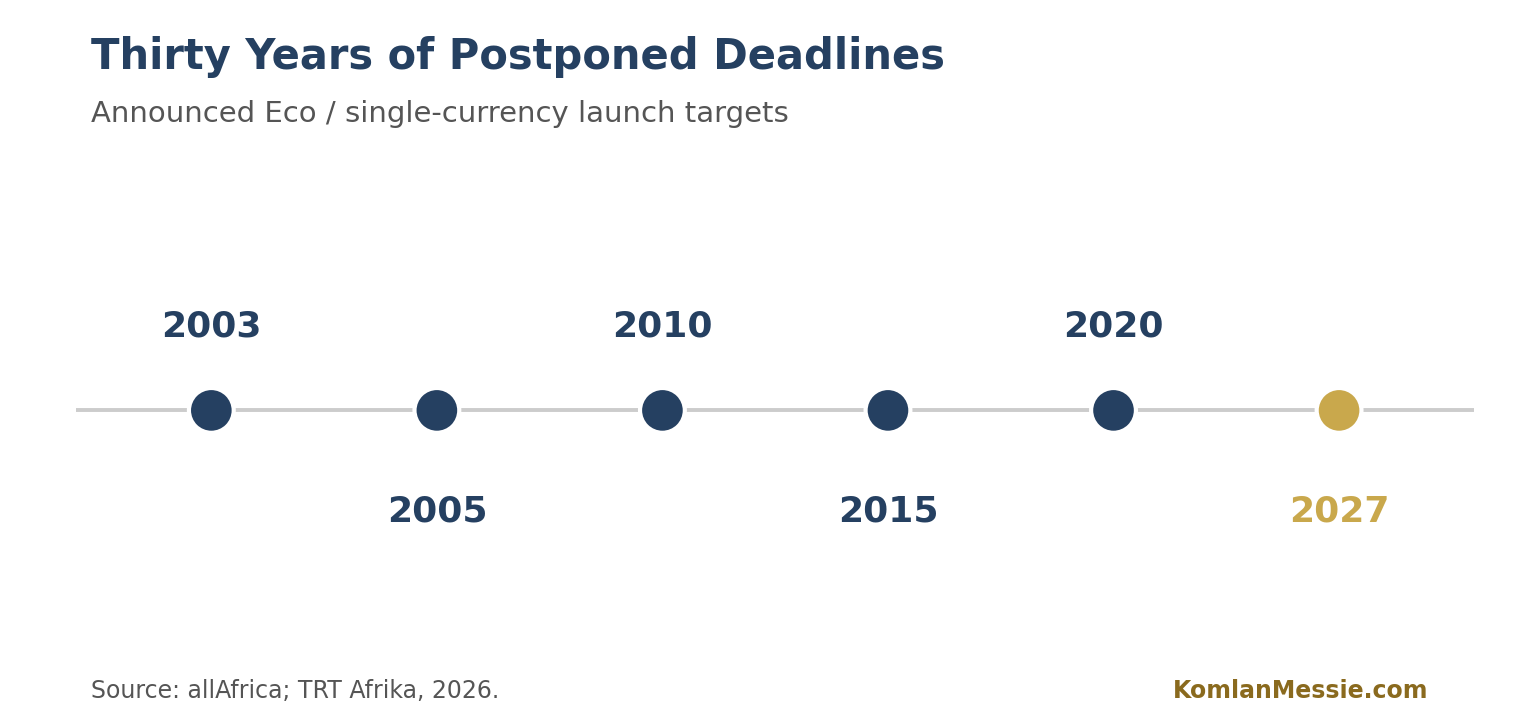
The Eco will succeed only if ECOWAS converts a political declaration into seven verifiable conditions: fiscal and monetary discipline that survives election cycles, a central bank with real authority, an honest framework for managing Nigeria's economic weight, political cohesion across a fragmenting bloc, a financed and enforceable sequencing plan, a real economy integrated enough to justify a shared currency, and a credible domestic revenue base. Where any one of these conditions is missing, the region reproduces the same failure pattern that shelved the project in 2003, 2005, 2010, 2015 and 2020.

6countries named in ECOWAS's July 2026 first-mover group, out of a bloc that once assumed fifteen.ECOWAS, 2026
9.9%average tax-to-GDP ratio across the region, less than half the 20% WAEMU convergence benchmark.AfDB, 2026
2027the sixth announced launch target, after deadlines set in 2003, 2005, 2010, 2015 and 2020 all lapsed.allAfrica, 2026

1. Convergence: the discipline that cannot be skipped

A single currency requires member states to accept a shared monetary policy, which only works if their inflation, deficits and debt move within a common band. ECOWAS's convergence criteria require single-digit inflation, a fiscal deficit ceiling of 4% of GDP, central bank financing of government limited to 10% of the prior year's tax revenue, and reserves covering at least three months of imports. These criteria have existed in some form since the early 2000s and have never been met simultaneously by the full membership.1

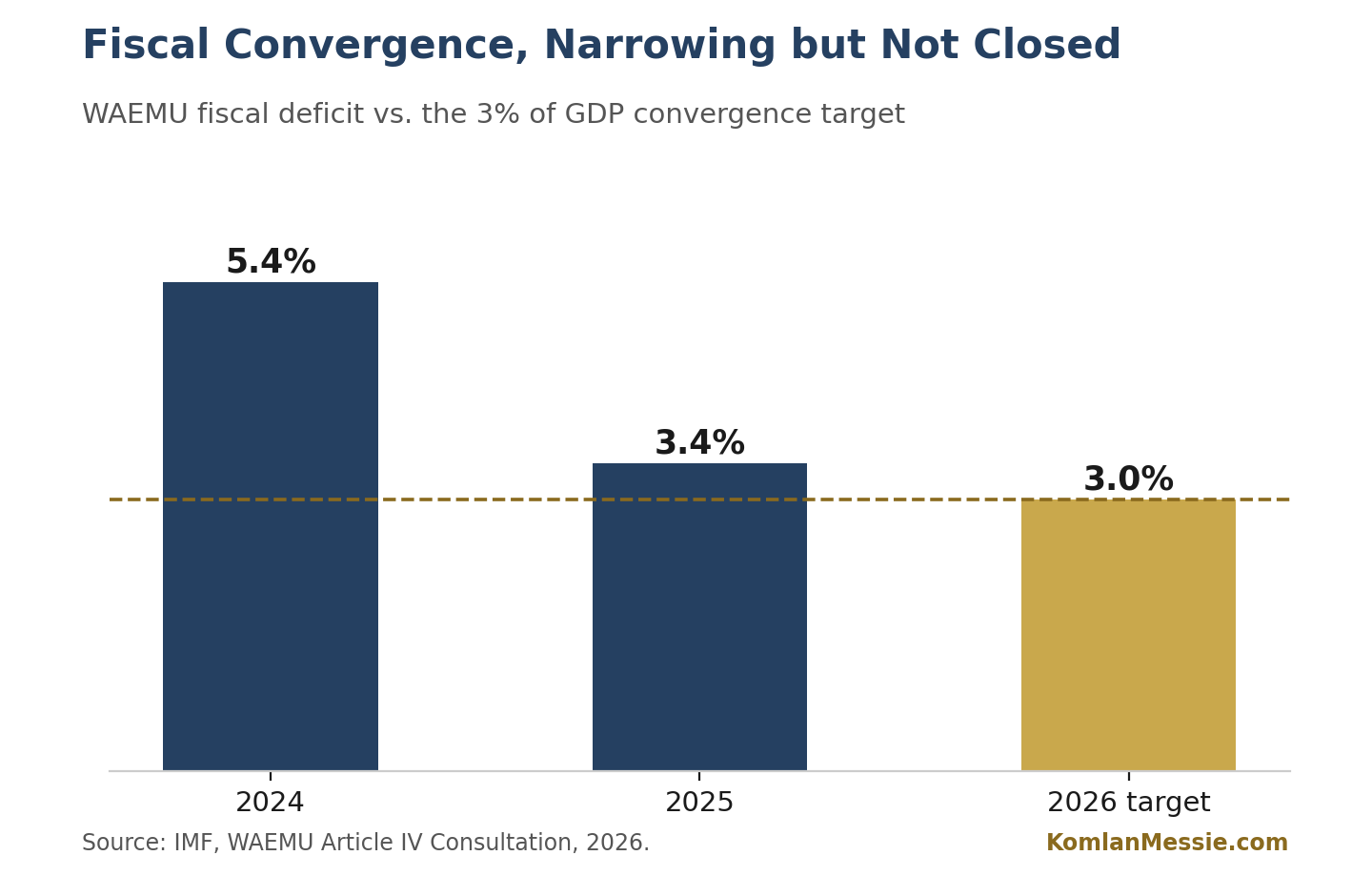
Fiscal convergence chart

The West African Economic and Monetary Union's own fiscal deficit fell from 5.4% of GDP in 2024 to 3.4% in 2025, still above the 3% target the IMF and the WAEMU Commission have set as the anchor for a revised Convergence Pact. A currency union without enforced convergence becomes a transfer union by default: the strongest economy absorbs the shocks of the weakest, precisely the design flaw the euro area spent a decade correcting after 2010. Convergence must be locked in through binding regional surveillance, not annual communiqués.1

2. Who holds the keys? The central bank question

A single currency without a single lender of last resort and a single monetary policy committee is not a currency union, it is a fixed exchange-rate arrangement with extra steps. As of mid-2026, ECOWAS has registered the Eco trademark and continues consultations between the Commission and central bank governors, but the future regional central bank's governance, decision-making rules and relationship to the existing BCEAO have not been settled.7,9 The real question for leaders is not whether the Eco has a name and a trademark, both of which are settled, but whether it will have an operationally independent institution with clear rules before the first country adopts it.

3. The Nigeria factor: managing an economic giant

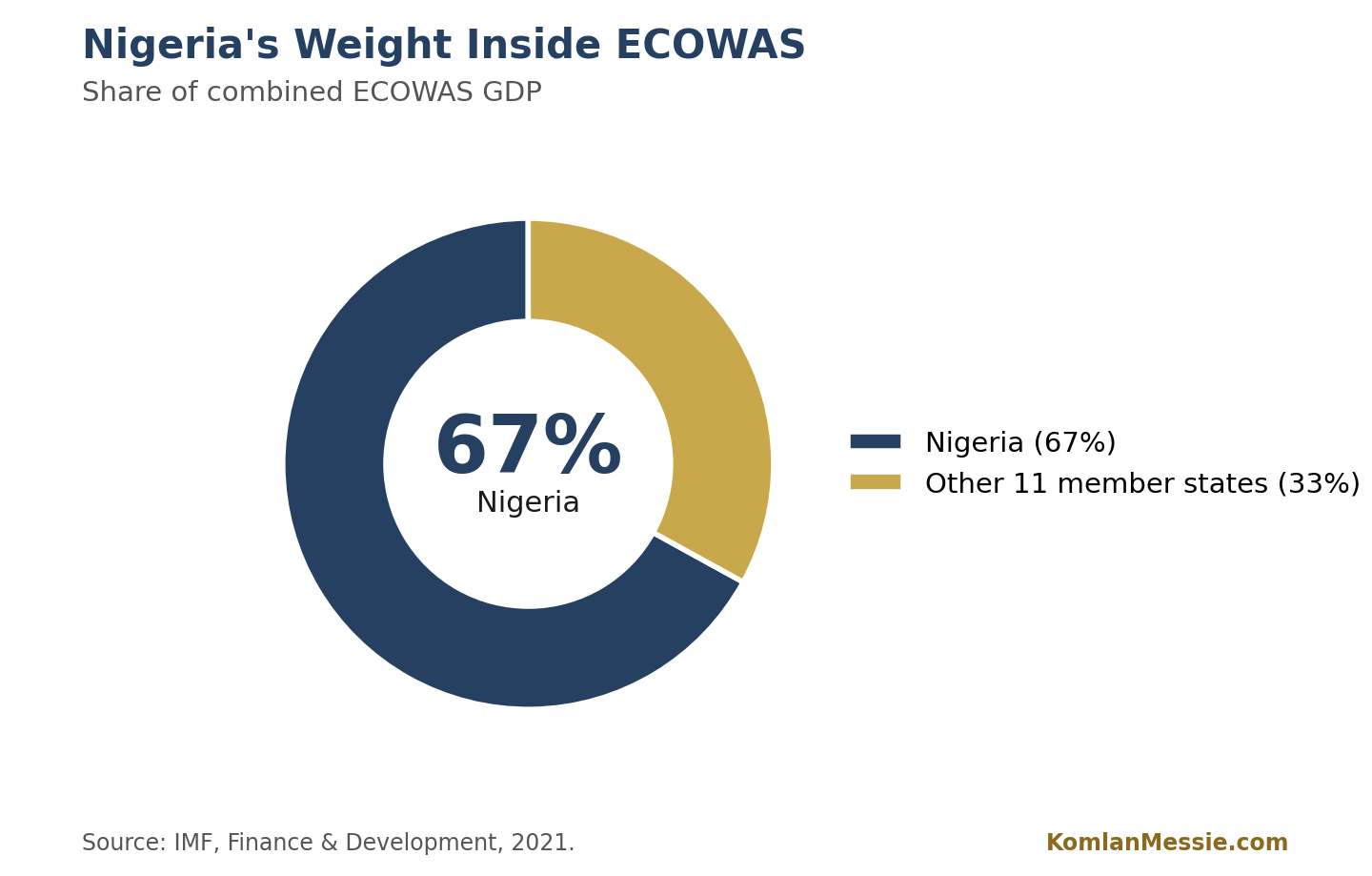
Donut chart: Nigeria is 67% of combined ECOWAS GDP

Nigeria's economic weight inside ECOWAS is the single largest structural risk to the project's political durability. Nigeria accounts for roughly two-thirds of ECOWAS's combined GDP, while the bloc's five smallest economies together represent under 2% of it. Monetary unions with one dominant economy tend to set policy that fits the dominant member and misfits everyone else, unless smaller members receive real influence over decision-making and access to stabilization instruments. From an institutional perspective, the credibility of the Eco depends less on Nigeria's participation than on the voting and governance architecture smaller members are given in exchange for accepting Nigeria's monetary gravity.2

4. A region redrawing its own map

Timeline of five postponed Eco launch deadlines, now 2027

The Eco project assumed a fifteen-member ECOWAS. That assumption no longer holds. Mali, Burkina Faso and Niger have withdrawn from ECOWAS while remaining inside the CFA franc zone, complicating both the management of the currency and the political sequencing of any successor. Guinea has separately announced it will keep its national currency rather than join the Eco at launch. ECOWAS's own July 2026 communiqué identified a working first-mover group of six: Nigeria, Ghana, Sierra Leone, Liberia, Guinea and The Gambia, a list that itself illustrates how far the bloc has moved from a unified fifteen-member rollout. The real question for leaders is not simply whether to launch the Eco but which ECOWAS is launching it.4,6,8

5. First movers: the bet on going it alone, together

The decision to allow ready countries to launch first, rather than waiting for all fifteen, is the single most important design change in the Eco's history. It is also unproven. At the July 2026 Lungi summit, ECOWAS formally adopted a phased, multi-speed rollout instead of the prior simultaneous-launch requirement, directing the Commission and the West African Monetary Agency to intensify coordination ahead of the December 2026 summit. Multi-speed monetary integration only works if non-qualifying members receive real technical and financial support to catch up, and if the first-mover group commits to firm eligibility rules rather than political convenience. Without both, sequencing becomes a permanent two-tier system rather than a transition path.3,5

6. Trade before currency: building the market the Eco will serve

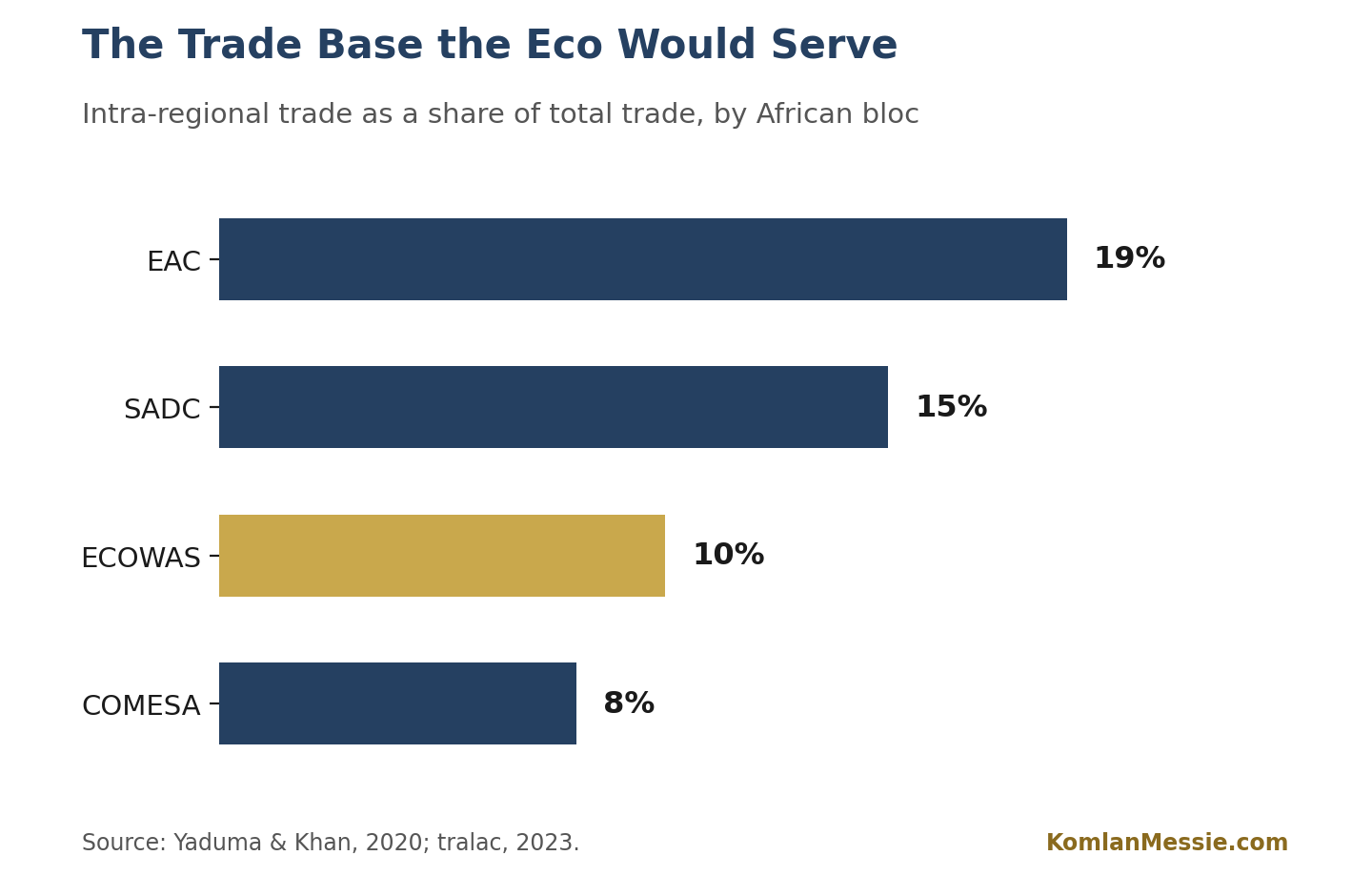
Bar chart comparing intra-regional trade share across African blocs

A currency union is most valuable when it removes friction from trade that is already substantial. ECOWAS has not yet built that trade base. Intra-ECOWAS trade remains at roughly 10 to 12% of the bloc's total trade, well below the levels seen in more integrated blocs and far below the intra-EU benchmark that underpinned the euro. The IMF has estimated that a single currency could still raise intra-ECOWAS trade by 15 to 20% if implemented prudently, precisely the argument for sequencing monetary union with, rather than ahead of, deeper trade liberalization under the African Continental Free Trade Area.13,14,15

7. The revenue test: funding discipline from within

A monetary union cannot outrun a fiscal crisis. West Africa's tax base is currently too shallow to sustain the deficit and debt discipline convergence requires. The African Development Bank's 2026 Regional Economic Outlook found the region's average tax-to-GDP ratio over the past five years was 9.9%, less than half the 20% WAEMU convergence benchmark, which limits governments' ability to finance development priorities without recourse to debt. Weak domestic revenue mobilization pushes governments toward central bank financing and short-term borrowing, exactly what the Eco's convergence criteria are designed to restrict. Revenue reform is slower and less politically rewarding than summit declarations, but it is the one condition without which every other condition eventually fails.3

What next: the 12 to 36 month window

Between now and the December 2026 summit, three markers will show whether these seven conditions are converging or diverging.

Eligibility rulesWhether the ECOWAS Commission and WAMA publish binding, transparent eligibility criteria for the first-mover group.
The Convergence PactWhether the WAEMU Convergence Pact is formally adopted rather than repeatedly proposed.
Central bank governanceWhether the regional central bank's governance structure is settled before, not after, the first country adopts the Eco.

“The Eco does not fail or succeed on the strength of a political declaration made in Lungi. It succeeds if seven conditions, each measurable and each currently incomplete, are met before the first note enters circulation.”

NovaHub Consulting

Where NovaHub fits

NovaHub Consulting advises governments, regional institutions and investors on the institutional design questions this analysis raises: convergence surveillance, central bank governance and revenue mobilization.

Book a conversation
Komlan Messie
About the author

Komlan Messie, MBA, Polytechnician

A career built at the intersection of business, diplomacy and civic leadership.

Komlan Messie, MBA, is an international executive, entrepreneur and strategic advisor with more than two decades of experience across management, technology, institutional development, strategic transformation and international development. His work focuses on helping organisations, institutions and leaders navigate transformation, innovation, public policy and complex strategic challenges.

Mr. Messie is the founder and Chief Executive Officer of NovaHub Consulting and the Regional Executive Director of WACSOF-FOSCAO, the West African civil society network spanning ECOWAS member states. He is also the cofounder and chairman of the Réseau des Entrepreneurs et Professionnels Africains (REPAF) and the chairman of the Forum Afrique Expansion Canada, and he co-founded Aliments Frunil in Canada. He is a former Vice President of the Project Management Institute Montreal (PMI Montreal) in Canada.

He holds an MBA from HEC Montréal, an M.Sc. in Computer Science and Operations Research from École Polytechnique de Montréal, and a B.Eng. in Electrical Engineering from École Polytechnique de Thiès (Senegal), and is PRINCE2 certified. He works across Canada, Africa and especially the ECOWAS region in French, English, Ewe and Wolof.

Continue the conversation with Komlan Messie
View full profile →

Download this article

Read offline or share with your team, including all charts and diagrams.

Sources

1.  International Monetary Fund, IMF Executive Board Concludes 2026 Discussions on Common Policies of WAEMU (2026), imf.org.

2.  International Monetary Fund, The Promise of a West Africa Currency Union, Finance & Development (2021), imf.org.

3.  African Development Bank, West Africa Regional Economic Outlook 2026, as reported by allAfrica (2026), allafrica.com.

4.  allAfrica.com, West Africa: ECOWAS Reaffirms 2027 Launch of Eco Single Currency (2026), allafrica.com.

5.  Dabafinance, ECOWAS Reaffirms 2027 Launch of ECO Single Currency (2026), dabafinance.com.

6.  The Rio Times, West African Bloc ECOWAS Targets 2027 ECO Currency Launch (2026), riotimesonline.com.

7.  Africanews, Guinea Opts Out of Planned ECOWAS Single Currency, the Eco (2026), africanews.com.

8.  Africanews, ECOWAS Reaffirms Plans to Launch Single Currency in 2027 (2026), africanews.com.

9.  Pegasus Reporters, ECOWAS Reaffirms Plans to Launch Single Currency by 2027 (2026), pegasusreporters.com.

10.  Cap Mad, From UEMOA to the Eco: ECOWAS Bets on Step-by-Step Monetary Integration (2026), capmad.com.

11.  Liberian Observer, ECOWAS Single Currency Faces Race Against Time (2026), liberianobserver.com.

12.  UN Economic Commission for Africa, Assessment of Progress on Regional Integration in Africa (2025), tralac.org.

13.  tralac, Intra-Africa Trade Facts and Figures (2023), tralac.org.

14.  Yaduma, N., & Khan, H., Intra-regional Trade and African Economic Integration (2020), aehnetwork.org.

15.  TheCable, Moving Nigeria Closer to the Centre of the Eco (2026), thecable.ng.

← Back to Blog & Opinions
Newsletter

Get the analysis before the decision is made.

Subscribe for new insights, policy briefs and event updates. No noise, unsubscribe at any time.

Download the full paper

Enter your details to receive the secure download link. You will also be added to our newsletter list.

ENGAGE NOVAHUB