Senegal, Togo, Canada and across Africa
@gonovahub
Blog & Opinions

Africa's Banks Are Winning. But Are They Ready for AI?

The AI Governance Imperative: Why Africa's Financial Sector Must Govern AI Before It Scales.

Komlan Messie, MBA, Polytechnician, CEO of NovaHub Consulting • 2026 • 7 min read

Africa's banks are winning, but is AI governed
Africa's banks just posted a return on equity nearly double the global average. At the same time, no African market has crossed 20 percent AI adoption, and only a handful of financial supervisors on the continent have a board-level AI policy.

That gap, between commercial performance and institutional readiness, is the strategic story of the next decade in African finance. The institutions that will lead Africa's financial sector through 2035 will not be the ones that deploy AI fastest. They will be the ones that govern it first. Speed without governance produces exposure: model bias in credit decisions, regulatory penalties, reputational loss and systemic risk that regulators are not yet equipped to catch. For African CEOs, ministries and investors, the strategic question is no longer should we adopt AI. It is: do we have the governance architecture to deploy it safely, at scale, before our competitors or our regulators force the pace.

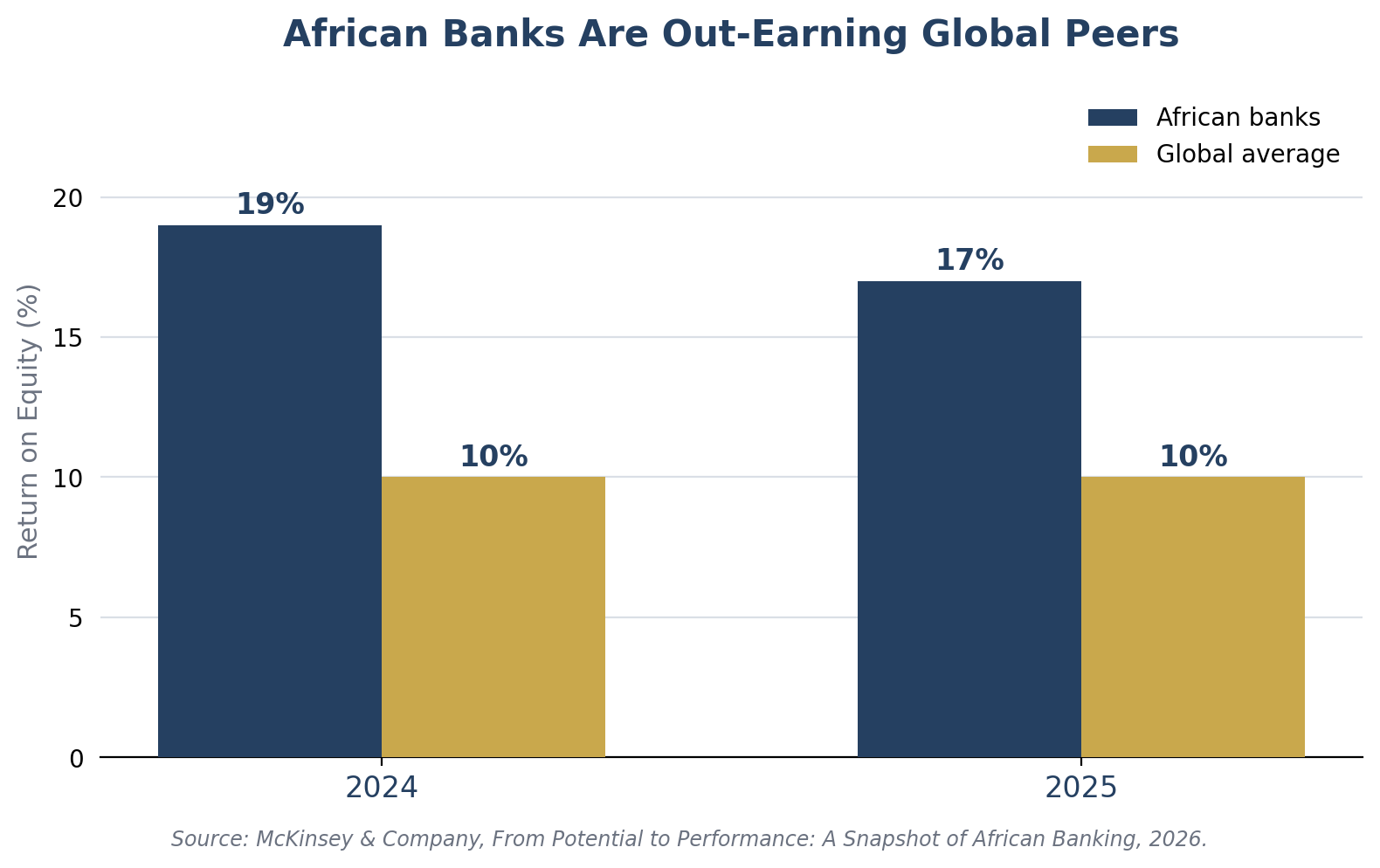
19%African bank ROE in 2024, vs. 10% global average. McKinsey, 2026
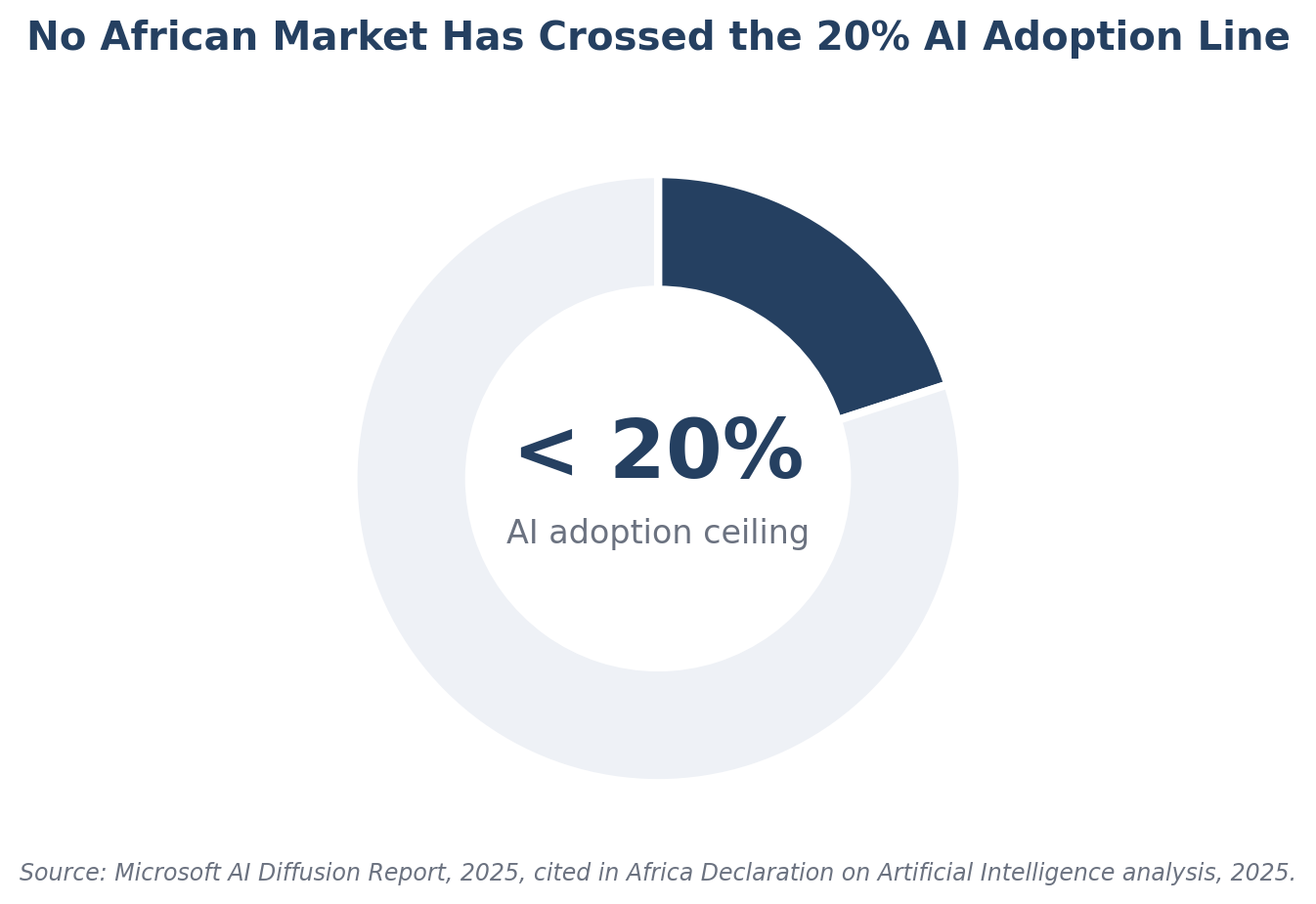
<20%AI adoption ceiling across every African market. Microsoft, 2025
$1Tprojected AI-driven GDP gain for Africa by 2035. AfDB, 2025

The performance paradox: winning today, exposed tomorrow

African banks are outperforming, but the underlying engine is still analog. African banks delivered a return on equity of 19 percent in 2024 and 17 percent in 2025, against a global average of roughly 10 percent, driven largely by high interest margins and strong non-interest income. Yet this performance has been achieved with AI still at the margins of core operations. Retail banking is the most common entry point for digital transformation on the continent, cited by 39 percent of senior bank executives surveyed across 40 countries.2

Bar chart: African banks out-earning global peers, 19 percent vs 10 percent

Current profitability is a rate story, not a productivity story. Interest-rate cycles turn. When they do, institutions without an AI-driven cost and risk advantage will find their margins compress with nothing to offset them. Boards should treat today's strong earnings as a funding window, not a validation to slow down. This is the moment to invest in AI capability while the balance sheet can absorb it.

The adoption ceiling: why no one has broken 20 percent

Donut chart: no African market has crossed the 20 percent AI adoption line

Structural constraints, electricity availability, data centre capacity, internet access, digital skills and linguistic barriers, keep every African market below this threshold. Among financial institutions with at least early-stage adoption, the most common uses are customer service chatbots, fraud detection and anti-money-laundering screening, with African institutions leaning toward AI-driven credit scoring. Globally, the bar remains high: only four of the fifty largest banks worldwide reported realised AI return on investment in 2025.1,7 The infrastructure gap is real, but it is not the binding constraint for most financial institutions. Capital, talent and governance capacity are. Institutions do not need to wait for continental infrastructure to catch up. Targeted, well-governed deployment in credit scoring, fraud detection and compliance can generate returns today, ahead of the infrastructure curve.

The governance deficit: rules written after the fact

Regulators are behind the institutions they supervise, and institutions are behind their own ambitions. A 2025 World Bank survey of 27 financial sector authorities found that most expect AI to deliver a net positive impact, yet few have board-level AI strategies or supervisory policies in place. The African Union's Continental AI Strategy, endorsed in July 2024, sets a broad governance framework that member states must translate into national and sectoral policy during its 2025 to 2027 Ignition phase. In April 2025, 49 African countries signed the Africa Declaration on Artificial Intelligence in Kigali, establishing a $60 billion Africa AI Fund, a strong political signal that has not yet translated into binding financial-sector rules.4,5,6 In the absence of binding sector-specific regulation, the burden of governance falls on individual institutions. Waiting for regulators to define the rules is not a strategy, it is a delay that increases exposure. The real question for leaders is not whether ECOWAS or the AU will eventually regulate AI in finance. It is whether the institution's own governance architecture will meet or exceed that future standard before it is written.

The trillion-dollar countdown

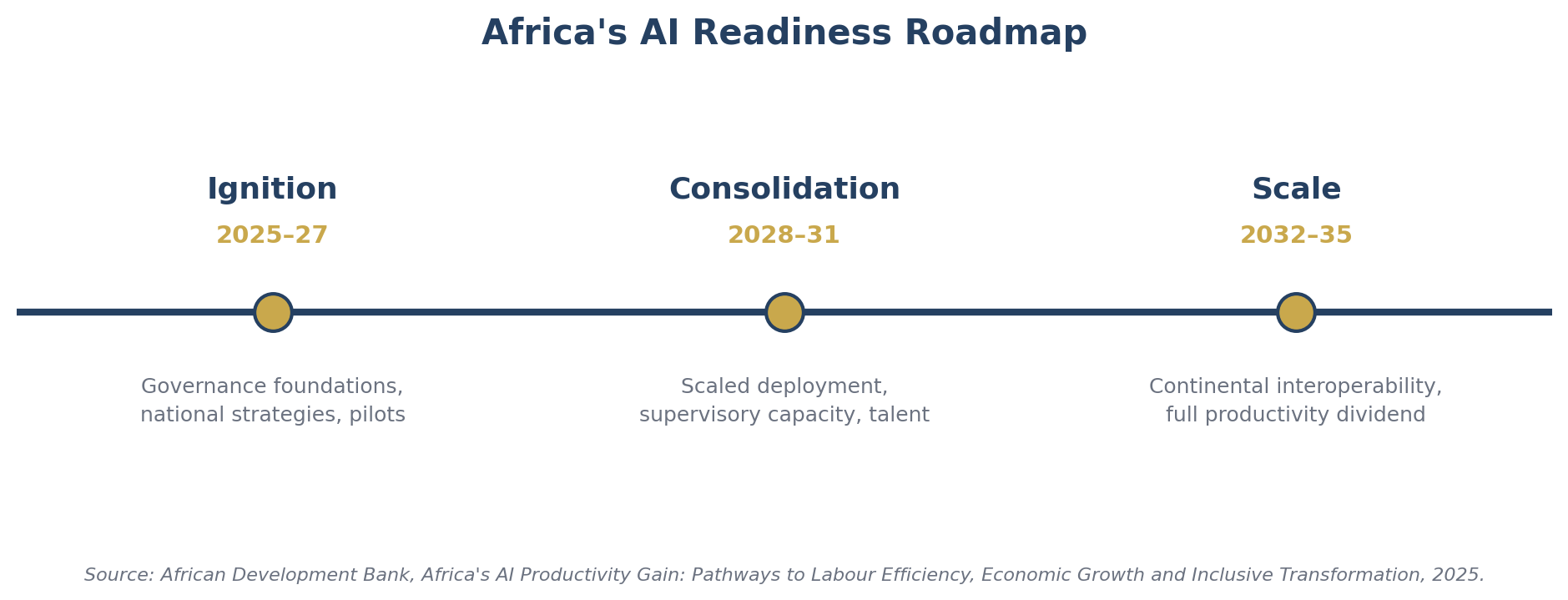
Timeline: Africa's AI readiness roadmap, Ignition, Consolidation, Scale

AI could add roughly $1 trillion to Africa's GDP by 2035, but only on a phased, disciplined path. The African Development Bank projects that AI-driven productivity gains could add approximately $1 trillion to Africa's GDP by 2035, provided the continent builds workforce skills, regulatory trust and adequate capital investment in parallel. The Bank's roadmap moves through three phases: Ignition (2025-2027), Consolidation (2028-2031) and Scale (2032-2035).3 This is not an open-ended opportunity. The Bank is explicit that early milestones by 2026 will determine whether the flywheel starts turning at all. Institutions that build governance and capability during Ignition will compound their advantage through Consolidation and Scale. Those that wait will be building governance under regulatory and competitive pressure, at higher cost.

The AI Firewall: a blueprint for governing at speed

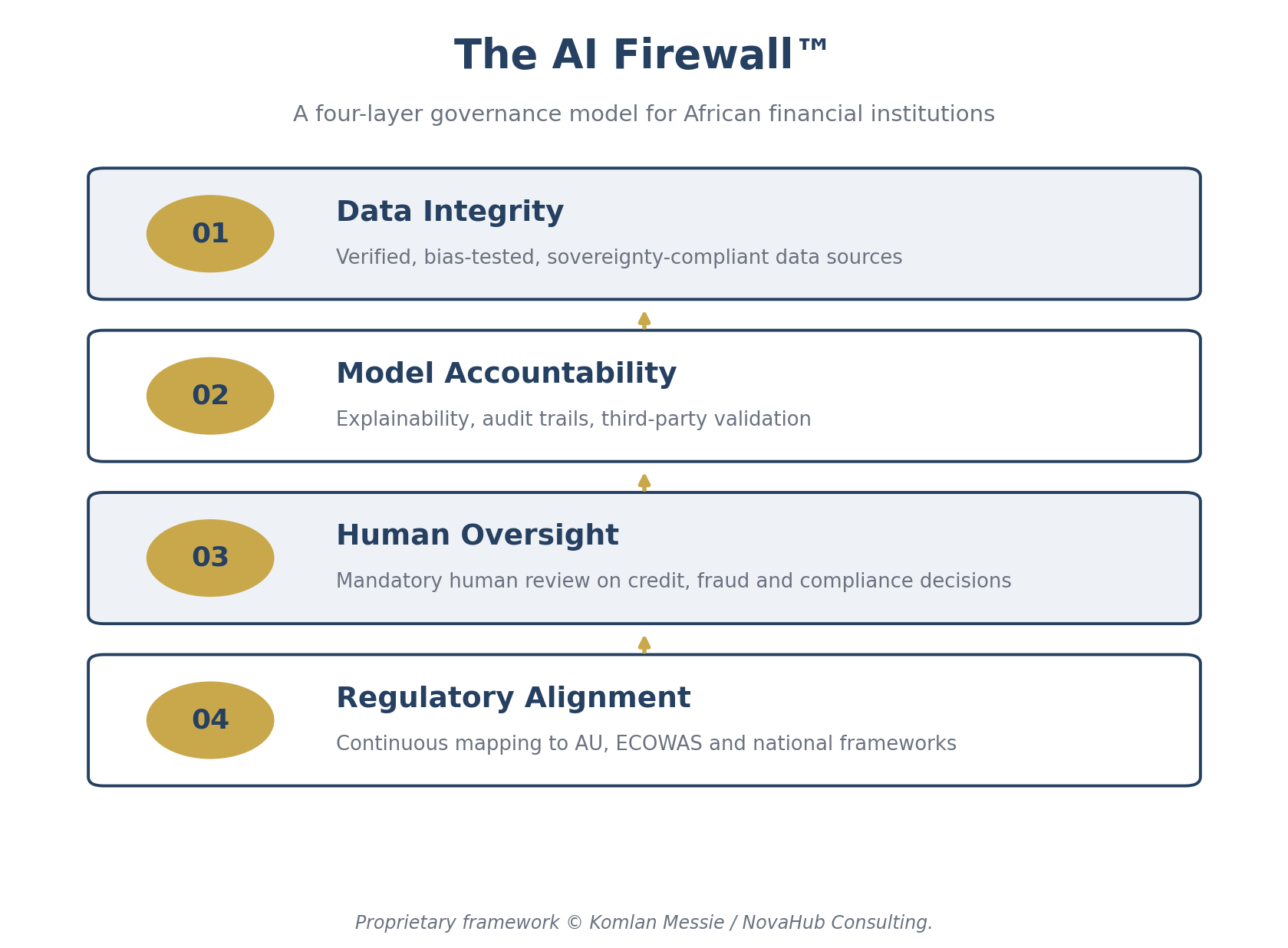
The strategic issue is not whether to adopt AI. It is whether the institution has a governance architecture capable of absorbing AI at the pace the market and the balance sheet demand. Financial institutions that treat AI governance as a compliance afterthought consistently underperform those that build it as core infrastructure. The AI Firewall™ is a four-layer governance model designed for this environment, sequencing the safeguards most programs bolt on too late:

The AI Firewall framework: Data Integrity, Model Accountability, Human Oversight, Regulatory Alignment
Data IntegrityVerified, bias-tested, sovereignty-compliant data sources before any model is trained or deployed.
Model AccountabilityExplainability, audit trails and third-party validation for every model touching a credit, fraud or compliance decision.
Human OversightMandatory human review at defined decision points, on credit, fraud and compliance.
Regulatory AlignmentContinuous mapping against African Union, ECOWAS and national frameworks as they evolve.

Institutions that implement these four layers before scaling AI deployment convert a regulatory and reputational risk into a competitive moat. Governance is not the brake on AI adoption in African finance. It is the only mechanism that makes scale possible without catastrophic failure.

The leadership playbook: three moves to make now

Bank & fintech CEOsFund AI governance from current profitability, not a future budget cycle. Appoint board-level accountability for AI risk within the next two quarters.
Regulators & central banksFormalise sector-specific AI supervisory guidance ahead of the AU's 2027 Consolidation phase, rather than adopting frameworks reactively after an incident forces the issue.
Development partners & investorsStructure AI-related financing and technical assistance around governance capability, not only technology procurement.

“Speed without governance produces exposure. Governance without speed produces irrelevance. The institutions that win will build both, together, starting now.”

NovaHub Consulting

Where NovaHub fits

NovaHub Consulting advises banks, fintechs, regulators and investors on AI governance architecture, using the AI Firewall™ framework to convert regulatory exposure into a durable advantage.

Book a conversation
Komlan Messie
About the author

Komlan Messie, MBA, Polytechnician

A career built at the intersection of business, diplomacy and civic leadership.

Komlan Messie, MBA, is an international executive, entrepreneur and strategic advisor with more than two decades of experience across management, technology, institutional development, strategic transformation and international development. His work focuses on helping organisations, institutions and leaders navigate transformation, innovation, public policy and complex strategic challenges.

Mr. Messie is the founder and Chief Executive Officer of NovaHub Consulting and the Regional Executive Director of WACSOF-FOSCAO, the West African civil society network spanning ECOWAS member states. He is also the cofounder and chairman of the Réseau des Entrepreneurs et Professionnels Africains (REPAF) and the chairman of the Forum Afrique Expansion Canada, and he co-founded Aliments Frunil in Canada. He is a former Vice President of the Project Management Institute Montreal (PMI Montreal) in Canada.

He holds an MBA from HEC Montréal, an M.Sc. in Computer Science and Operations Research from École Polytechnique de Montréal, and a B.Eng. in Electrical Engineering from École Polytechnique de Thiès (Senegal), and is PRINCE2 certified. He works across Canada, Africa and especially the ECOWAS region in French, English, Ewe and Wolof.

Continue the conversation with Komlan Messie
View full profile →
Download this article

Read offline or share with your team, including all charts and the AI Firewall™ framework diagram.

Sources

1.  African Development Bank. (2025). Africa's AI Productivity Gain: Pathways to Labour Efficiency, Economic Growth and Inclusive Transformation. afdb.org.

2.  Backbase and African Banker. (2025). Africa Digital Banking Experience Series 2025: Retail Banking, Competing for the Modern African Customer. africabusinesscommunities.com.

3.  EY-Parthenon. (2025). Generative AI in Banking Survey. Cited in AfricAI Group, The AI Moment in African Financial Services, 2026. africai.group.

4.  Future Center for Advanced Studies and Research. (2025). Assessing the African Union's Efforts to Establish AI Governance. futureuae.com.

5.  McKinsey & Company. (2026). From Potential to Performance: A Snapshot of African Banking. Cited in Consultancy.Africa, 2026. consultancy.africa.

6.  OECD. (2025). Harnessing AI in Finance for Financial Inclusion in Africa: Africa Capital Markets Report 2025. oecd.org.

7.  World Bank. Boeddu, G. et al. (2025). Artificial Intelligence for Financial Sector Supervision: An Emerging Market and Developing Economies Perspective. Commissioned by the South African G20 Presidency. documents1.worldbank.org.

← Back to Blog & Opinions
Newsletter

Get the analysis before the decision is made.

Subscribe for new insights, policy briefs and event updates. No noise, unsubscribe at any time.

Download the full paper

Enter your details to receive the secure download link. You will also be added to our newsletter list.

ENGAGE NOVAHUB