Senegal, Togo, Canada and across Africa
@gonovahub
Blog & Opinions

15 Countries, 15 Markets: The West African Mobile Telecom Battle

Who is winning mobile connectivity in West Africa?

Komlan Messie, MBA, Polytechnician, CEO of NovaHub Consulting • 2026 • 6 min read

West African mobile telecom battle: 15 countries, 15 markets
Senegal reports 125.8 percent mobile penetration. Guinea-Bissau reports 128.1 percent. Only one of them has more than 60 percent of its population actually online.

On paper, West Africa is already connected. Senegal's mobile penetration stands at 125.8 percent, Côte d'Ivoire's exceeds 181 percent, and Togo has just crossed the 100 percent mark for the first time.6,7,9 In reality, fifteen national markets are moving at radically different speeds, and the same headline statistic, SIM penetration, conceals both genuine progress and deep digital divides. The region is no longer fighting to add SIM cards. It is fighting to turn fifteen fragmented markets into a single infrastructure for growth, regional integration and digital sovereignty. The countries winning this battle are not the ones with the most subscribers, but the ones converting connectivity into real usage, data, payments and jobs.

181%mobile penetration in Côte d'Ivoire in 2024, the highest in the region. ARTCI, 2025
26.5%real mobile internet usage in Guinea, despite SIM penetration of 108.9%. World Bank and ITU
7.8%of Africa's GDP is now generated by the mobile sector. GSMA, 2026

1. Fifteen markets, three speeds

Five criteria allow an objective ranking of the fifteen West African markets: mobile subscriptions, penetration rate, 4G and 5G coverage, real mobile internet adoption, and digital market maturity. The table below uses the most recent figure published by each national regulator. Where none exists, the latest verifiable World Bank and ITU figure is used, with the year indicated. No figure is estimated or interpolated.1,5,6,7,9,10,11,12

CountrySubscriptionsPenetration4G/5G coverageInternet usageMaturity
Côte d'Ivoire49M accounts (2022)181.0% (2024)4G 63.7% (2022)Not publishedLeader
Guinea-BissauNot consolidated128.1% (2023)Not published32.5% (2023)Laggard
Senegal23.4M mobile internet125.8% (2025)Not published60.1% (2024)Challenger
Burkina FasoNot consolidated119.0% (2022)Not publishedNot publishedConstrained
Benin10.3M real users78.1% real (2025)58% of internet subs.64.9% (2025)Challenger
Cabo Verde0.59M (2023)113.0% (2023)Not published71.0% (2024)Leader
Mali25.9M (2022)112.1% (2022)Not publishedNot publishedConstrained
GuineaNot consolidated108.9% (2022)Not published26.5% (2023)Laggard
Sierra Leone8.9M (2022)108.0% (2022)Not publishedNot publishedLaggard
GambiaNot consolidated106.8% (2022)Not publishedNot publishedLaggard
Togo8.7M (Q3 2025)100.3% (2025)4G 42% of devicesNot publishedChallenger
GhanaNot consolidated98.8% (2023)Not publishedNot publishedLeader
Nigeria179.6M (2025)82.9% (2025)4G 51.6%, 5G 3.4%52.0% (2025)Leader
NigerNot consolidated65.7% (2023)Not publishedNot publishedLaggard
LiberiaNot consolidated32.1% (2022)Not publishedNot publishedLaggard

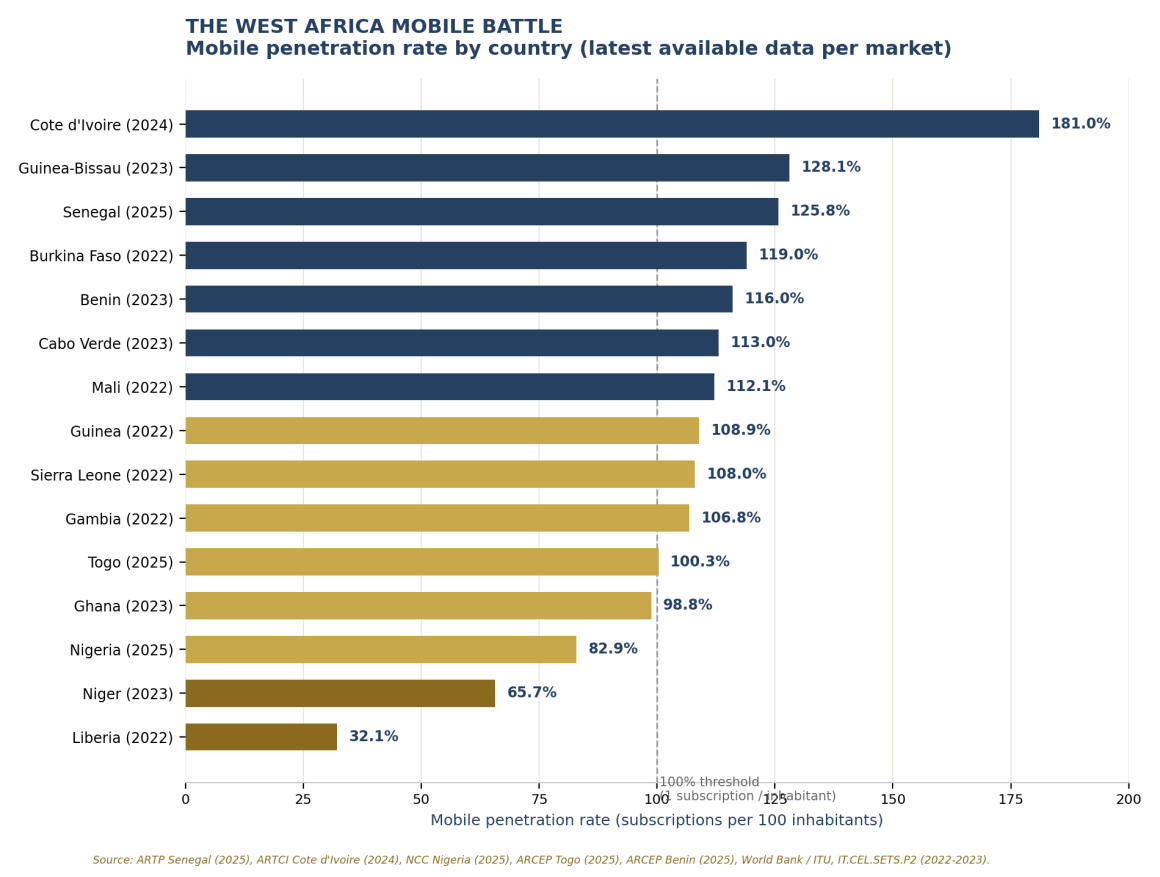
Benin's table row reports real unique users (78.1 percent), while the ranking chart below uses the regulator's 2023 SIM-based figure (116.0 percent). The gap between the two is the point of this article.

Bar chart: mobile penetration rate by country in West Africa, latest available data
Group 1: The LeadersNigeria, Côte d'Ivoire, Ghana and Cabo Verde. Markets where connectivity has already turned into an economic ecosystem: mature mobile money, meaningful weight in national GDP, stable regulatory framework.
Group 2: The Rising ChallengersSenegal, Benin and Togo. Sharp recent growth in penetration and active reform agendas, but still a wide gap between SIM cards and real mobile internet usage.
Group 3: The Structural LaggardsGuinea, Guinea-Bissau, Sierra Leone, Gambia, Niger and Liberia, plus Mali and Burkina Faso for security-related reasons. Either a shortage of reliable public data, or a genuine unresolved digital divide.

2. The SIM card is the wrong metric

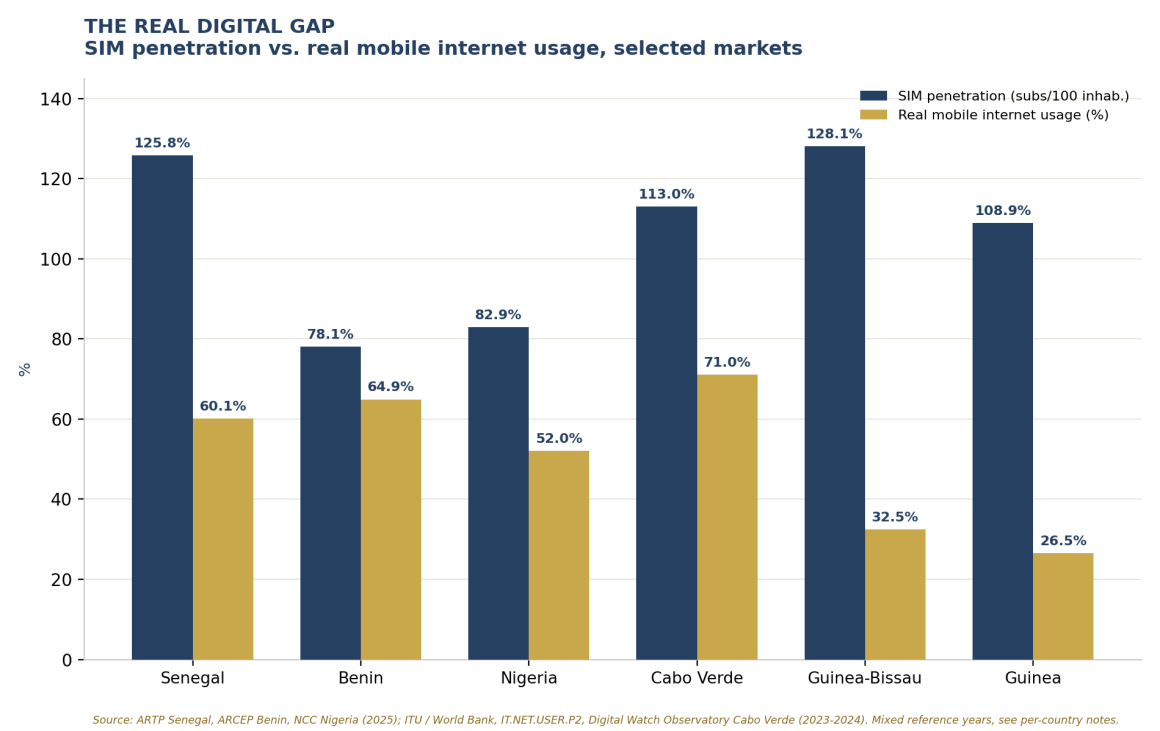
SIM penetration does not predict digital maturity. Guinea and Guinea-Bissau both show penetration above 100 percent, yet real mobile internet usage three to four times lower than Cabo Verde or Senegal. Guinea-Bissau records 128.1 percent penetration and 32.5 percent internet usage. Cabo Verde records 113.0 percent and 71.0 percent.6,10,11,12 It is this gap, not the SIM count, that should guide public policy.

Bar chart: SIM penetration versus real mobile internet usage, selected West African markets

3. Mobile is now a macroeconomic engine

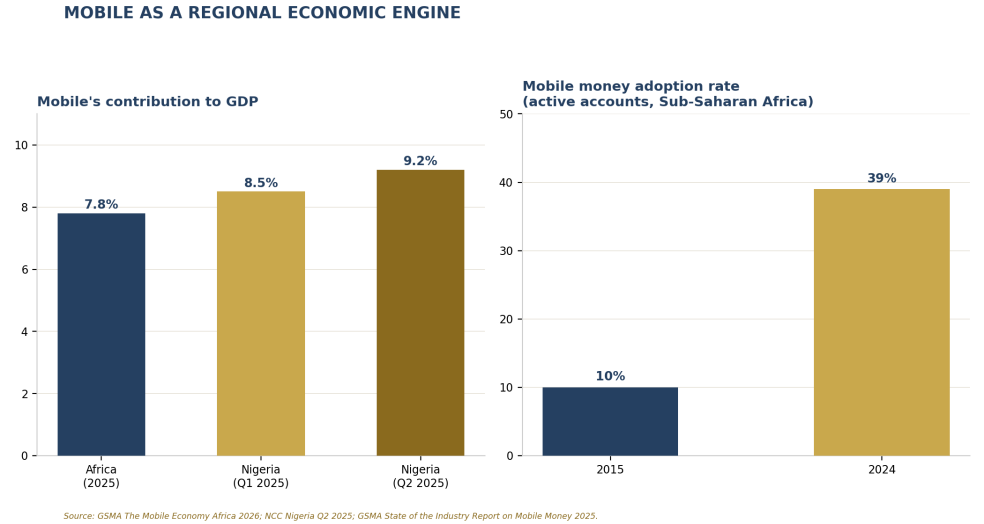
Bar charts: mobile contribution to GDP and mobile money adoption rate in Sub-Saharan Africa

Mobile is no longer a peripheral sector. It now accounts for 7.8 percent of Africa's GDP and up to 9.2 percent of Nigeria's GDP in the second quarter of 2025.1,5 Mobile money adoption in Sub-Saharan Africa rose from 10 percent in 2015 to 39 percent in 2024, proof that network coverage translates, under the right conditions, into real financial inclusion.3

4. Who wins the battle

West Africa does not simply need more connections. It must turn its mobile networks into infrastructure for growth, regional integration and digital sovereignty. African operators are progressively repositioning as digital partners to businesses and governments, with artificial intelligence, network APIs and enterprise digitalization as the new engines of value.2 The real winner of this battle will be neither the country with the most subscribers nor the operator with the largest market share, but the regional institution able to turn fifteen fragmented markets into a single market for data, payments and digital services.

What leaders should measure instead

Three shifts follow from the data.

Governments and regulatorsReport real mobile internet usage alongside SIM penetration, so that policy targets the usage gap rather than the subscription count.
Regional institutionsTreat the fifteen national markets as one data, payments and digital services market, and track convergence at that level.
Operators and investorsPrice markets on conversion of connectivity into usage, mobile money and enterprise services, not on subscriber totals.

“The winner will not be the country with the most subscribers. It will be the institution that turns fifteen markets into one.”

NovaHub Consulting

Where NovaHub fits

NovaHub Consulting advises governments, regulators, operators and investors on digital market diagnostics, regional integration and the institutional design questions this analysis raises.

Book a conversation
Komlan Messie
About the author

Komlan Messie, MBA, Polytechnician

A career built at the intersection of business, diplomacy and civic leadership.

Komlan Messie, MBA, is an international executive, entrepreneur and strategic advisor with more than two decades of experience across management, technology, institutional development, strategic transformation and international development. His work focuses on helping organisations, institutions and leaders navigate transformation, innovation, public policy and complex strategic challenges.

Mr. Messie is the founder and Chief Executive Officer of NovaHub Consulting and the Regional Executive Director of WACSOF-FOSCAO, the West African civil society network spanning ECOWAS member states. He is also the cofounder and chairman of the Réseau des Entrepreneurs et Professionnels Africains (REPAF) and the chairman of the Forum Afrique Expansion Canada, and he co-founded Aliments Frunil in Canada. He is a former Vice President of the Project Management Institute Montreal (PMI Montreal) in Canada.

He holds an MBA from HEC Montréal, an M.Sc. in Computer Science and Operations Research from École Polytechnique de Montréal, and a B.Eng. in Electrical Engineering from École Polytechnique de Thiès (Senegal), and is PRINCE2 certified. He works across Canada, Africa and especially the ECOWAS region in French, English, Ewe and Wolof.

Continue the conversation with Komlan Messie
View full profile →

Download this article

Read offline or share with your team, including all charts and figures.

Sources

1.  GSMA (2026), The Mobile Economy Africa 2026, gsma.com/solutions-and-impact/connectivity-for-good/mobile-economy/africa.

2.  GSMA Intelligence (2025), The Mobile Economy Africa 2025, gsmaintelligence.com/research/the-mobile-economy-africa-2025.

3.  GSMA (2025), The State of the Industry Report on Mobile Money 2025, gsma.com/sotir.

4.  GSMA (2024), Mobile Economy Sub-Saharan Africa 2024, press release, gsma.com/newsroom.

5.  Nigerian Communications Commission (2026), December 2025 performance report, as reported by vanguardngr.com.

6.  Autorité de Régulation des Télécommunications et des Postes du Sénégal, ARTP (2026), Quarterly report Q4 2025, artp.sn.

7.  Autorité de Régulation des Télécommunications/TIC de Côte d'Ivoire, ARTCI, as reported by Afrique Diplomatique (2025).

8.  U.S. International Trade Administration (2023), Côte d'Ivoire Country Commercial Guide, Telecommunications, trade.gov.

9.  Autorité de Régulation des Communications Électroniques et des Postes du Togo, ARCEP Togo (2026), Market observatory, Q3 2025, arcep.tg.

10.  Autorité de Régulation des Communications Électroniques et de la Poste du Bénin, ARCEP Bénin (2026), Annual report 2025, as reported by La Nation Bénin and L'Événement Précis.

11.  World Bank and International Telecommunication Union, Mobile cellular subscriptions per 100 people (IT.CEL.SETS.P2) and Internet users (IT.NET.USER.P2), 2022 to 2023, data.worldbank.org.

12.  Digital Watch Observatory (2026), Cabo Verde country profile, dig.watch/countries/cabo-verde.

← Back to Blog & Opinions
Newsletter

Get the analysis before the decision is made.

Subscribe for new insights, policy briefs and event updates. No noise, unsubscribe at any time.

Download the full paper

Enter your details to receive the secure download link. You will also be added to our newsletter list.

ENGAGE NOVAHUB