Africa's Banks Are Winning. But Are They Ready for AI?
African banks posted a return on equity nearly double the global average. No African market has crossed 20% AI adoption. That gap is the strategic story of the next decade.
Read the articleWhy Canada's dependence on a single market demands a new strategic frontier, and why Africa is ready.
Komlan Messie, MBA, Polytechnician, CEO of NovaHub Consulting • 2026 • 9 min read
Canada has a strategy for Africa. It does not yet have a budget for one. In December 2025, the Senate's Standing Committee on Foreign Affairs and International Trade confirmed what African partners had already concluded.
Canada's Africa Strategy, launched in March 2025, correctly diagnoses the opportunity: a continent of 1.5 billion people, the world's largest free trade area under construction, and a demographic profile that will define the next century of global growth.2,3 What it fails to correct is the instrument. Ottawa continues to fund an aid relationship in a decade when Africa is negotiating investment relationships, and the gap between the two is where Canadian influence is quietly leaking away. The strategic issue is not whether Canada cares about Africa. It is whether Canada is prepared to capitalize its own strategy, and whether African institutions are prepared to negotiate the relationship on investment terms rather than accept it on aid terms.
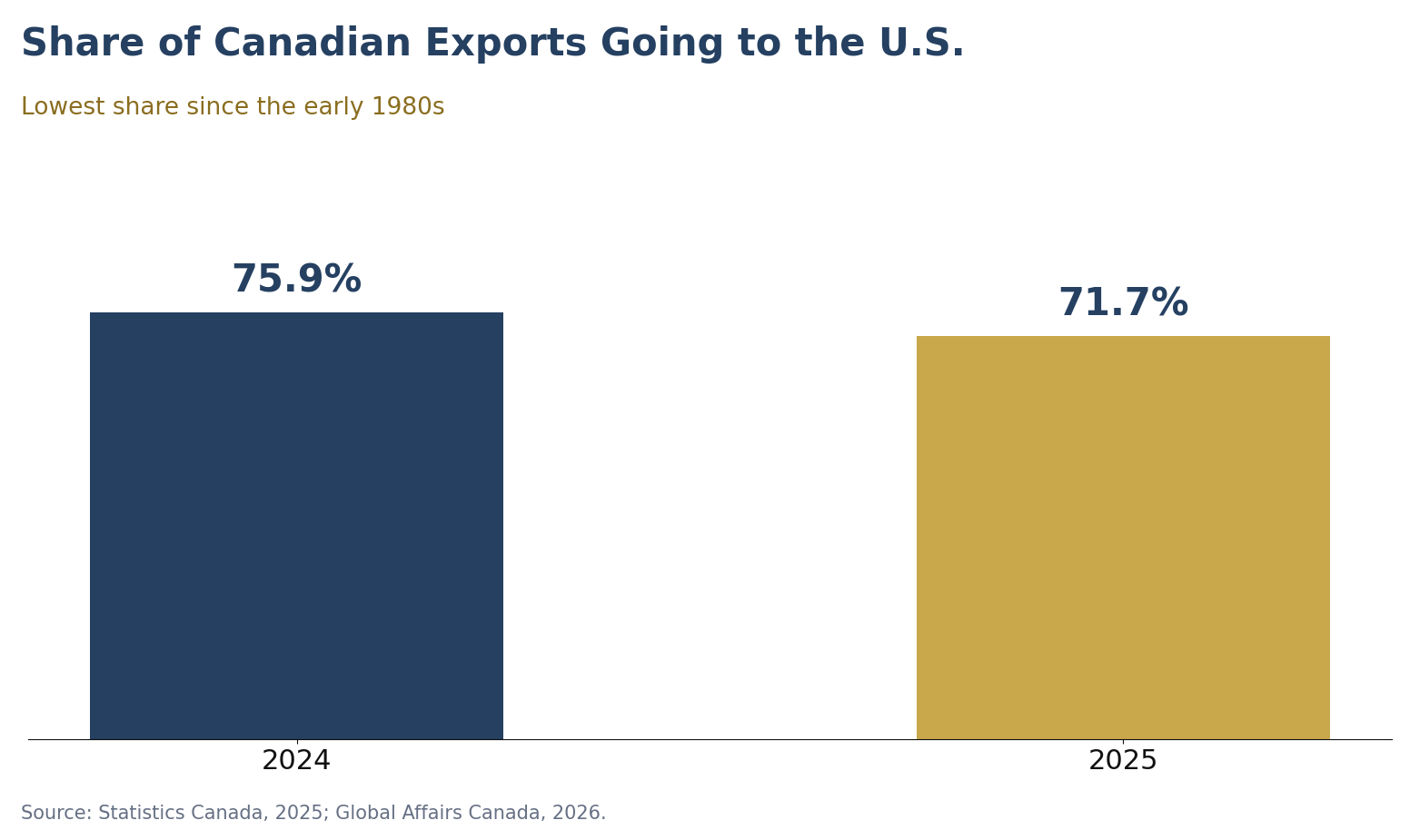
Canada's economic model depends on a single customer, and that dependence is exactly the vulnerability an Africa partnership is built to offset. Approximately 76% of Canada's merchandise exports were destined for the United States in 2024, one of the highest single-market concentrations of any developed economy, though tariff disputes pulled that share down to roughly 72% in 2025, the lowest since the early 1980s.15,16 Crude oil and motor vehicles alone accounted for just over 30% of total Canadian exports to the United States in 2024, and the United States supplied 62% of everything Canada bought from abroad.17,18 A single-buyer relationship strips a seller of pricing power. Diversification is no longer a strategic preference for Canada. It is a structural necessity, and the AfCFTA has created a single market of 1.3 billion people and roughly $3.4 trillion in combined GDP, an institutional counterpart Canada's other regional strategies do not have at comparable scale.19
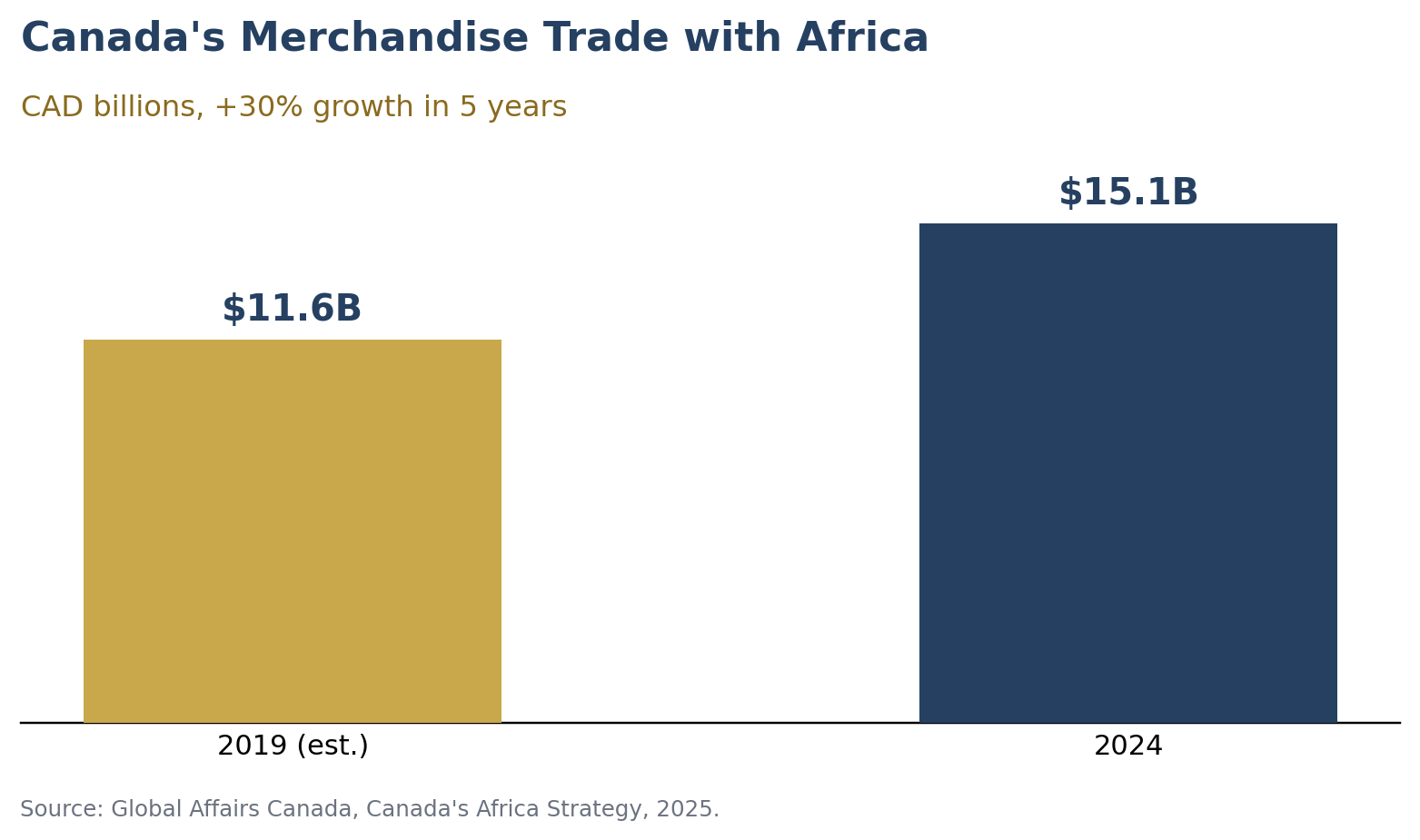
Canada's development assistance to Africa has grown steadily, but this growth has masked, rather than corrected, a collapsing commercial relationship. Canada invested approximately $4.5 billion in bilateral international assistance to Africa over the past five years, an envelope that increased by 52% over eight years.2 Over the same period, Africa's share of Canadian trade has stayed under 1% of total exports. Canada's merchandise trade with Africa reached $15.1 billion in 2024, up nearly 30% over five years, a headline that sounds encouraging until set against the base: Africa still represents just over one percent of Canada's total merchandise trade.2,6,8 The pattern holds at the provincial level too. Quebec's own goods exports to Africa grew from $743 million CAD in 2014 to $1.05 billion CAD in 2023, a compound annual growth rate of roughly 3.8%, yet Africa still represents under 1% of Quebec's total merchandise exports, according to a 2025 study commissioned by REPAF (Réseau des Entrepreneurs et Professionnels Africains) with Kasi Insight.1 Aid answers how Canada supports African development. Trade answers how central Africa is to Canada's own economic future. Canada has scaled up the first while leaving the second essentially flat, and for African decision-makers this is a clear diagnostic test: when a partner's assistance rises while its investment stays flat, the relationship is not deepening. It is being managed.7
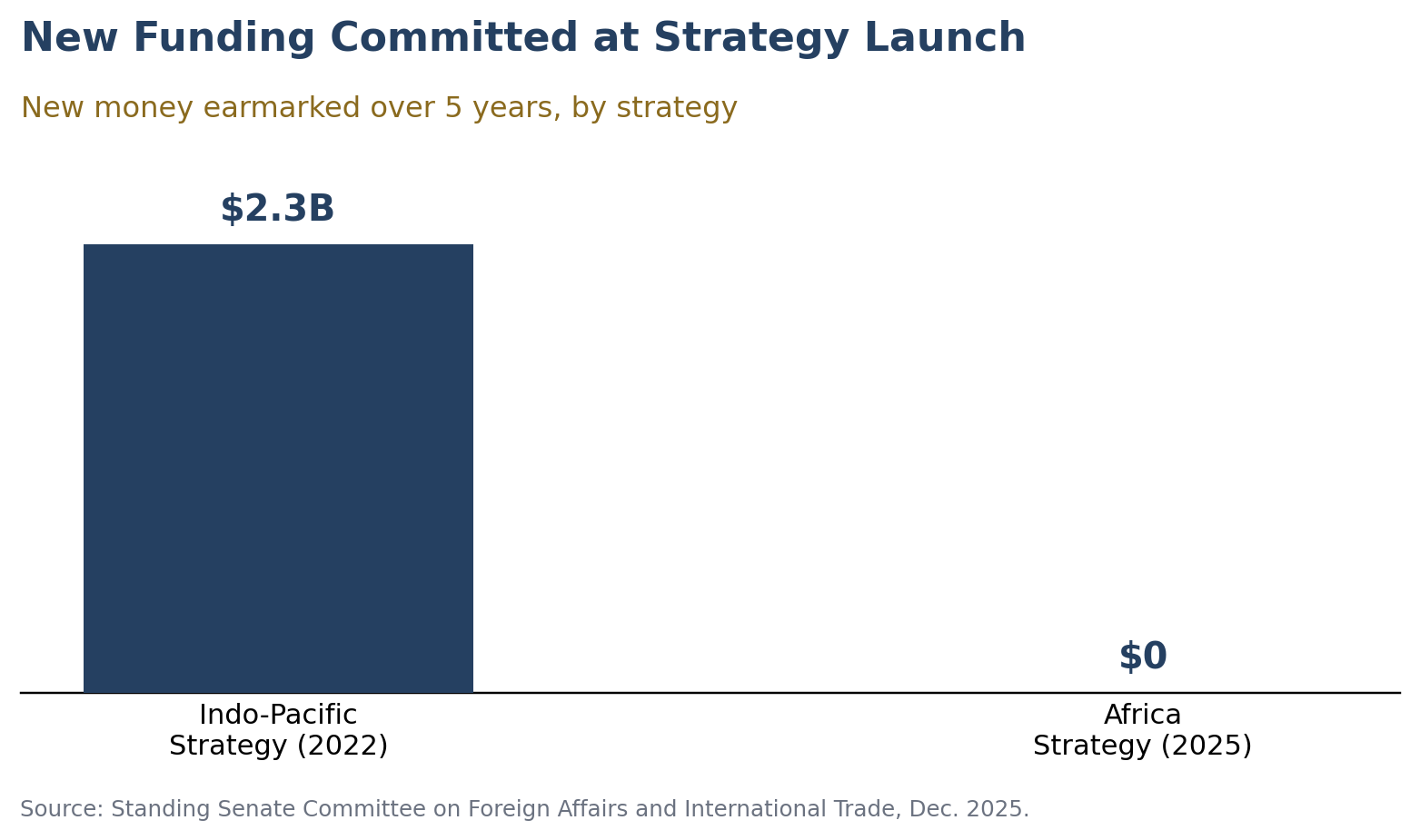
When Canada launched its Indo-Pacific Strategy in 2022, it came with $2.3 billion in new funding over five years. When Canada launched its Africa Strategy in March 2025, no comparable new funding was earmarked.5,14 At the G20 summit in South Africa in November 2025, Prime Minister Mark Carney stated that Africa was not among the government's early priorities because other regions offered the most immediate return.8,9 A strategy without a budget is a communications document. Meanwhile, competitors are moving with capital attached: Italy's Mattei Plan, delivered jointly with the African Development Bank, channels approximately $625 million over five years directly into private equity and venture capital for food security, SME development and infrastructure.12 The credibility of Canada's Africa Strategy will not be established at its launch. It will be established at its first budget cycle.
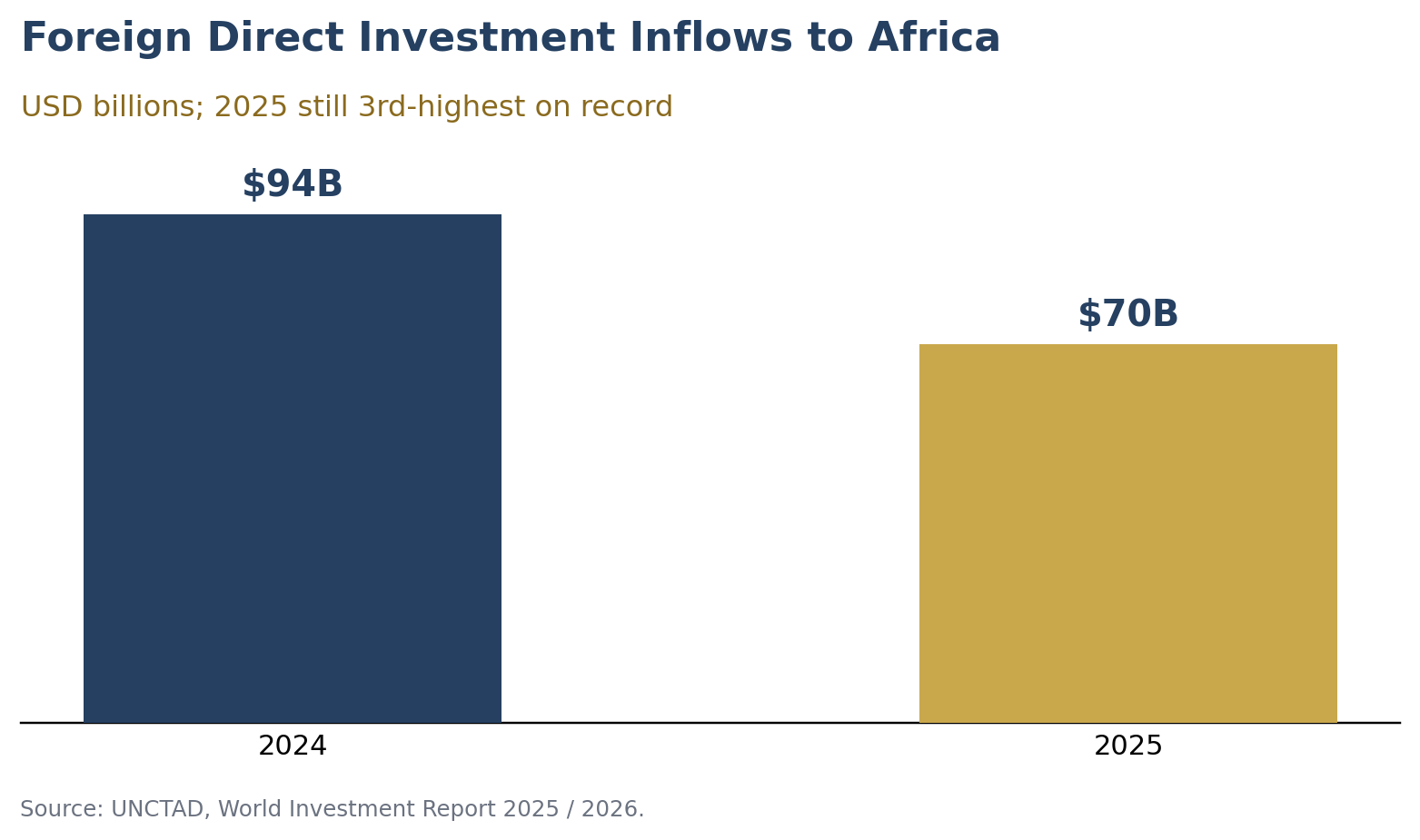
Global capital is already repositioning toward Africa, and Canada is one of the slower movers in a field of increasingly assertive competitors. Foreign direct investment into Africa rose sharply in 2024, reaching close to $94 billion, before moderating to approximately $70 billion in 2025, still the third-highest level on record and roughly one-third above the continent's long-term average.10,11 Investment is concentrating in energy, digital infrastructure, logistics and critical minerals, sectors where Gulf and Asian investors have moved decisively.11 Nigeria became Canada's second-largest African trading partner in 2024 at approximately $2.9 billion, and Côte d'Ivoire its fourth-largest, evidence that commercial relationships can scale quickly once capital and attention align.8 Canada's traditional advantage, a reputation unburdened by colonial history, is a door-opener, not a substitute for capital. That advantage has a shelf life.
Where Canadian capital does reach Africa, it is heavily concentrated in a single sector, which limits the relationship's resilience and its political value. Africa is Canada's second-largest overseas mining region, with Canadian mining assets on the continent valued at CAD $45.9 billion in 2024.13 This demonstrates that Canadian firms will commit capital to Africa when risk-adjusted returns are clear. It also demonstrates the limits of the current model: mining investment creates limited local value-addition compared with agri-technology, clean energy or digital infrastructure, sectors UNCTAD identifies as the fastest-growing components of African FDI.10 REPAF's own sector mapping points the same direction: agri-tech, fintech, renewable energy, health technology, smart infrastructure and critical minerals are the six industries it identifies as the strongest fit for Quebec exporters, precisely the diversified mix Canada's mining-heavy Africa portfolio is missing.1 A relationship concentrated in extractive capital is politically fragile for both sides. The objective for African decision-makers should not be more capital in the abstract. It should be diversified capital, structured through instruments such as blended finance, FinDev Canada co-investment, and sector-specific funds.
Africa's institutional leverage is rising precisely as Canada's strategy is stalling, which changes the terms on which this relationship should be negotiated. The AfCFTA, the flagship initiative of the African Union's Agenda 2063, is designed to accelerate intra-African trade and strengthen the continent's collective negotiating position in global trade and investment.4 Canada has responded with limited institutional steps, including a memorandum of understanding with the African Union Commission, a new Africa Trade Hub, and Foreign Investment Promotion and Protection Agreements with eight African countries, appropriate first steps that are not yet a framework for negotiating with African institutions as counterparts rather than recipients.2 WACSOF-FOSCAO's own mandate across fifteen West African states illustrates the model Canada should be engaging: civil society and regional institutions that operate at the ECOWAS level, not only the national level. For African governments and institutions, the negotiating posture should shift from requesting Canadian assistance to proposing joint investment vehicles, co-financed infrastructure, and reciprocal market access. REPAF's own modeling reinforces the scale of what is possible when that posture shifts: with stronger export-support infrastructure, standardized bilingual contract templates and accessible export financing, it projects Quebec's exports to Africa could grow from $1.15 billion CAD today to $10.8 billion CAD by 2035, sustaining an estimated 85,000 direct jobs in clean energy, mining equipment, digital services and creative industries.1
Three sequenced horizons for building a capitalized partnership rather than another declaration.
“A partnership that scales its rhetoric faster than its capital is not a partnership in transition. It is a partnership on hold. Equal partnership will not be declared by either side. It will be built, one capitalized commitment at a time, by whichever side moves first.”
NovaHub Consulting advises governments, regional institutions and investors on the capital instruments, risk-sharing structures and institutional engagement models this analysis raises.
Book a conversationRead offline or share with your team, including all charts.
1. Réseau des Entrepreneurs et Professionnels Africains (REPAF) and Kasi Insight, Évaluation du potentiel d'échanges commerciaux et d'investissements entre le Québec et l'Afrique (2025), repaf.org/evaluation-du-potentiel-dexportation-du-quebec-vers-lafrique/.
2. Global Affairs Canada, Canada's Africa Strategy: A Partnership for Shared Prosperity and Security (2025), international.canada.ca.
3. Global Affairs Canada, Canada launches its first global Africa strategy (2025), canada.ca.
4. Global Affairs Canada, Canada and Africa (2025), international.gc.ca.
5. Standing Senate Committee on Foreign Affairs and International Trade, Canada-Africa: Seizing a Strategic Opportunity (2025), sencanada.ca.
6. ONE Campaign / ONE Data, Why Canada Should Trade More with Africa (2025), data.one.org.
7. ONE.org Canada, Canada-Africa Strategy at One Year: Turning Words into Action (2026), one.org.
8. Foreign Policy Research Institute, Canada and Africa: Bridging the Gap Between Potential and Policy (2026), fpri.org.
9. The Conversation, Canada risks missing out on Africa's trade boom under Mark Carney (2026), theconversation.com.
10. UN Trade and Development (UNCTAD), World Investment Report 2025 (2025), unctad.org.
11. UNCTAD, Africa is attracting investment in strategic industries (2026), unctad.org.
12. Senate of Canada, African markets can help break Canada's dependence on the U.S.: Senator Gerba (2025), sencanada.ca.
13. Policy analysis citing Statistics Canada, Table 36-10-0008-01, Canada's Trade Diversification Is Incomplete Without Africa (2026), maxpolicy.substack.com.
14. House of Commons of Canada, FAAE Committee, Report No. 28 (2024), ourcommons.ca.
15. Statistics Canada, Canadian international merchandise trade, December 2024 (2025), www150.statcan.gc.ca.
16. Global Affairs Canada, Monthly trade report: December 2025 (2026), international.canada.ca.
17. Library of Parliament, Canadian Trade and Investment Activity: Canada-United States (2025), lop.parl.ca.
18. Scotiabank Economics, Canada-US Trade: Getting Up To Speed (2025), scotiabank.com.
19. AfCFTA Secretariat, About the AfCFTA (2025), au-afcfta.org.
← Back to Blog & OpinionsAfrican banks posted a return on equity nearly double the global average. No African market has crossed 20% AI adoption. That gap is the strategic story of the next decade.
Read the articleFive deadlines have already come and gone. A sixth is now set for 2027. Seven measurable conditions, not a summit declaration, will decide if it holds.
Read the articleNearly one million people in West Africa have no recognized nationality, and 47 million children are unregistered. The cost is economic, and it is security.
Read the article