Senegal, Togo, Canada and across Africa
@gonovahub
Blog & Opinions

ECOWAS and West Africa Are Going Digital. But the Numbers Tell a Very Different Story.

Mobile money is booming. Broadband access is not. Here is what that gap means for leaders.

Komlan Messie, MBA, Polytechnician, CEO of NovaHub Consulting • 2026 • 8 min read

ECOWAS digital transformation, mobile money versus broadband
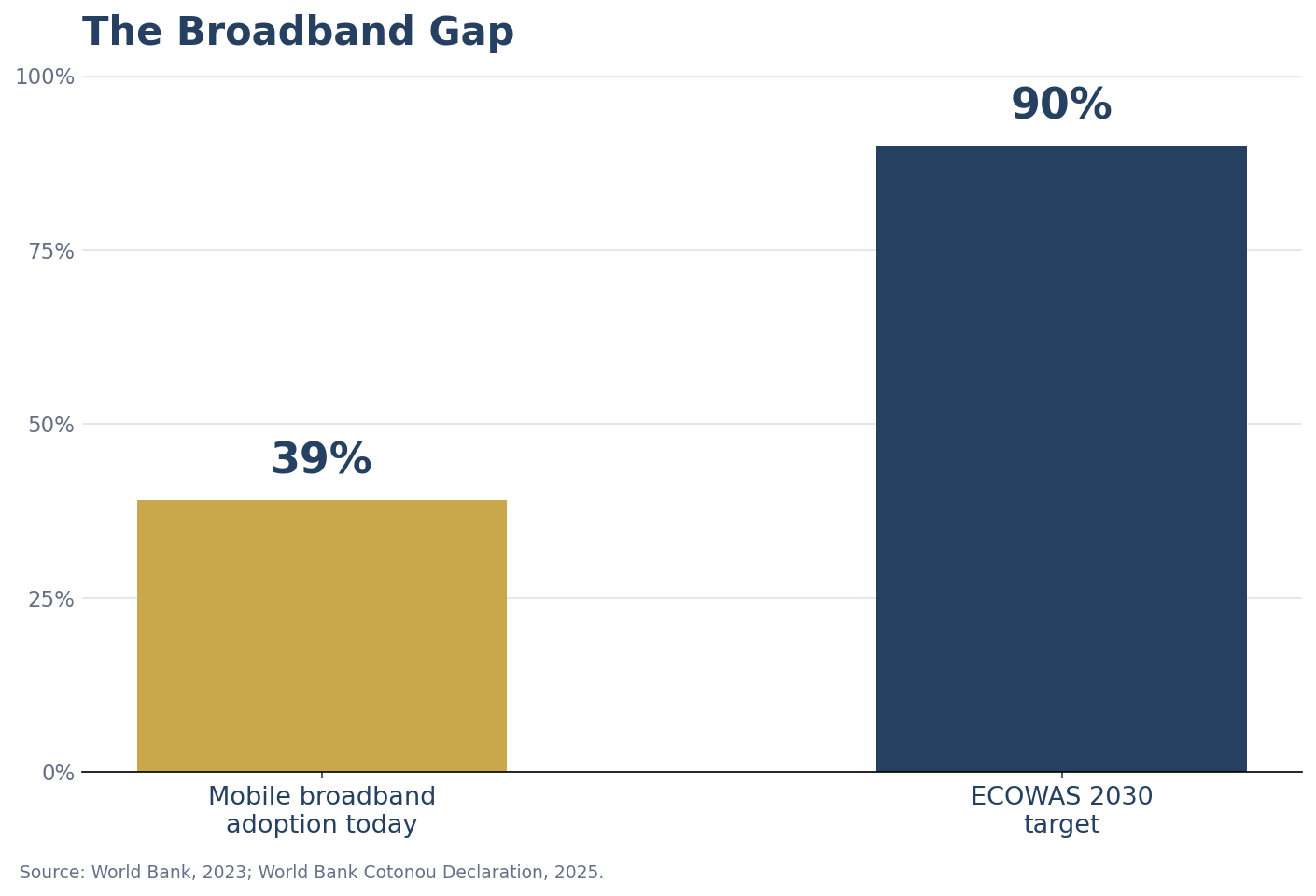
Two numbers rarely appear side by side. In 2024, West Africa processed $357 billion in mobile money transactions across 485 million registered accounts. In the same region, mobile broadband adoption still sits below 40 percent.

One number describes a region racing ahead. The other describes a region still catching up. Both are true. That contradiction, not the headline growth figures, is what leaders need to understand before they build strategy on ECOWAS's digital story.

485Mmobile money accounts registered across West Africa, 2024.
<40%mobile broadband adoption across the same region.
68%of 2024 fintech funding concentrated in one country.
90%ECOWAS broadband access target for 2030.

The Real Story Behind the Numbers

The dominant narrative about West Africa's digital economy is a growth narrative: mobile money, fintech funding, startup capital, all rising. That narrative is accurate and incomplete. The strategic issue is not whether West Africa is digitalising. It is that the region's digital progress is bifurcated by layer and concentrated by geography, while the institutions meant to correct both are still in the design phase.

For CEOs, financial executives, technology leaders, governments and investors, the practical question is not 'is ECOWAS digitalising.' It is: which layer, which country, and on what timeline. This brief answers that question using verified 2024 to 2026 data.

Chart: mobile broadband adoption versus the ECOWAS 2030 target
INSIGHT 01

Two Speeds, One Region

What

Financial services adoption is outpacing basic connectivity. West Africa's mobile money ecosystem processed $357 billion in transactions across 485 million registered accounts in 2024, contributing to a $150 billion GDP uplift across Sub-Saharan Africa between 2013 and 2022, with West Africa's GDP rising 4.1 percent as a direct result (GSMA, 2024). Yet mobile broadband adoption across the same region remains below 40 percent, held back primarily by retail pricing (World Bank, 2023).

Why it matters

A region cannot be both a fintech leader and a connectivity laggard by coincidence. Mobile money succeeded because it rides on basic voice networks and agent cash points, not on broadband. That is precisely why its growth cannot be read as proof that the region's core digital infrastructure is solving itself.

Strategic implication: Treat digital adoption as a layered indicator, not a single score. A market can be fintech-mature and infrastructure-immature at the same time. Investment and policy priorities should be set layer by layer, not read off one aggregate growth number.
INSIGHT 02

One Region, Fifteen Realities

What

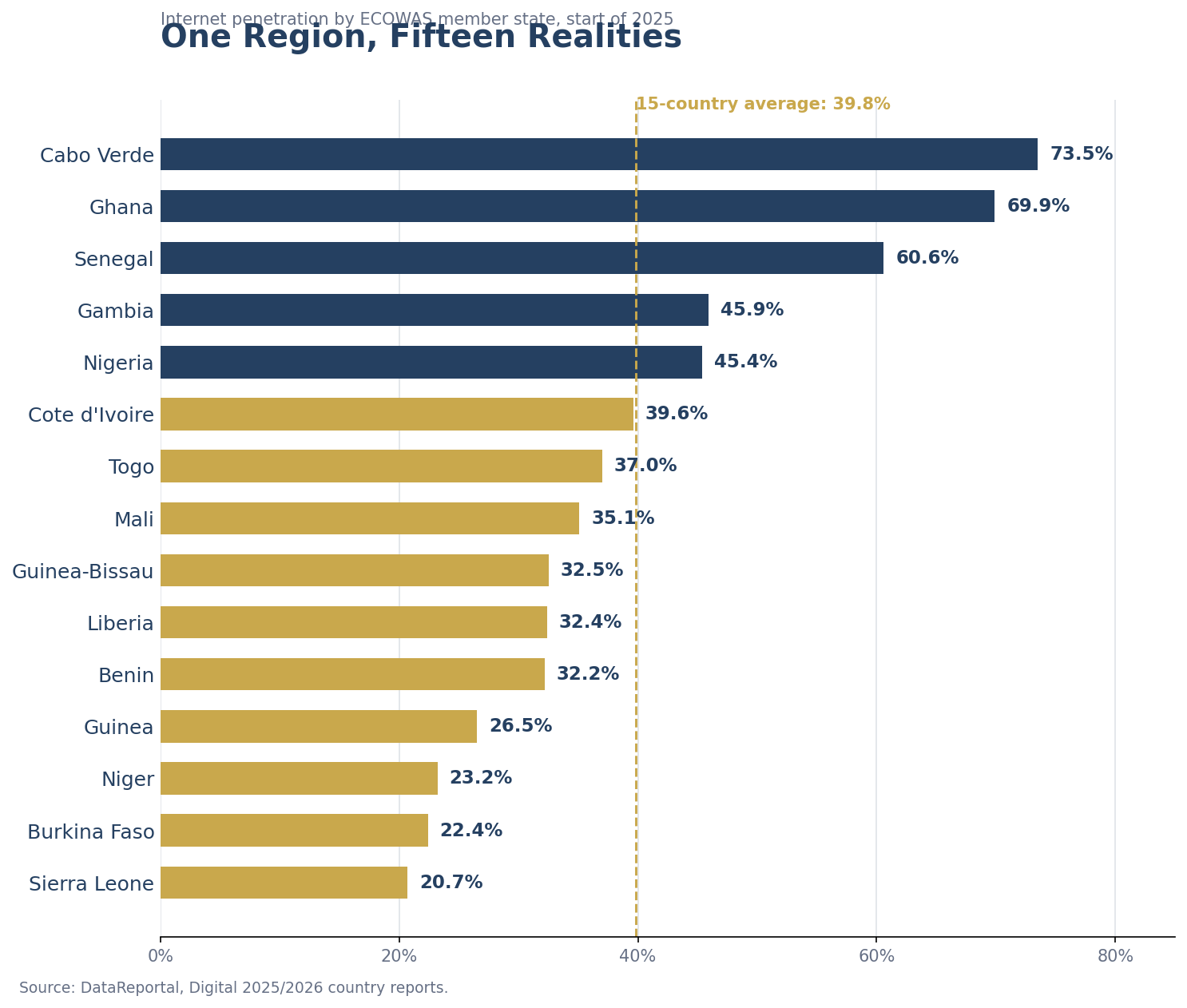
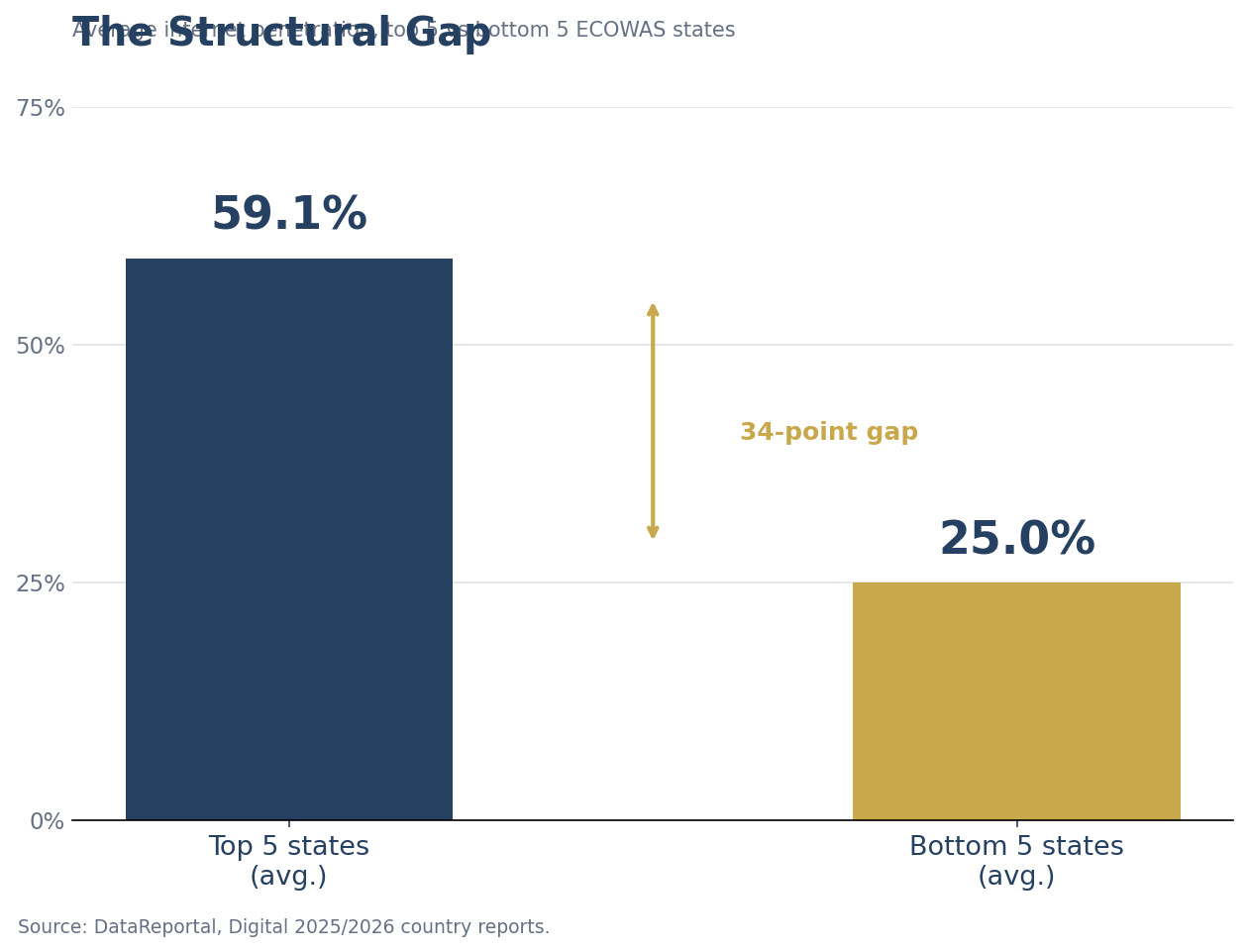
Ranked by internet penetration at the start of 2025, ECOWAS's 15 member states span a wide range: Cabo Verde leads at 73.5 percent, followed by Ghana at 69.9 percent and Senegal at 60.6 percent. At the other end, Sierra Leone sits at 20.7 percent, Burkina Faso at 22.4 percent and Niger at 23.2 percent (DataReportal, 2025; DataReportal, 2026). The five highest-ranked states average 59.1 percent penetration; the five lowest average 25.0 percent, a 34-point gap.

Why it matters

A single regional number, whether it is 40 percent or 45 percent, is a population-weighted average dominated by Nigeria and Ghana. It describes no actual member state well. Cabo Verde's digital economy and Sierra Leone's are not two points on the same curve; they are different starting conditions requiring different playbooks.

Strategic implication: Treat ECOWAS as 15 distinct markets on 15 different timelines, not one bloc with one average. Market entry sequencing, regulatory engagement and infrastructure investment should be prioritised country by country against this ranking, not against a regional headline figure.
Bar chart of internet penetration across all 15 ECOWAS member states Bar chart comparing the top 5 and bottom 5 ECOWAS states by internet penetration
INSIGHT 03

The Money Is Real, and So Is the Concentration

What

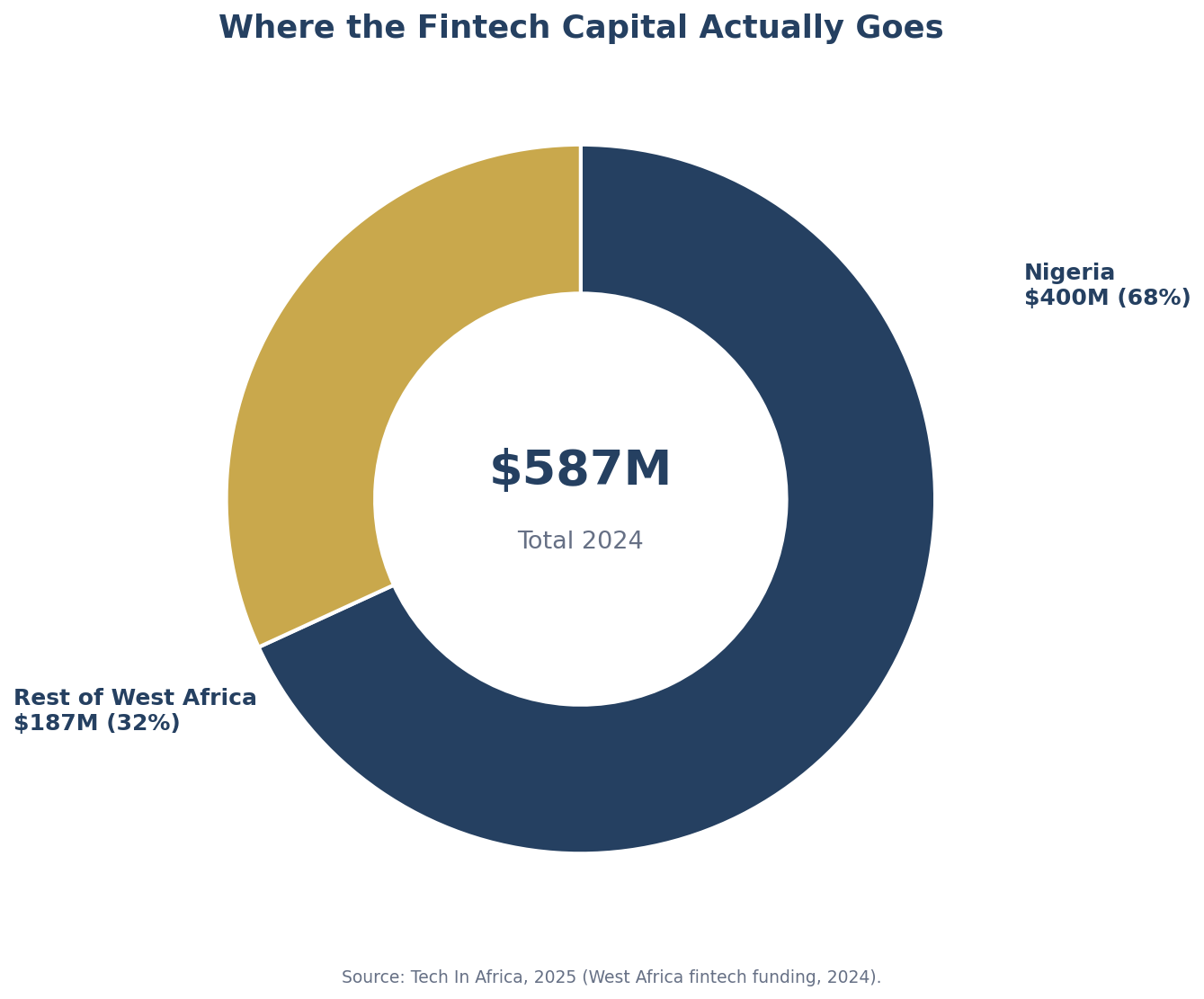
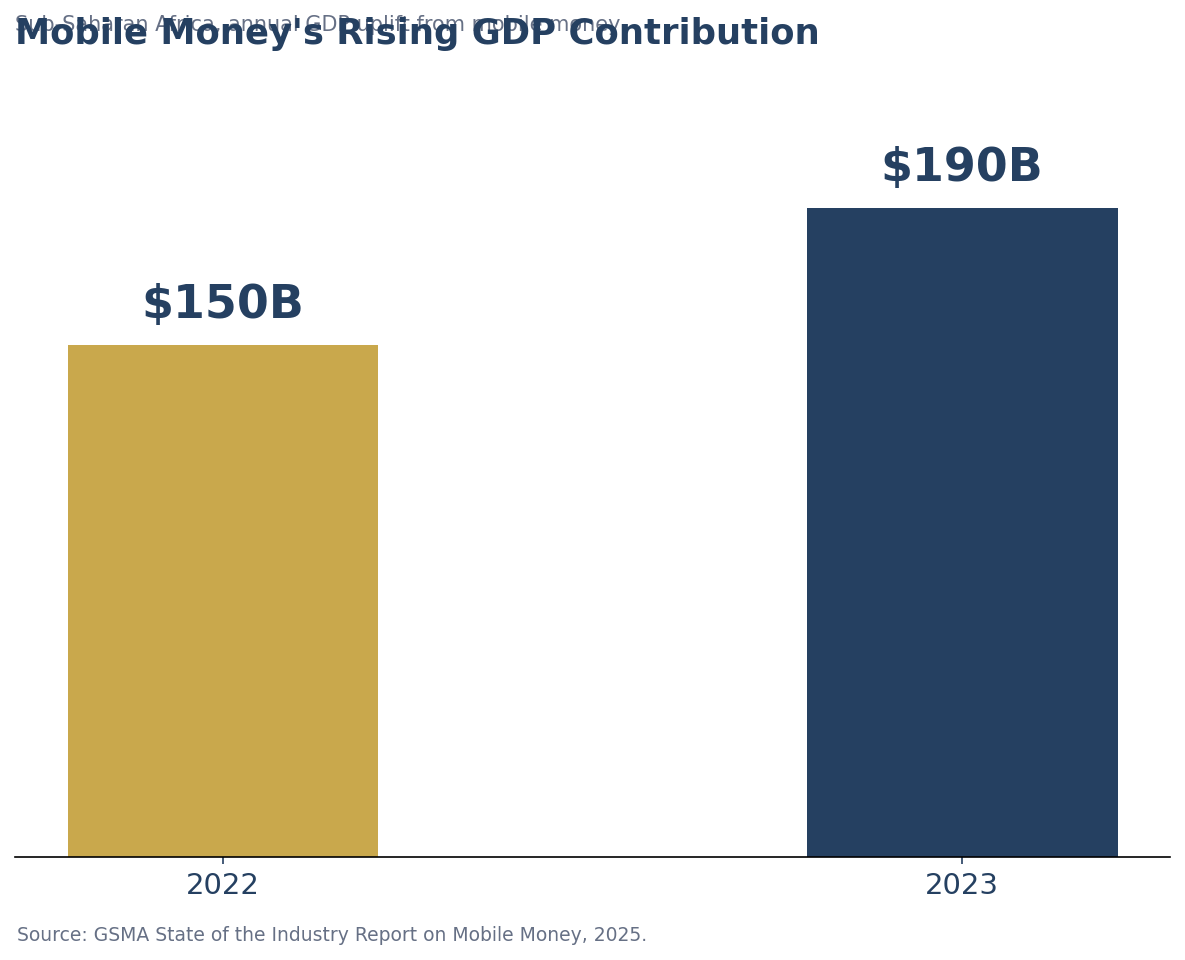
Sub-Saharan Africa's mobile money economy contributed an estimated $190 billion to GDP in 2023, up from $150 billion in 2022 (GSMA, 2025). But the regional fintech funding total for West Africa in 2024, $587 million, was heavily concentrated: Nigeria alone accounted for $400 million, roughly 68 percent of the entire regional figure (Tech In Africa, 2025).

Why it matters

Regional totals invite regional assumptions. An investor or policymaker reading 'West Africa raised $587 million' may assume a broad-based ecosystem. The underlying distribution says otherwise: capital is following one market, with Ghana and Francophone West Africa, including Senegal and Côte d'Ivoire, described by analysts as emerging but still secondary.

Strategic implication: A 'West Africa' pitch to a bank, a development partner or a board is, in practical terms, a Nigeria pitch with an option value on 14 other markets. Capital allocation, market entry sequencing and risk models should say so explicitly rather than average across a bloc that does not behave like one market.
Donut chart showing West Africa fintech funding concentrated in Nigeria
Bar chart of mobile money's rising GDP contribution, 2022 to 2023
INSIGHT 04

Declarations Move Faster Than Delivery

What

On 18 November 2025, ministers from West and Central Africa adopted the Cotonou Declaration alongside the World Bank, committing the region to 90 percent broadband access, interoperable digital identity and payment systems, a doubling of intra-African e-commerce, 20 million people trained in digital skills and 2 million digital jobs, all by 2030 (World Bank, 2025). The Declaration also called for a Regional Digital Transformation Financing Mechanism to fund these commitments.

Why it matters

By the time ECOWAS ministers met again in Freetown on 27 March 2026, the financing mechanism remained at the design stage, and two flagship infrastructure projects, a Regional Cybersecurity Coordination Centre and a Regional Internet Exchange Point, were still under feasibility study rather than under construction (ECOWAS Commission, 2026).

Strategic implication: Regional declarations are a signal of political alignment, not a delivery timeline. Institutions and investors engaging with ECOWAS's digital agenda should track the financing mechanism and the infrastructure feasibility studies as the real leading indicators, not the declaration date.
INSIGHT 05

Affordability Is the Silent Barrier

What

The median price of an entry-level mobile broadband plan in Africa stood at 4.2 percent of gross national income per capita in 2024, the highest of any world region, though down from 4.6 percent the previous year (ITU, 2025). Africa's fixed broadband prices average 14.8 percent of gross national income, more than seven times the International Telecommunication Union's recommended affordability threshold of 2 percent (Brookings, 2025).

Why it matters

Coverage maps overstate access. A tower reaching a village does not mean the household connected to it can afford to use it. Affordability, not signal availability, is frequently the binding constraint on the adoption figures that infrastructure investment is meant to move.

Strategic implication: Broadband strategy that focuses only on coverage kilometres will miss the affordability half of the equation. Regulatory levers, spectrum pricing, tax treatment of devices and data, and competitive market structure deserve equal weight in any digital infrastructure plan.
INSIGHT 06

The Institutions Are Catching Up, Slowly

What

At the 20th ECOWAS Ministerial Session on Telecommunications, ICT and Digitalisation in Freetown, ministers reviewed a revised Supplementary Act on data protection, a revised cybercrime directive, a draft directive on electronic communications and a proposed Regional e-Government Strategy (ECOWAS Commission, 2026). These followed earlier institutional steps, including the West Africa Regional Digital Integration Program, backed by $266.5 million in World Bank financing approved in 2023 (World Bank, 2023).

Why it matters

This is genuine institutional progress. It is also, by design, slow progress: once adopted regionally, each instrument still requires transposition into national law in each of the 15 member states, a process that typically takes years.

Strategic implication: Do not plan around the assumption of near-term regulatory harmonisation. Build compliance and market-entry strategies around the current patchwork of national frameworks, while tracking regional instruments as a multi-year horizon rather than an operating reality.

The Three-Horizon Path to 2030

2026 to 2027

HARMONISE

National ratification of the data protection and cybercrime frameworks; design and capitalisation of the Regional Digital Transformation Financing Mechanism.

2027 to 2029

INTERCONNECT

Construction of the Regional Internet Exchange Point and Cybersecurity Coordination Centre; rollout of interoperable digital identity and payment rails across member states.

2029 to 2030

SCALE

Push toward the 90 percent broadband access target, 2 million digital jobs, and an operational single digital market across the 15 ECOWAS states.

What Leaders Should Take From This

The real question for leaders is not whether to believe in West Africa's digital growth story. It is which numbers to build on. Mobile money numbers are proof of demand and execution capacity. Broadband and institutional numbers are proof of how much runway remains.

From an institutional perspective, the region's digital transformation is not a single story arriving on schedule in 2030. It is several stories, moving at different speeds, that leaders must read separately to allocate capital, policy attention and partnerships correctly.

“Which numbers a leader chooses to build on, not which numbers a leader chooses to believe, is what will separate strategy from narrative in West Africa's digital decade.”

NovaHub Consulting

Where NovaHub fits

NovaHub Consulting advises governments, financial institutions and investors on digital transformation sequencing, market entry across ECOWAS member states, and the regulatory-tracking questions this brief raises.

Book a conversation
Komlan Messie
About the author

Komlan Messie, MBA, Polytechnician

A career built at the intersection of business, diplomacy and civic leadership.

Komlan Messie, MBA, is an international executive, entrepreneur and strategic advisor with more than two decades of experience across management, technology, institutional development, strategic transformation and international development. His work focuses on helping organisations, institutions and leaders navigate transformation, innovation, public policy and complex strategic challenges.

Mr. Messie is the founder and Chief Executive Officer of NovaHub Consulting and the Regional Executive Director of WACSOF-FOSCAO, the West African civil society network spanning ECOWAS member states. He is also the cofounder and chairman of the Réseau des Entrepreneurs et Professionnels Africains (REPAF) and the chairman of the Forum Afrique Expansion Canada, and he co-founded Aliments Frunil in Canada. He is a former Vice President of the Project Management Institute Montreal (PMI Montreal) in Canada.

He holds an MBA from HEC Montréal, an M.Sc. in Computer Science and Operations Research from École Polytechnique de Montréal, and a B.Eng. in Electrical Engineering from École Polytechnique de Thiès (Senegal), and is PRINCE2 certified. He works across Canada, Africa and especially the ECOWAS region in French, English, Ewe and Wolof.

Continue the conversation with Komlan Messie
View full profile →
Download this article

Read offline or share with your team, including all charts.

Sources

1.  GSMA. (2024). State of the Industry Report on Mobile Money 2024. gsma.com.

2.  GSMA. (2025). State of the Industry Report on Mobile Money 2025. gsma.com.

3.  World Bank. (2023). Accelerating Digital Transformation in West Africa. worldbank.org.

4.  World Bank. (2025). Regional Summit on Digital Transformation in Western and Central Africa: Cotonou Declaration. worldbank.org.

5.  Tech In Africa. (2025). Fintech Funding in Africa: Regional Breakdown. techinafrica.com.

6.  Tech In Africa. (2025). Nigeria & Kenya Lead as Africa's Big 4 Dominate 2025 Funding. techinafrica.com.

7.  International Telecommunication Union. (2025). Measuring Digital Development: Facts and Figures 2025. itu.int.

8.  Brookings Institution. (2025). Accelerating Digital Inclusion in Africa. brookings.edu.

9.  ECOWAS Commission. (2026). 20th Ministerial Session on Telecommunications, ICT and Digitalisation, Freetown. ecowas.int.

10.  DataReportal. (2025). Digital 2025 country reports for Nigeria, Ghana, Senegal, Côte d'Ivoire, Mali, Niger, Guinea, Benin, Togo, Sierra Leone, Liberia, The Gambia, Guinea-Bissau and Cabo Verde. datareportal.com.

11.  DataReportal. (2026). Digital 2026: Burkina Faso. datareportal.com.

← Back to Blog & Opinions
Newsletter

Get the analysis before the decision is made.

Subscribe for new insights, policy briefs and event updates. No noise, unsubscribe at any time.

Download the full paper

Enter your details to receive the secure download link. You will also be added to our newsletter list.

ENGAGE NOVAHUB